

 中文简体
中文简体 Español
 عربى
عربى
What is the working principle of a micro sprayer?
Industry News-Content
Direct Answer: The Core Mechanics of a Micro Sprayer
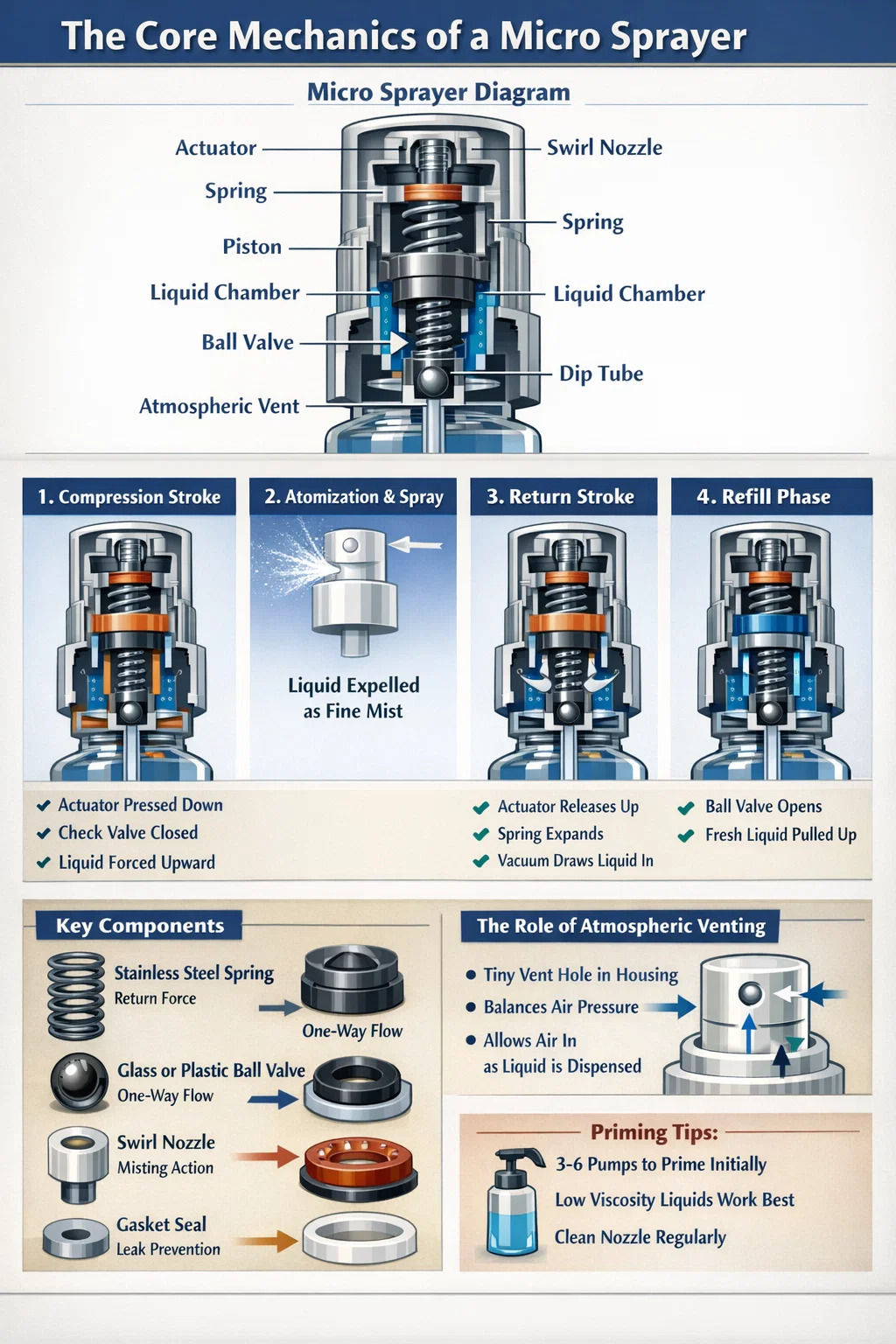
The fundamental working principle of a micro sprayer is based on the displacement of liquid and atmospheric pressure, specifically utilizing a positive displacement pump mechanism. When the actuator is depressed, it compresses a spring and reduces the volume inside a small chamber, forcing liquid out through a precision nozzle. Upon release, the spring pulls the piston back, creating a vacuum that draws fresh liquid from the bottle through the dip tube to refill the chamber for the next spray.
Step-by-Step Functional Phases of the Micro Sprayer
A high-quality micro sprayer operates in a cyclical four-stage process that ensures a consistent fine mist output, typically ranging from 0.1ml to 0.15ml per stroke.
The Downward Stroke and Compression
As the user applies pressure to the actuator, the internal piston moves downward into the housing. This action increases the pressure inside the liquid chamber. Because the liquid is incompressible, the pressure forces the check valve at the bottom of the pump (usually a small glass or stainless steel ball) to close tightly against its seat, preventing the liquid from flowing back down into the bottle.
Atomization and Discharge
With the bottom valve closed, the only exit path is upward through the stem and out the nozzle. The micro sprayer nozzle contains a specialized swirl chamber. As the liquid enters this chamber at high velocity, it is spun into a vortex. This rotational energy causes the liquid to shatter into microscopic droplets as it hits the air, creating the characteristic "fine mist."
The Upward Stroke and Vacuum Creation
When the user releases the actuator, the compressed spring provides the force needed to push the piston back to its original position. This increase in internal volume creates a strong vacuum. The differential pressure causes the bottom ball valve to lift, allowing atmospheric pressure inside the bottle to push liquid up the dip tube and back into the chamber.
Critical Components Influencing Spray Performance
The efficiency of a micro sprayer depends on the tight tolerances of its internal components. Even a deviation of 0.01mm in the nozzle orifice can significantly alter the spray pattern.
| Component | Function in Principle | Material Impact |
|---|---|---|
| Internal Spring | Provides the return force | Stainless steel avoids rust |
| Ball Valve | Ensures one-way flow | Glass or Plastic for compatibility |
| Swirl Nozzle | Atomizes the liquid stream | Precision PP or POM plastic |
| Gasket | Prevents external leakage | PE or EPE foam for sealing |
The Role of Atmospheric Venting
A micro sprayer would cease to function after just a few pumps if it weren't for the venting system. As liquid is removed from the bottle, a vacuum is created inside the container itself. To counteract this, every micro sprayer has a tiny vent hole in the housing.
- This vent allows air to enter the bottle to replace the dispensed liquid.
- Without this air exchange, the bottle would collapse or the pump would fail to prime.
- Advanced designs use a one-way vent valve to ensure air goes in but liquid cannot leak out if the bottle is tipped over.
Optimizing Performance: Priming and Viscosity
The "priming" of a micro sprayer refers to the number of strokes required to fill the chamber with liquid for the first time. Most precision sprayers require 3 to 6 strokes to fully evacuate the air and draw up the product.
Viscosity Challenges
The working principle of a micro sprayer is optimized for liquids with low viscosity, such as alcohol-based perfumes or water-based toners. If a liquid is too thick (like a heavy oil), the vacuum created during the upward stroke may not be strong enough to pull the liquid up the dip tube, leading to a "dry" pump or a weak, streaky spray rather than a mist.
Nozzle Maintenance
Because the orifice in a micro sprayer is incredibly small, any dried residue can interfere with the swirl chamber. Regular use helps keep the channels clear, while products with high sugar or salt content may require periodic rinsing of the actuator in warm water to maintain the intended spray pattern.
Our Products //
Related Product




- E-mail: [email protected]
- Phone: +86-15962399191
- Add: No. 60-7, East Side of Jinzhong Road, Jinfeng Town, Zhangjiagang City, Suzhou City, Jiangsu Province
Copyright © Zhangjiagang Haojie Packaging Technology Co., Ltd. All Rights Reserved.
 China Cosmetic Packaging Manufacturers
China Cosmetic Packaging Manufacturers