

 中文简体
中文简体 Español
 عربى
عربى
What is a micro sprayer?
Industry News-Content
Defining the Micro Sprayer and Its Primary Function
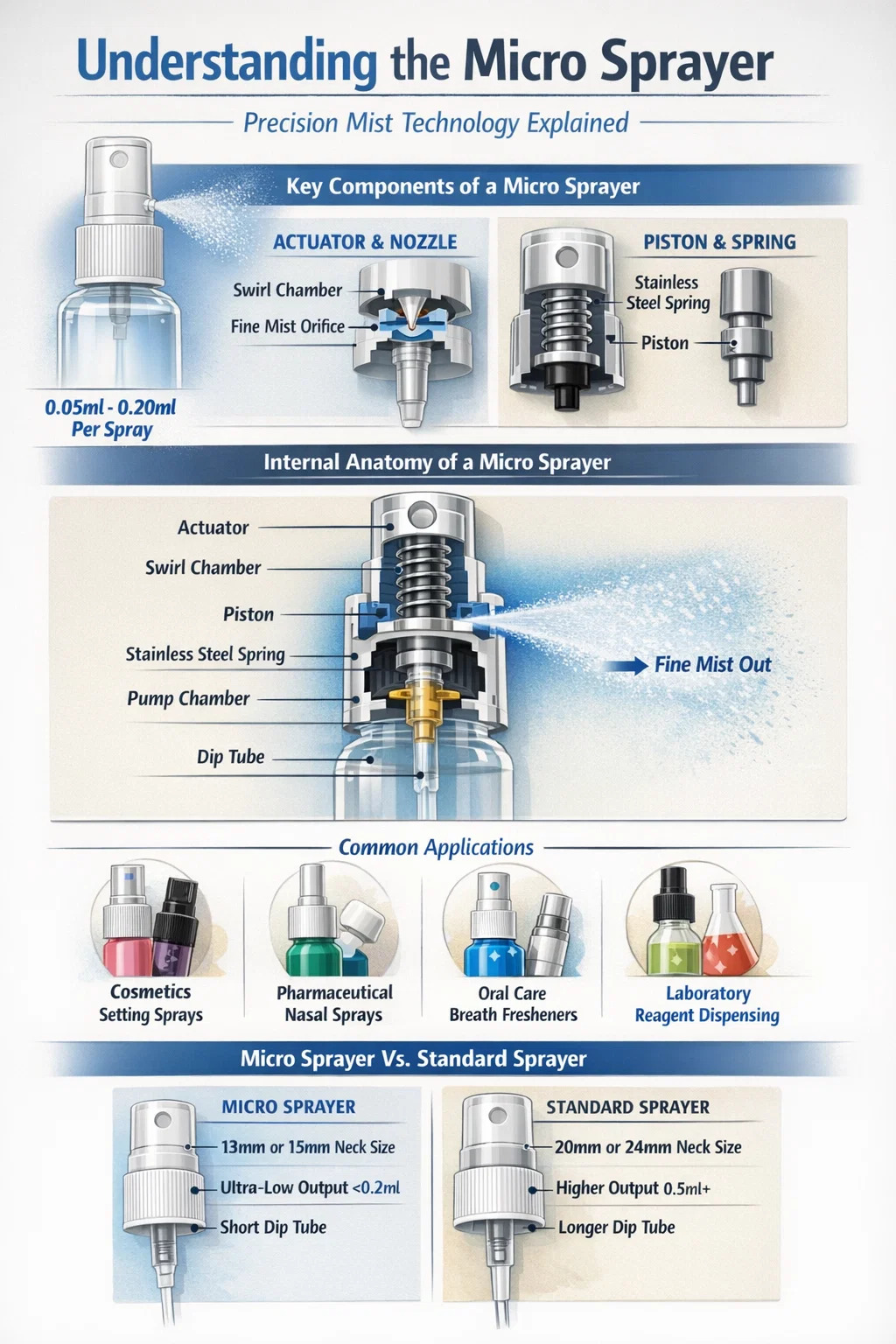
To answer the question "What is a micro sprayer?", it is a precision-engineered dispensing device designed to convert liquid into an extremely fine, consistent mist with a very low output volume per stroke. Unlike standard trigger sprayers used for household cleaning, a micro sprayer typically dispenses between 0.05ml and 0.20ml of product at a time, making it the ideal choice for high-value liquids where dosage control and delicate application are paramount.
These devices rely on a compact internal piston and a specialized nozzle orifice to break the surface tension of the liquid. The result is a cloud of droplets that provides even coverage without drenching the target surface, which is essential for personal care, pharmaceutical, and laboratory environments.
Core Components and Technical Anatomy
Understanding the effectiveness of a micro sprayer requires looking at the internal assembly. These pumps are far more complex than they appear on the surface.
The Actuator and Nozzle
The actuator is the part you press. In a micro sprayer, the nozzle inside the actuator features a tiny swirl chamber. As liquid is forced through this chamber at high pressure, it begins to spin rapidly, causing it to atomize into a fine mist as it exits the orifice.
The Engine and Spring Mechanism
Inside the housing sits the "engine." It consists of a piston and a high-tension spring. For a micro sprayer to function correctly, the spring must be strong enough to return the piston quickly, creating a vacuum that draws more liquid up the dip tube. High-quality sprayers often use 304 or 316-grade stainless steel springs to prevent corrosion from the liquid contents.
The Dip Tube
Because the volume of liquid moved is so small, the dip tube of a micro sprayer usually has a narrower diameter than standard pumps. This ensures that the vacuum pressure is sufficient to lift the liquid even when the bottle is nearly empty.
Applications and Industrial Usage
The versatility of the micro sprayer has led to its adoption across several specialized industries where precision is non-negotiable.
| Industry | Product Example | Key Benefit |
|---|---|---|
| Cosmetics | Setting Sprays | Non-disturbing fine mist |
| Pharmaceutical | Nasal Decongestants | Exact dosage (e.g., 0.1ml) |
| Oral Care | Breath Fresheners | Compact and portable size |
| Laboratory | Reagent Application | Minimal chemical waste |
Distinction Between Micro Sprayers and Standard Fine Mist Sprayers
It is a common mistake to use these terms interchangeably, but they serve different purposes. A standard fine mist sprayer is often used for hair spray or room fresheners, typically featuring a 20/410 or 24/410 neck size and a higher output. The micro sprayer is distinct due to several factors:
- Small Neck Diameter: Often found in 13mm, 15mm, or 18mm sizes.
- Ultra-low Output: While a standard sprayer might give 0.5ml, the micro sprayer keeps it strictly under 0.2ml.
- Short Dip Tubes: Designed for small vials ranging from 2ml to 30ml.
How to Select the Right Micro Sprayer
Choosing the correct hardware for your liquid product involves more than just picking a color. Consider these constructive steps for a successful implementation:
Testing Product Viscosity
The micro sprayer is primarily built for water-thin liquids. If your formula contains heavy oils or particulate matter (like shimmer in a setting spray), it may clog the swirl chamber. Always conduct a 48-hour spray test to ensure the nozzle doesn't seize.
Ensuring Closure Compatibility
Micro sprayers come in different closure types: screw-on, crimp-on, and snap-on. Screw-on types are best for refillable consumer goods, while crimp-on micro sprayers are essential for perfumes and pharmaceuticals to prevent tampering and ensure an airtight seal.
Overcap Functionality
A micro sprayer should always be paired with an overcap. Because the orifice is so small, dust or dried product can easily block the exit. A well-fitting cap maintains the hygiene and functionality of the pump over its entire lifespan.
Maintenance and Troubleshooting
If a micro sprayer stops working, it is usually not a mechanical failure but a blockage. You can often restore function by following these steps:
- Submerge the actuator in warm distilled water for 10 minutes.
- Pump the warm water through the system to dissolve any crystallized salts or sugars.
- If the pump is stuck, check if the vent hole in the cap is blocked, which can create a vacuum lock inside the bottle.
Our Products //
Related Product



- E-mail: [email protected]
- Phone: +86-15962399191
- Add: No. 60-7, East Side of Jinzhong Road, Jinfeng Town, Zhangjiagang City, Suzhou City, Jiangsu Province
Copyright © Zhangjiagang Haojie Packaging Technology Co., Ltd. All Rights Reserved.
 China Cosmetic Packaging Manufacturers
China Cosmetic Packaging Manufacturers