

 中文简体
中文简体 Español
 عربى
عربى
What is the difference between a treatment pump and a lotion pump? Let's uncover the differences between the two.
Industry News-Content
The Difference Between Lotion Pumps and Treatment Pumps
Although both are devices used to dispense liquids from bottles, they differ significantly in design, function, and suitable contents.
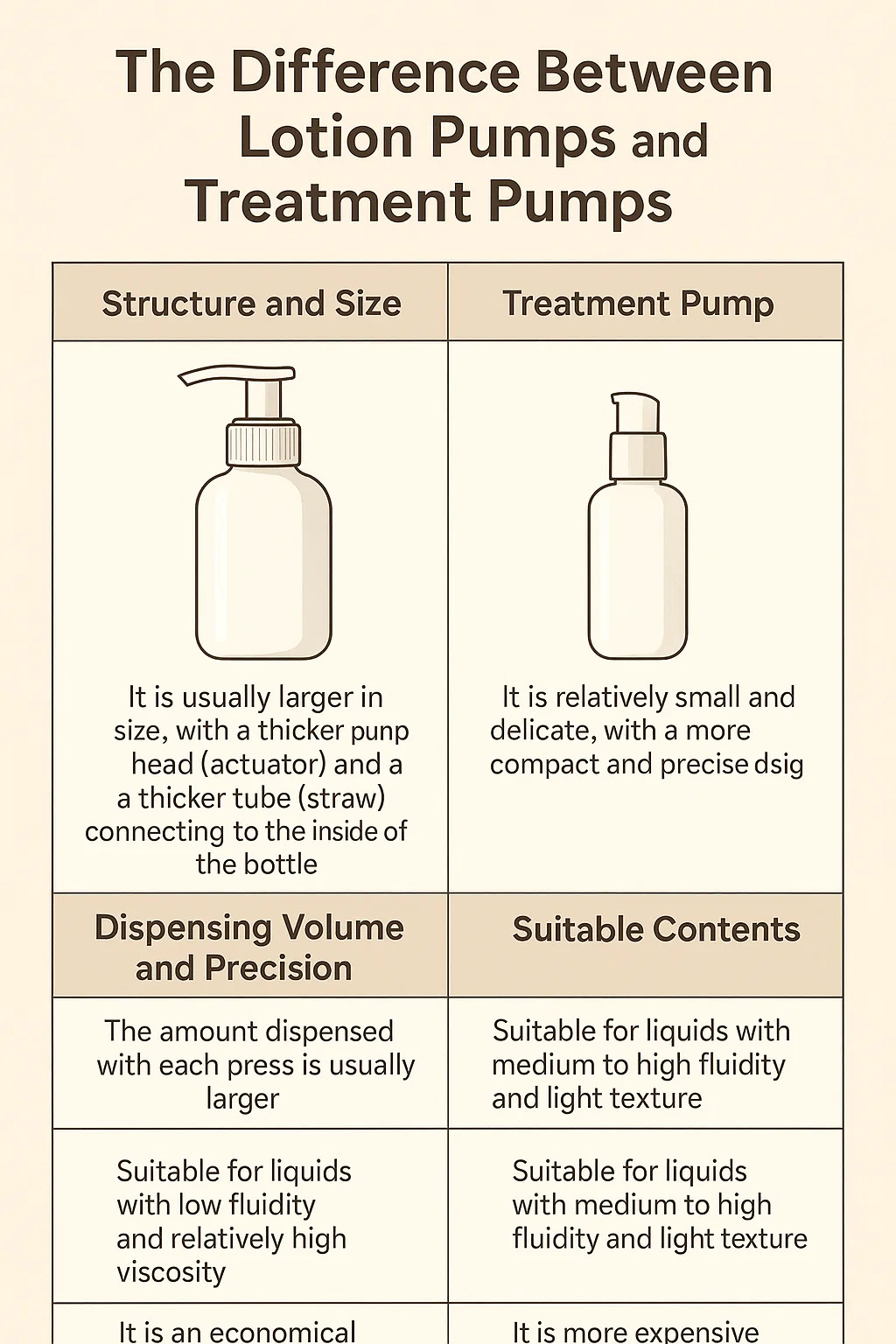
1. Structure and Size
Lotion Pump:
General description: It is usually larger in size, with a thicker pump head (actuator) and a thicker tube (straw) connecting to the inside of the bottle.
Function: This design is intended to handle thicker, larger quantities of liquid.
Treatment Pump:
General description: It is relatively small and delicate, with a more compact and precise design for the pump head and internal components.
Function: This small size allows for better control of small, precise dosages.
2. Dispensing Volume and Precision
Lotion Pump:
Volume characteristics: The amount dispensed with each press is usually larger (generally a larger number of milliliters).
Uses: Suitable for products that require quick, large-area application, such as body lotion, shampoo, or large-package face cream.
Treatment Pump:
Volume characteristics: The amount dispensed with each press is very small and fixed (usually a tiny number of milliliters).
Uses: Precise control is its core advantage, especially suitable for high-value, high-efficacy serums, eye creams, or products requiring strict dosage control.
3. Suitable Contents
Lotion Pump:
Content types: Suitable for liquids with low fluidity and relatively high viscosity. For example: lotions of various concentrations, conditioners, shower gels, and pump-dispensed face creams.
Treatment Pump:
Content types: Suitable for liquids with medium to high fluidity and light texture. For example: various serums, gels, toners, and products with high concentrations of active ingredients. Its precise structure helps prevent excessive contact between the product and external air.
4. Price and Positioning
Lotion Pump:
Positioning: It is an economical option, often used in packaging for mass-market, high-consumption products. Treatment Pump:
Positioning: Due to its more precise and complex structure, it is more expensive and is often used in packaging for high-end products that emphasize advanced technology or active ingredients.
| Feature | Treatment Pump (Essence Pump) | Lotion Pump (Standard Pump) |
| Common Use | High-value serums, light face creams, eye creams, precise application products. | Body lotions, shampoos, conditioners, shower gels, heavier moisturizers. |
| Size & Design | Smaller, more slender, and often features a more integrated, streamlined design. | Larger, bulkier, with a wider actuator (press-down head) and thicker dip tube. |
| Dispensing Volume | Very small and highly controlled (Micro-dosing). Delivers a precise, measured "dose." | Larger output volume per pump. Designed for speed and coverage. |
| Product Consistency | Best for thin to medium-viscosity (more liquid) products like serums and gels. | Best for thick or high-viscosity (creamy/heavy) products like body lotion and heavy cream. |
| Cost & Packaging | Higher cost due to precision engineering. Used for premium/cosmeceutical products. | Lower cost, standard utility. Used for high-volume, mass-market products. |
Our Products //
Related Product

- E-mail: [email protected]
- Phone: +86-15962399191
- Add: No. 60-7, East Side of Jinzhong Road, Jinfeng Town, Zhangjiagang City, Suzhou City, Jiangsu Province
Copyright © Zhangjiagang Haojie Packaging Technology Co., Ltd. All Rights Reserved.
 China Cosmetic Packaging Manufacturers
China Cosmetic Packaging Manufacturers