

 中文简体
中文简体 Español
 عربى
عربى
What are the uses of a micro sprayer?
Industry News-Content
- 1 Agricultural and Crop Protection Applications
- 2 Greenhouse and Horticultural Uses
- 3 Medical and Clinical Applications
- 4 Cosmetics and Personal Care
- 5 Industrial and Manufacturing Applications
- 6 Laboratory and Scientific Research
- 7 Food and Beverage Industry
- 8 Home and Garden Uses
- 9 Comparison of Micro Sprayer Types and Their Primary Uses
- 10 Environmental and Cooling Applications
- 11 Key Factors When Choosing a Micro Sprayer
A micro sprayer is a precision liquid-dispensing device designed to emit an ultra-fine mist through a small nozzle, typically producing droplet sizes ranging from 10 to 100 microns. Its primary uses span agriculture, horticulture, cosmetics, laboratory research, medical treatment, industrial coating, and home gardening. The defining advantage over conventional sprayers is the controlled, uniform droplet delivery that minimizes waste, reduces chemical runoff, and ensures even coverage on target surfaces. Whether you are misting a greenhouse full of orchids or applying a topical anesthetic in a clinical setting, micro sprayers deliver results that coarser equipment simply cannot match.
Agricultural and Crop Protection Applications
In modern farming, micro sprayers have become indispensable tools for precise pesticide and fertilizer delivery. Traditional broadcast spraying can waste up to 40–60% of applied chemicals through drift, runoff, or over-saturation. Micro sprayer irrigation systems, by contrast, place water and dissolved nutrients directly within inches of the root zone, improving fertilizer use efficiency to over 90% in field trials conducted in California's Salinas Valley.
Drip-based micro sprayer heads installed on riser stakes are commonly used in row crops such as strawberries, peppers, and melons. Each head covers a radius of roughly 3 to 6 feet, depending on operating pressure, so growers can tailor coverage patterns to plant spacing. When used with fertigation systems, soluble nutrients like calcium nitrate or potassium sulfate are injected directly into the micro sprayer line, eliminating the need for separate foliar application passes.
Frost Protection
One specialized but vital agricultural use is frost mitigation. When air temperatures approach 32°F (0°C), micro sprayers activate over fruit trees or vegetable beds to coat foliage with a thin film of water. As the water freezes, it releases latent heat, keeping the plant tissue at 32°F rather than dropping further. California citrus growers have used this technique to protect crops worth hundreds of millions of dollars during unexpected late-season freezes. The micro sprayer's fine mist is critical here — too heavy a spray adds excessive ice weight and can break branches.
Integrated Pest Management
Micro sprayers are also used in targeted pesticide application as part of integrated pest management (IPM) programs. Instead of blanket spraying an entire field, growers can activate individual micro sprayer zones only where pest pressure is detected. This reduces total pesticide load, lowers input costs, and decreases the risk of developing pesticide-resistant insect populations. Studies from Wageningen University in the Netherlands found that targeted micro sprayer use in greenhouse tomato production cut insecticide application volumes by up to 35% compared to conventional spraying.
Greenhouse and Horticultural Uses
Greenhouses and nurseries represent one of the highest-density use cases for micro sprayers. Plants grown under glass or poly film require consistent humidity, precise irrigation, and periodic foliar feeding — all tasks that micro sprayer systems handle simultaneously.
Propagation houses use micro sprayers to mist unrooted cuttings every few minutes during the rooting phase. Fine mist keeps leaf surfaces cool, reduces transpiration stress, and maintains a high-humidity environment around the cutting without waterlogging the growing medium. Commercial poinsettia producers, for instance, rely on automated micro sprayer benches timed to mist cuttings every 90 seconds during peak summer propagation cycles.
Orchid growers use overhead micro sprayer systems to simulate the tropical rainforest canopy drip that epiphytic orchids are adapted to. The fine water particles settle slowly on aerial roots and leaf axils, replicating natural humidity cycles. Many commercial orchid operations in Florida and the Netherlands run micro sprayer cycles at dawn and dusk to match natural dew patterns, resulting in faster growth rates and more consistent blooming schedules.
Hanging basket and potted flower production also benefits significantly. Traditional overhead watering with full-flow nozzles can dislodge growing media, compact substrate, and damage delicate blooms. Micro sprayers deliver water gently across the container surface, preventing erosion and preserving plant aesthetics — a key concern for retail-ready floriculture products.
Medical and Clinical Applications
In healthcare settings, micro sprayer technology enables precise topical delivery of medications, antiseptics, and anesthetics to specific tissue sites. The clinical advantage is controlling dose volume while ensuring uniform coverage — a challenge with conventional swabs, gauze, or pump bottles.
Endoscopic and Surgical Use
Endoscopic micro sprayers are thin-catheter devices inserted through a working channel of an endoscope to apply hemostatic agents, fibrin sealants, or topical anesthetics directly to mucosal surfaces. Devices like the EndoMax micro spray catheter allow clinicians to apply epinephrine solutions to actively bleeding gastric ulcers with consistent droplet coverage across a 3–5 cm² surface area, improving hemostasis rates compared to injection-only techniques.
In laparoscopic surgery, micro sprayer devices deliver fibrin glue or antimicrobial solutions to surgical sites through trocar ports, coating sutured tissue planes without pooling excess liquid in the abdominal cavity. The precise spray pattern reduces the risk of adhesion formation and infection at anastomosis sites.
Dermatology and Wound Care
Wound irrigation micro sprayers help clinicians clean chronic ulcers, surgical incisions, and burn wounds. Saline or antimicrobial solutions delivered as a controlled mist reduce bacterial load without the mechanical trauma caused by jet irrigation. Pressure-adjustable micro sprayer wands used in burn units can deliver irrigation at 8–15 psi, the recommended range for effective debridement without damaging fragile granulation tissue.
Cosmetic dermatologists also use micro sprayer devices to apply hyaluronic acid serums, numbing sprays before laser treatments, and post-procedure calming mists such as thermal spring water. The uniformity of coverage over irregular facial contours makes hand-held micro sprayer bottles a preferred delivery method over cotton pads, which can unevenly distribute actives.
Respiratory Therapy
Nebulizer-class micro sprayers generate aerosols in the 1–5 micron range specifically designed to penetrate deep into the bronchial tree and alveoli. These are used to administer bronchodilators like albuterol, corticosteroids like budesonide, and mucolytics in patients with asthma, COPD, or cystic fibrosis. The micro spray particle size is calibrated to bypass the upper airway and deposit in the lower respiratory tract, maximizing therapeutic effect per dose.
Cosmetics and Personal Care
The beauty industry has embraced micro sprayer technology across skincare, makeup setting, hair care, and nail application. Consumers and professionals alike value the fine mist for its ability to apply product uniformly without over-application or streaking.
- Setting sprays: Makeup setting sprays use micro sprayer nozzles to distribute a fine film of polymers and humectants over finished makeup looks. The mist locks pigments in place, reduces cakiness, and extends wear time. Professional makeup artists prefer micro spray setting formulas because they don't disturb powder layers the way wet droplets from coarser nozzles can.
- Facial misting: Travel-size facial micro sprayer bottles filled with thermal water, rose water, or hyaluronic acid mist have become ubiquitous skincare tools. Dermatologists recommend their use during long flights to combat cabin air dehydration, which can reduce skin moisture levels by up to 37% on trans-oceanic routes.
- Hair care: Micro sprayer bottles for hair allow stylists and consumers to add targeted hydration to dry sections before heat styling, apply leave-in conditioners evenly along the hair shaft, or dampen sections for cutting and braiding without soaking roots. The controlled moisture prevents frizz that results from over-wetting.
- Nail art: Nail technicians use micro sprayer systems to apply gradient chrome powder suspensions, alcohol-based nail polish thinners, and UV-curable top coats as thin, even layers. The spray application allows blending effects impossible to achieve with a brush.
- Tanning: Spray tanning booths and handheld airbrush systems are essentially precision micro sprayer devices calibrated to coat skin with self-tanning dihydroxyacetone (DHA) solutions in 15–20 micron droplets, ensuring even bronzing without streaks or uneven absorption.
Industrial and Manufacturing Applications
In manufacturing environments, micro sprayer systems handle a surprisingly wide range of process tasks — from lubrication to surface treatment — where precision dispensing translates directly into product quality and cost savings.
Minimum Quantity Lubrication (MQL)
CNC machining operations use micro sprayer MQL systems to deliver tiny pulses of cutting oil — typically 5 to 50 milliliters per hour — directly to the tool-workpiece interface. This replaces flood coolant systems that consume 50 to 500 liters per hour, dramatically reducing coolant cost, disposal fees, and machine cleaning time. Automotive parts manufacturers like Toyota and BMW have adopted MQL micro sprayer systems across their machining lines, cutting coolant costs by over 80% without sacrificing tool life or surface finish quality.
Surface Coating and Priming
Electronics manufacturers use micro sprayer conformal coating systems to apply protective lacquers to PCBs. The micro spray nozzle deposits a uniform 25–75 micron layer of acrylic, silicone, or urethane coating without bridging component leads or creating voids that compromise insulation. Selective coating robots equipped with micro sprayer heads can mask and coat areas as small as 1 mm² with positional accuracy under 0.1 mm.
In food packaging, micro sprayers apply release agents to molds, conveyors, and baking pans. Canola oil or lecithin-based release sprays applied at 0.1–0.3 g/m² reduce sticking without leaving excess residue that would compromise packaging adhesion or consumer aesthetics.
Dust Suppression
Mining, quarrying, and demolition operations employ micro sprayer cannon systems to suppress airborne silica and coal dust particles. Micro sprayers produce droplets sized to match the dust particle diameter — around 10–50 microns — maximizing collision probability between water droplets and dust particles. The resulting agglomerated particles settle rapidly, reducing respirable dust concentrations at workface sites by 60–85% according to National Institute for Occupational Safety and Health (NIOSH) field assessments.
Laboratory and Scientific Research
Research laboratories use micro sprayers extensively in sample preparation, slide staining, and thin-film deposition processes. The precise volume control makes micro sprayer technology essential when working with expensive reagents or when reproducibility is critical.
In mass spectrometry imaging (MSI), matrix-assisted laser desorption/ionization (MALDI) sample preparation requires coating tissue sections with matrix compounds like 2,5-dihydroxybenzoic acid (DHB) or alpha-cyano-4-hydroxycinnamic acid (CHCA) in a homogeneous crystalline layer. Robotic micro sprayer devices such as the HTX TM-Sprayer deposit matrix solutions in controlled, overlapping passes at speeds of 750–1100 mm/min, producing co-crystal matrix layers with crystal sizes under 20 microns — essential for high spatial resolution MSI experiments.
Histology labs use micro sprayer applicators to apply hematoxylin and eosin stains, mounting media, and coverslip adhesives to glass slides. The micro spray coating reduces stain volume by up to 70% compared to immersion staining protocols while providing equivalent or superior staining uniformity — important in high-volume diagnostic pathology labs processing thousands of slides per day.
Electrospray ionization (ESI) sources in analytical chemistry are essentially precision micro sprayer devices that nebulize liquid samples into charged droplets for ionization and mass analysis. The nozzle geometry and spray voltage determine droplet size distribution and ionization efficiency, directly affecting detection sensitivity and analytical accuracy.
Food and Beverage Industry
Food processing plants use micro sprayer technology for flavoring, glazing, humidifying, and antimicrobial treatment of products across multiple stages of production. The fine mist delivery ensures consistent product flavor, appearance, and shelf life without over-application that would alter texture or weight.
- Bakery glazing: Automated micro sprayer tunnels apply egg wash, sugar syrup, or oil glazes to bread, pastries, and crackers moving on conveyor lines at speeds up to 30 meters per minute. The consistent film thickness (typically 0.5–2 g/m²) ensures uniform browning and sheen across entire production batches.
- Meat and seafood treatment: Antimicrobial micro sprayer systems apply lactic acid, citric acid, or peroxyacetic acid solutions to fresh meat carcasses in USDA-approved pathogen reduction programs. Studies have shown a 1–2 log reduction in E. coli and Salmonella surface counts using micro spray application compared to immersion chilling alone.
- Flavor enhancement: Snack food manufacturers spray flavor oils, seasoning slurries, and sauces onto chips and extruded snacks through micro sprayer drums. The fine droplets coat tortilla chips and pretzels evenly, preventing clumping of flavor particles and reducing over-seasoning losses.
- Humidity control: Supermarket produce misters are perhaps the most consumer-visible micro sprayer application. Overhead micro spray systems in produce aisles activate every 15–20 minutes to maintain relative humidity above 90% around leafy vegetables, reducing wilting and extending display life by 20–30% compared to non-misted displays.
Home and Garden Uses
For home users, micro sprayer bottles and small-scale irrigation micro sprayers offer versatility across houseplant care, kitchen gardening, cleaning, and DIY projects. Entry-level hand-held micro sprayer bottles are available for under $10, while automated micro sprayer kits for raised beds and container gardens range from $30 to $200 depending on zone count and timer sophistication.
Houseplant enthusiasts use micro sprayers to mist tropical aroids like monsteras and calatheas, which prefer high ambient humidity (60–80% RH) that most homes don't naturally provide. A consistent misting schedule with a micro sprayer bottle adds localized humidity without overwatering. Terrarium keepers spray enclosures with dechlorinated water or dilute liquid fertilizers to maintain moisture gradients across the substrate surface.
Vegetable and herb gardens on balconies and patios benefit enormously from micro sprayer drip kits connected to timers. A single micro sprayer emitter head covering a 12-inch planter pot uses roughly 0.5 gallons per hour compared to 2–4 gallons per hour for a standard overhead sprinkler head, directly cutting water usage while maintaining adequate soil moisture for productive crops like cherry tomatoes, basil, and peppers.
Home cleaning applications include micro sprayer bottles for applying all-purpose cleaners, disinfecting solutions, glass cleaners, and furniture polish. The fine mist covers large surface areas like countertops and windows more efficiently than pouring or using coarser trigger sprayers, reducing chemical waste and streak formation.
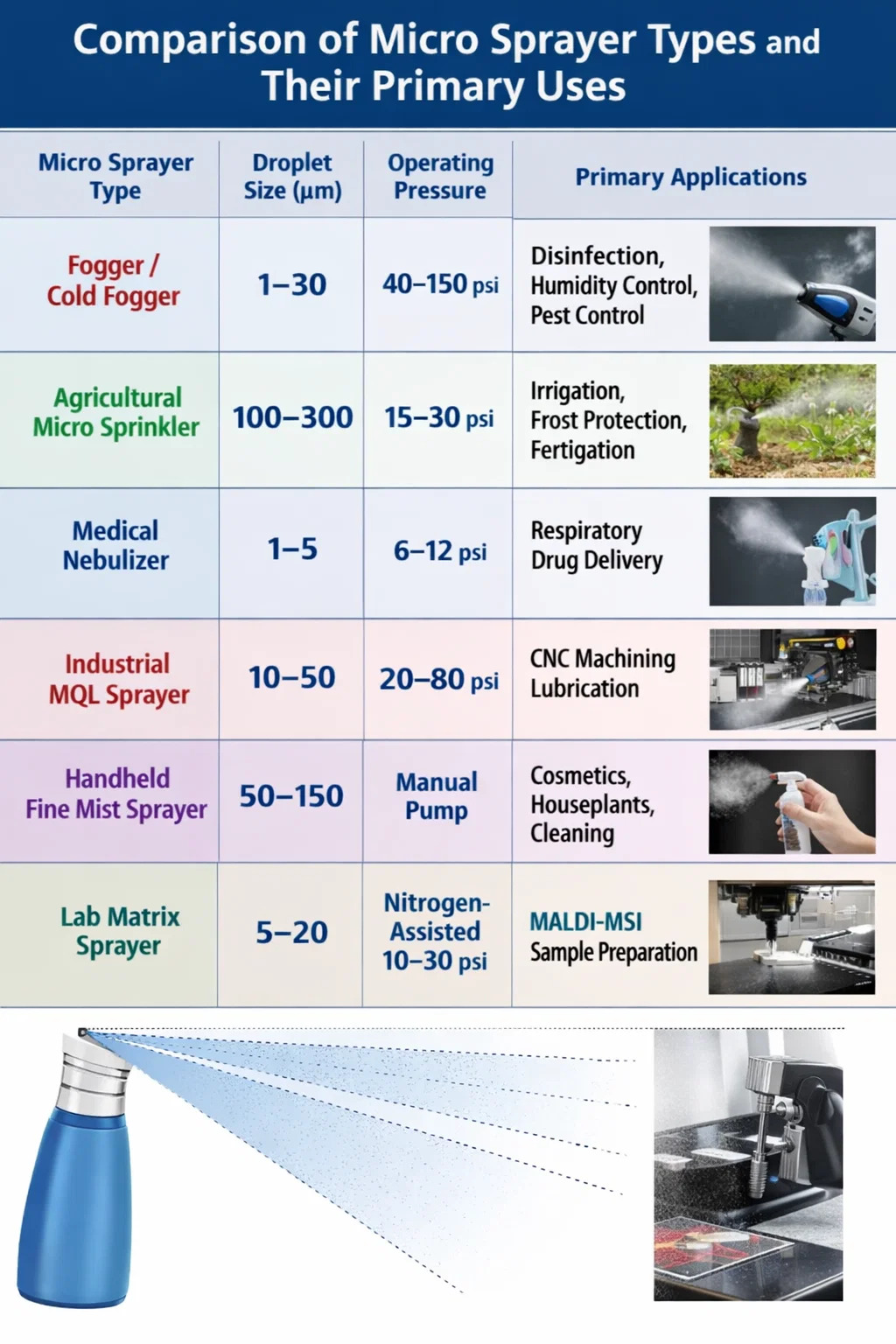
Comparison of Micro Sprayer Types and Their Primary Uses
Different micro sprayer configurations are optimized for specific applications. Choosing the wrong type results in poor coverage, wasted material, or equipment damage. The table below summarizes the most common micro sprayer types, their typical droplet sizes, operating pressures, and best use cases.
| Micro Sprayer Type | Droplet Size (µm) | Operating Pressure | Primary Applications |
|---|---|---|---|
| Fogger / Cold Fogger | 1–30 | 40–150 psi | Disinfection, humidity control, pest control |
| Agricultural Micro Sprinkler | 100–300 | 15–30 psi | Irrigation, frost protection, fertigation |
| Medical Nebulizer | 1–5 | 6–12 psi | Respiratory drug delivery |
| Industrial MQL Sprayer | 10–50 | 20–80 psi | CNC machining lubrication |
| Handheld Fine Mist Sprayer | 50–150 | Manual pump | Cosmetics, houseplants, cleaning |
| Lab Matrix Sprayer | 5–20 | Nitrogen-assisted, 10–30 psi | MALDI-MSI sample preparation |
Environmental and Cooling Applications
Outdoor venues, sports facilities, and public spaces have adopted micro sprayer misting systems as evaporative cooling solutions. When ambient temperatures exceed 90°F, overhead micro sprayer misting lines reduce the perceived temperature in the immediate vicinity by 10–25°F through flash evaporation. Theme parks like Disneyland and Universal Studios install high-pressure micro sprayer fog lines along queue areas, cutting guest heat stress without leaving surfaces wet.
Data center cooling is another emerging application. Adiabatic pre-cooling systems use micro sprayer arrays upstream of air intake units to evaporatively cool incoming air before it reaches computer room air handlers. Microsoft and Google have tested micro sprayer evaporative pre-coolers at facilities in hot climates, reducing mechanical cooling energy consumption by 20–40% during summer peak demand periods.
Environmental remediation projects use micro sprayer systems to distribute bioaugmentation solutions — suspensions of specific microbial strains — evenly across contaminated soil surfaces or within bioreactor vessels. The fine spray maximizes the contact area between added microorganisms and contaminated substrate, accelerating hydrocarbon or heavy metal remediation timelines.
Key Factors When Choosing a Micro Sprayer
With so many micro sprayer configurations available, selecting the right device requires matching the sprayer's technical specifications to the specific requirements of the task. The wrong choice can result in poor coverage uniformity, nozzle clogging, chemical waste, or equipment failure.
- Droplet size requirement: Define the target droplet range based on application. Respiratory therapy needs 1–5 µm; agricultural irrigation works with 100–300 µm. Mismatch between droplet size and application leads to drift losses or inadequate penetration.
- Liquid viscosity compatibility: High-viscosity fluids like silicone oils or dense fertilizer solutions may require larger orifice nozzles or pneumatic-assist micro sprayer designs that would clog standard gravity-fed units.
- Coverage area: Calculate the total area needing coverage per cycle. A single rotating micro sprayer head covers 3–10 square meters; large greenhouse or industrial systems require manifolded multi-head layouts designed for uniform distribution coefficients (DU) above 80%.
- Material compatibility: Corrosive chemicals like acid-based fertilizers or bleach require micro sprayer components made from PVDF, Viton, or 316 stainless steel rather than standard polypropylene or brass fittings that degrade rapidly.
- Automation needs: Time-sensitive applications like propagation misting or automated manufacturing processes require micro sprayer systems with solenoid valves, programmable logic controllers (PLCs), or timer modules rather than manually operated pump devices.
- Maintenance interval: Hard water deposits calcium carbonate scale inside micro sprayer nozzle orifices rapidly. Systems in high-use environments should have flush cycles, self-cleaning rotating deflectors, or accessible nozzle cartridges that can be replaced in under 30 seconds without tools.
Our Products //
Related Product



- E-mail: [email protected]
- Phone: +86-15962399191
- Add: No. 60-7, East Side of Jinzhong Road, Jinfeng Town, Zhangjiagang City, Suzhou City, Jiangsu Province
Copyright © Zhangjiagang Haojie Packaging Technology Co., Ltd. All Rights Reserved.
 China Cosmetic Packaging Manufacturers
China Cosmetic Packaging Manufacturers