

 中文简体
中文简体 Español
 عربى
عربى
What Are Perfume Notes? A Complete Guide to Fragrance Layers
Industry News-Content
- 1 What Are Perfume Notes? The Short Answer
- 2 The Three-Tier Note Structure Explained
- 3 How Perfume Notes Interact Over Time
- 4 Common Perfume Notes by Category
- 5 Fragrance Families and How Notes Define Them
- 6 How Concentration Affects Perfume Notes
- 7 Why Glass Perfume Bottles Matter for Preserving Notes
- 8 Natural vs. Synthetic Notes: What's the Difference in Practice
- 9 How to Read a Perfume Note Description
- 10 Practical Tips for Evaluating Perfume Notes Before Buying
- 11 The Role of Accords in Modern Perfume Note Construction
- 12 Storing Your Fragrances to Protect Note Integrity
What Are Perfume Notes? The Short Answer
Perfume notes are the individual scent layers that make up a fragrance, categorized by how quickly they evaporate and when they become detectable on your skin. Every perfume you spray unfolds in three distinct stages — top notes hit first, middle notes emerge as those fade, and base notes linger for hours. This layered structure is the reason a fragrance smells different 30 minutes after application compared to the moment you first spritz it.
Understanding perfume notes isn't just trivia for fragrance enthusiasts — it's the practical framework that helps you choose a scent you'll actually enjoy wearing all day, not just the first five seconds in a store. A fragrance that smells like fresh citrus in the bottle can dry down into something musky and woody hours later. Knowing why that happens changes how you shop, how you store your collection, and how you interpret the descriptions on every glass perfume bottle you pick up.
The Three-Tier Note Structure Explained
Perfumers have organized fragrance composition around a pyramid model for well over a century. Each tier of the pyramid corresponds to a different evaporation rate and a different role in the overall scent experience.
Top Notes: The First Impression
Top notes are what you smell the moment a fragrance makes contact with your skin or clothing. They are composed of small, light molecules that evaporate rapidly — typically within 15 to 30 minutes. Because they're the first thing your nose detects, top notes carry an enormous amount of commercial weight. They're the reason perfume counters exist and why marketing leans so heavily on first-spritz impressions.
Common top note ingredients include citrus elements like bergamot, lemon, and grapefruit, as well as lighter herbs such as basil, mint, and lavender. Aldehydic notes — the synthetic, soapy-bright molecules made famous by Chanel No. 5 — also often function as top notes. Despite lasting only 15 to 30 minutes, top notes account for a significant portion of a buyer's initial purchase decision. This is why sampling a fragrance on skin and waiting before buying is consistently better advice than spraying and deciding immediately.
Middle Notes: The Heart of the Fragrance
Also called heart notes, middle notes emerge as the top notes begin to fade, typically appearing 20 to 60 minutes into wear. They form the core identity of a perfume — the part that defines its character and that most people are actually living with for the majority of the day. Heart notes generally last between 2 and 5 hours on skin, though concentration and skin chemistry affect this significantly.
Floral notes dominate the heart note category: rose, jasmine, ylang-ylang, geranium, and peony are among the most frequently used. Spices like cinnamon, cardamom, and black pepper often appear here too, as do softer herbs like thyme and sage. In oriental and gourmand fragrances, heart notes frequently carry warmth — think cinnamon bark layered with benzoin or tonka bean beginning to emerge. A skilled perfumer uses heart notes to create a seamless bridge between the bright opening and the deeper finish.
Base Notes: The Foundation That Stays
Base notes are the heaviest, slowest-evaporating molecules in a formula. They don't typically become fully apparent until 30 minutes to an hour after application, and they can last anywhere from 4 hours to more than 24 hours on skin and fabric. Base notes anchor the entire fragrance, giving it depth, longevity, and the quality perfumers call "sillage" — the scent trail left behind as someone moves through a room.
Classic base note ingredients include sandalwood, cedarwood, vetiver, patchouli, oakmoss, musks (both natural and synthetic), ambergris, labdanum, benzoin, and vanilla. Many base notes are derived from resins, woods, and animal-derived or bio-synthesized musks. Iso E Super, a synthetic woody molecule introduced commercially in the 1970s, appears in base note compositions of hundreds of modern fragrances, valued for its smooth, cedar-like quality and its ability to amplify other ingredients.
How Perfume Notes Interact Over Time
The note structure isn't as cleanly sequential as the pyramid model might suggest. In practice, all three tiers are present in the bottle simultaneously — what changes is which molecules are most volatile and therefore most detectable at any given point. A base note like vetiver is technically present from the first second, but its large, heavy molecules are overwhelmed initially by the fast-evaporating citrus on top.
This is why the concept of "dry down" matters so much in fragrance evaluation. The dry down refers to the full evolution of a scent on your skin — watching it move from opening through heart to base. Professional reviewers and serious collectors often evaluate a fragrance over an entire day before forming a final opinion. A fragrance that opens with sharp, medicinal lavender might dry down into something warm, sweet, and deeply wearable by hour three.
Skin chemistry also plays a real role here. Your skin's pH level, natural oils, hydration level, and even diet can alter how notes develop. The same bottle of fragrance applied to two different people can smell noticeably different after an hour. This is one reason why the advice to smell a fragrance on a strip first, then on your own skin, is practically meaningful — not just marketing talk.
Common Perfume Notes by Category
The fragrance industry uses hundreds of natural and synthetic ingredients, but they cluster into recognizable families. Here's a practical breakdown of commonly encountered notes across all three tiers:
| Note Tier | Duration on Skin | Common Examples | Scent Character |
|---|---|---|---|
| Top Notes | 15–30 minutes | Bergamot, lemon, grapefruit, mint, basil | Fresh, bright, sharp |
| Middle Notes | 2–5 hours | Rose, jasmine, cardamom, geranium, cinnamon | Floral, spicy, herbal |
| Base Notes | 4–24+ hours | Sandalwood, vetiver, musk, patchouli, vanilla | Woody, warm, deep |
Beyond these classic ingredients, modern perfumery has introduced entirely synthetic aroma chemicals that don't map onto natural sources. Hedione (a jasmine-like molecule), Ambroxan (an ambergris substitute), and Cashmeran (a warm, powdery synthetic) are now staples of contemporary formulation. These molecules often perform functions that natural materials cannot — lasting longer, projecting further, or delivering a specific facet of a scent without the variability of plant-derived ingredients.
Fragrance Families and How Notes Define Them
Perfume notes don't exist in isolation — they're grouped into broader fragrance families that help describe a scent's overall character. The major families recognized by the industry include:
- Floral: Built around rose, jasmine, peony, lily, or violet. The most commercially dominant family globally, spanning everything from single-note soliflores to complex bouquets.
- Oriental/Amber: Characterized by warm resins, musks, vanilla, and spices in the base and heart. Think rich, sensual, and heavy-wearing.
- Woody: Dominated by sandalwood, cedarwood, vetiver, and oud. Often unisex in appeal and particularly popular in niche perfumery.
- Fresh/Citrus: Leads with citrus and aquatic top notes, often supported by clean musks and light woods. Tends to have shorter longevity than heavier families.
- Fougère: A classic masculine family built on the trio of lavender, oakmoss, and coumarin (a tonka-derived molecule). Most barbershop and traditional men's scents belong here.
- Chypre: Built on the contrast between bright bergamot top notes and deep oakmoss/labdanum base notes, with floral or fruity heart notes in between. Associated with sophistication and complexity.
- Gourmand: A relatively modern family featuring edible notes like chocolate, caramel, coffee, and baked goods. Often layered over warm oriental base notes.
Most commercial fragrances are hybrids — a floriental, a woody floral, a fresh fougère. The note breakdown listed on the brand's website or on the label of a glass perfume bottle gives you the primary building blocks, but the family classification tells you the emotional register the perfumer was aiming for.
How Concentration Affects Perfume Notes
The concentration of fragrance oil in a product directly affects how prominently each note tier registers and for how long. This is why the same scent formula sold as an Eau de Toilette and a Parfum can feel like meaningfully different fragrances.
| Concentration Type | Fragrance Oil % | Typical Longevity | Note Character |
|---|---|---|---|
| Eau Fraîche | 1–3% | 1–2 hours | Predominantly top notes |
| Eau de Cologne (EDC) | 2–4% | 2–3 hours | Bright, light, top-note forward |
| Eau de Toilette (EDT) | 5–15% | 3–5 hours | Balanced across tiers |
| Eau de Parfum (EDP) | 15–20% | 5–8 hours | Richer heart and base presence |
| Parfum/Extrait | 20–40% | 8–24+ hours | Deep, base-note dominant |
A higher-concentration Parfum version of a fragrance will skip past the top notes more quickly — since they're overwhelmed by the density of heavier molecules — and settle into the heart and base with more authority. This is why Parfum versions often feel more intimate, closer to skin, and longer-lasting, while EDT versions feel airier and more casual. Neither is objectively better — the right concentration depends entirely on how you want to wear a scent and in what context.
It's also worth noting that concentration percentages are industry conventions, not legal standards. A brand's EDT may actually contain more fragrance oil than another house's EDP. The label is a guide, not a guarantee.
Why Glass Perfume Bottles Matter for Preserving Notes
The container holding your fragrance is far from a neutral choice. A glass perfume bottle preserves scent integrity in ways that plastic alternatives cannot match. Glass is chemically inert — it doesn't react with the alcohol and fragrance compounds inside, meaning no unwanted molecules leach into the formula over time. Plastic, particularly lower-grade variants, can interact with certain fragrance chemicals, degrading top notes first since they're the most volatile and chemically reactive components.
This matters especially for top notes, which are composed of small, reactive molecules that are already prone to oxidation when exposed to air and light. If a glass perfume bottle is tinted or opaque, it provides an additional layer of UV protection. Ultraviolet light accelerates the breakdown of fragrance molecules, particularly citrus top notes and light florals. A clear glass bottle left in sunlight can noticeably alter within weeks, with top notes degrading fastest — the very tier you're relying on for that bright, fresh opening.
How Different Glass Bottle Designs Affect Fragrance
Beyond material choice, the design of a glass perfume bottle affects how well each note tier is preserved. Sealed atomizer bottles with tight spray nozzles minimize air exposure far better than open splash bottles, slowing the oxidation of top note molecules. Bottles with tight-fitting caps over the spray head offer an additional seal. Wide-necked or open-topped bottles are technically usable but expose more surface area to air, which speeds up evaporation and note degradation.
The thickness and density of glass also varies between luxury and mass-market products. Heavy, thick-walled glass perfume bottles insulate the liquid better against temperature fluctuations — a major cause of fragrance degradation over time. Repeated warming and cooling cycles cause fragrance molecules to expand and contract, which accelerates chemical breakdown. Storing a fragrance in its original glass bottle, in a cool drawer away from light, can extend its useful life by years compared to leaving it on a sunny bathroom shelf.
Specialty Glass Perfume Bottle Formats
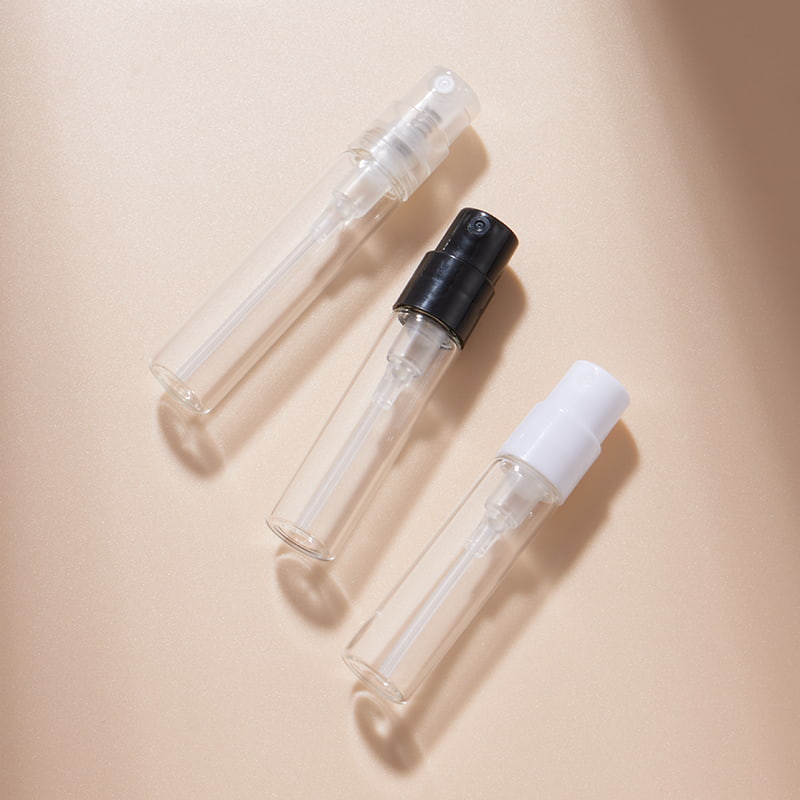
The market for glass perfume bottles extends well beyond the standard retail flacon. Travel atomizers — small glass perfume bottles with refillable reservoirs — have grown substantially in popularity, allowing collectors to carry multiple fragrances without committing to full-sized bottles. Decant culture within the fragrance community revolves almost entirely around small glass perfume bottles, typically ranging from 2ml to 30ml, sealed with tight stoppers or spray mechanisms.
Vintage glass perfume bottle collecting has become a significant hobby and secondary market category. Pre-1970s bottles from houses like Baccarat, René Lalique, and DeVilbiss command prices from a few hundred to tens of thousands of dollars at auction — driven not just by the historical fragrance they once contained, but by the artistry of the glass itself. Lalique's frosted glass designs, in particular, are recognized as collectible art objects entirely independent of their perfume-holding function.
Natural vs. Synthetic Notes: What's the Difference in Practice
A persistent misconception in fragrance discussion is that natural notes are inherently superior to synthetic ones. In practice, the distinction is more nuanced. Natural ingredients — extracted through steam distillation, cold pressing, or solvent extraction — carry complexity and variation that synthetics can't fully replicate. A rose absolute contains hundreds of individual chemical compounds, which is why natural rose smells richer and more "alive" than any single synthetic rose molecule.
However, natural ingredients also come with real drawbacks. Many are subject to crop variability — the quality and character of Bulgarian rose can shift year to year depending on rainfall and harvest conditions. Some natural materials like oakmoss and costus have been heavily restricted by the International Fragrance Association (IFRA) due to sensitization concerns. As of recent IFRA amendments, oakmoss — a foundational ingredient in classic chypre and fougère fragrances — is restricted to levels so low that many classic formulas have been permanently reformulated.
Synthetic notes, on the other hand, offer consistency, cost-effectiveness, and the ability to create scent impressions that don't exist in nature. Calone, synthesized in the 1960s, delivers the specific "ozonic marine" quality that defines aquatic fragrances — there's no natural material that smells quite like it. Ambroxan, derived from clary sage rather than real ambergris, provides a warm, skin-close quality that has become one of the defining characteristics of contemporary niche perfumery.
Most modern fragrances — at every price point — combine natural and synthetic materials strategically. A perfumer might use natural rose absolute for its complexity in the heart note but anchor it with synthetic musks in the base for consistency and longevity. The result is often more stable and predictable across the life of a product, which matters both for the consumer experience and for the integrity of the formula inside the bottle.
How to Read a Perfume Note Description
Most fragrance brands list notes on their websites, on the back of box packaging, or on informational cards accompanying a purchase. Learning to interpret these listings accurately makes a real difference in choosing fragrances you'll enjoy.
- Order matters: When notes are listed in three distinct groups labeled top, heart/middle, and base, read them in sequence. The first group tells you what you'll smell immediately; the last group tells you what you'll smell all day.
- Single-list notes are less informative: Some brands list notes as a single undifferentiated group. This gives you the ingredient set but not the temporal sequence, making it harder to predict how the fragrance will evolve.
- Marketing language vs. actual notes: Words like "warmth," "sophistication," or "aquatic freshness" describe impressions, not ingredients. Real notes are specific: bergamot, not "citrus freshness." Be aware of the difference.
- Listed notes are highlights, not complete formulas: A fragrance formula may contain 20 to 80 individual ingredients. The note listing on the box is a curated selection of the most prominent or marketable ones — not a comprehensive ingredient declaration.
- Some brands use accords, not individual notes: An "accord" is a blend of multiple ingredients designed to create a unified impression — like "sea accord" or "leather accord." These are proprietary combinations rather than single materials.
When you pick up a glass perfume bottle and see a note breakdown like "top: bergamot, pink pepper / heart: iris, rose / base: sandalwood, white musk," you now have a functional framework for predicting how that fragrance will perform — bright and slightly spicy on first spray, floral and powdery in the middle hours, warm and woody as it settles into your skin by evening.
Practical Tips for Evaluating Perfume Notes Before Buying
Given what you now know about how notes work, here are concrete steps that make fragrance evaluation more reliable:
- Apply to skin, not just paper strips. Blotter strips tell you what's in the bottle. Your skin tells you what the fragrance will actually smell like on you — including how your body chemistry affects the dry down.
- Wait at least 30 minutes before deciding. You're evaluating top notes in the first 10 minutes. The heart notes — which you'll actually live with — haven't fully emerged yet. Wait until the fragrance has settled before forming a firm opinion.
- Test no more than three fragrances at once. Olfactory fatigue — your nose's temporary inability to detect new scents — sets in quickly when evaluating multiple fragrances. Testing more than three at a sitting gives increasingly unreliable results.
- Request samples before committing to a full bottle. Many brands offer 1.5ml to 2ml spray samples. Wearing a fragrance through an entire day gives you the full top-to-base experience, which is the only reliable way to know if you'll enjoy it long-term.
- Consider the season and context. Heavy base-note-dominant fragrances — rich orientals, dense woods — tend to amplify in heat. Light citrus-forward fragrances can virtually disappear in cold weather. Matching note character to climate and occasion matters.
- Check if the formula has been reformulated. Many classic fragrances have been reformulated due to ingredient restrictions or cost considerations. If you're buying based on vintage reviews, the current formula — in whatever new glass perfume bottle design it now comes in — may express notes differently than what was originally described.
The Role of Accords in Modern Perfume Note Construction
Beyond individual ingredients, contemporary perfumery relies heavily on pre-built accords — combinations of multiple molecules engineered to produce a unified scent impression that may or may not correspond to a real-world material. The "violet" in a fragrance description, for instance, is almost always a synthetic accord rather than an extract from violet flowers (which don't yield significant extractable aromatic material despite the flower's association with scent).
Accords function across all three note tiers. A "green tea accord" in a top note position might blend a grassy aldehyde, a light citrus molecule, and a subtle earthy element. A "leather accord" in the base might combine birch tar, isobutyl quinoline, and a synthetic castoreum substitute to create the impression of cured hide without using any actual animal-derived material.
The widespread use of accords is one reason why modern fragrances are significantly more consistent batch-to-batch than their predecessors. When a key ingredient is a proprietary synthetic accord, it can be reproduced with near-perfect fidelity indefinitely — unlike natural botanicals, which vary with every harvest. For a collector with a cabinet of glass perfume bottles spanning decades, this also means that newer releases tend to smell more "polished" and less variable than older ones, though some argue at the cost of character and soul.
Storing Your Fragrances to Protect Note Integrity
Even the best formulation in the best glass perfume bottle will degrade if stored incorrectly. The enemies of fragrance longevity are consistent and well-documented: light, heat, humidity, and air exposure.
- Light: UV radiation breaks down fragrance molecules, particularly citrus and light floral top notes. Store bottles away from windows and out of direct light. Tinted or opaque glass perfume bottles offer some protection, but no glass is completely UV-proof without additional coating.
- Heat: Elevated temperatures accelerate chemical reactions within the fragrance formula. The bathroom, despite being the traditional location for perfume, is one of the worst storage spots due to heat and humidity fluctuations. A cool, dark drawer or closet shelf is significantly better.
- Humidity: Moisture can affect fragrance compounds, particularly those with natural ingredients. High humidity also promotes mold growth on spray mechanisms and can compromise bottle seals over time.
- Air exposure: Every time you open a splash bottle or remove a stopper, you introduce oxygen, which oxidizes fragrance molecules. Atomizer-style spray bottles minimize this by keeping the liquid sealed until sprayed.
- Temperature swings: Cycling between cold and warm repeatedly is more damaging than a consistently warm temperature. If you refrigerate fragrance, be consistent about it — don't move bottles in and out repeatedly.
A properly stored fragrance in a sealed glass perfume bottle can remain stable for 5 to 10 years or more. Fragrances with high citrus top note content or light floral hearts will show degradation sooner than orientals and woody fragrances with robust base note structures, which often improve with age as top notes mellow and base notes deepen.
Our Products //
Related Product

- E-mail: [email protected]
- Phone: +86-15962399191
- Add: No. 60-7, East Side of Jinzhong Road, Jinfeng Town, Zhangjiagang City, Suzhou City, Jiangsu Province
Copyright © Zhangjiagang Haojie Packaging Technology Co., Ltd. All Rights Reserved.
 China Cosmetic Packaging Manufacturers
China Cosmetic Packaging Manufacturers