

 中文简体
 Español
 عربى

Skincare Packaging: Pump, Airless & Glass Container Selection Guide for Brands
Industry News-Content
- 1 Neck Finish Decides What Actually Fits
- 2 Dosage, Viscosity, and the Pump You Actually Need
- 3 Airless, Glass or Plastic: Choosing the Container Body
- 4 Fine Mist, Lotion, Treatment and Airless Pumps Compared
- 5 Decoration, Material and Cost Trade-offs
- 6 Sample, Travel and Mini Formats
- 7 Quality Checks Before Approving Mass Production
- 8 Refillable and Mono-Material Directions
- 9 Briefing a Packaging Manufacturer
- 10 Frequently Asked Questions About Skincare Packaging
- 10.1 Which neck finish should I choose for a 30 ml serum?
- 10.2 Can I use the same pump for a toner and a body lotion?
- 10.3 How accurate is a typical skincare pump dose?
- 10.4 Is an airless bottle worth the extra cost?
- 10.5 What causes leaks during shipping even when the bottle passed a bench test?
- 10.6 How long should I allow from brief to production?
- 10.7 Do mono-material pumps perform as well as mixed-material ones?
A 30 ml serum that dispenses 0.5 ml per press when the label promises 0.25 ml is not a formula problem. It is a packaging problem, and it reaches the market more often than most brands expect. In nearly every case it traces back to three numbers that were agreed too late: the neck finish, the pump dose, and the fill volume.
The working order for any skincare packaging project is finish first, dose second, container body third, decoration last. That sequence keeps a launch on schedule because each decision constrains the next one. Reverse it, and you will pay for new tooling, replacement closures, a second round of stability testing, and a delayed shelf date.
What follows explains the specifications that matter, the tolerances worth writing into a purchase order, and the points where projects usually go wrong. Getting the neck finish and dose right before artwork sign-off removes roughly 80 percent of the risk in a skincare packaging program.
Neck Finish Decides What Actually Fits
Every closure in skincare packaging is defined by the bottle's neck finish, and the finish is described by two numbers. Take 18/415. The 18 is the neck diameter in millimetres measured across the threads. The 415 is a three-digit code from the Glass Packaging Institute finish system that describes the thread form, the thread height, and how far the thread runs down the neck.
This is where the first real mistake happens. A 410 bottle and a 415 bottle can both measure 18 mm across the neck, and both will accept an 18 mm pump when you test it by hand. They are not interchangeable.
Why a 410 Cap Will Not Rescue a 415 Bottle
The 415 thread sits deeper and starts lower, so a 410 closure will spin on, feel tight, and still leave a gap at the sealing surface. The pump may pass a hand squeeze in the office and fail a 45 degree Celsius transit test three weeks later. Because leakage usually appears only after the bottles have been filled, labelled, cartoned, and shipped, the cost is measured in pallets rather than units.
The cheapest protection is a go/no-go gauge. A set of gauges costs very little, takes seconds to use, and confirms that the glass or plastic neck matches the closure before anyone commits to a filling run. Ask for gauge reports with the pre-production samples, not after the first container has been loaded.
| Finish | Neck diameter | Typical container | Closure types that fit |
|---|---|---|---|
| 13/415 | 13 mm | 3 ml to 10 ml sample vials | Micro atomizers, mini crimp pumps |
| 15/415 | 15 mm | Small serum and travel bottles | Fine mist sprayers, small lotion pumps |
| 18/415 | 18 mm | 15 ml to 30 ml dropper and serum bottles | Lotion pumps, treatment pumps, mist sprayers |
| 20/410 | 20 mm | 20 ml to 50 ml toner and lotion bottles | 0.5 ml lotion pumps, fine mist sprayers |
| 24/410 | 24 mm | 50 ml to 100 ml cleansers and body lotions | 1.0 ml to 2.0 ml lotion pumps |
| 28/410 | 28 mm | 100 ml to 250 ml body care | 2.0 ml to 4.0 ml lotion pumps, mist sprayers |
Dosage, Viscosity, and the Pump You Actually Need
Two pumps with identical 24/410 collars can deliver 0.5 ml and 1.0 ml per press, because the dose is set by the internal chamber volume and the spring travel, not by the collar. If your product page says one to two pumps per use, that statement is a packaging specification, and it should be written into the pump drawing.
Formulators and packaging engineers should agree on three numbers before sampling: target dose per actuation, acceptable dose range, and the viscosity of the filled product at room temperature. If you want the mechanical background, this explanation of how a lotion pump works walks through the chamber, spring and dip tube path in plain terms.
Viscosity Sets the Engine, Not the Marketing Copy
The table below shows the ranges most suppliers work with. The figures are indicative industry ranges rather than fixed rules, and every formula still needs a physical sample test, because surfactants, salts and alcohol content can shift behaviour well outside the numbers on a viscosity report.
| Viscosity band | Product examples | Dispensing engine | Typical dose |
|---|---|---|---|
| Below 500 mPa.s | Toners, essences, alcohol mists | Fine mist sprayer | 0.05 ml to 0.15 ml |
| 500 to 3,000 mPa.s | Light serums, ampoules | Treatment pump | 0.15 ml to 0.25 ml |
| 3,000 to 12,000 mPa.s | Lotions, milks, emulsions | Lotion pump | 0.5 ml |
| 12,000 to 40,000 mPa.s | Creams, treatment balms | Cream pump or airless | 0.5 ml to 1.0 ml |
| Above 40,000 mPa.s | Butters, thick masks | Airless piston or jar | 0.3 ml to 0.5 ml |
Crimp and Screw Closures Are Not Interchangeable
A crimp pump is sealed onto the neck with a metal collar that the filling line presses into place. It is shorter, lighter, harder to tamper with, and it hides the neck entirely, which suits small glass bottles where the neck is not attractive. The trade-off is that it cannot be unscrewed for refilling, and it needs a crimping head on the filling line set to the correct collar diameter.
A screw pump with a 15/415 collar or similar threads on by hand or machine and can be reused on a refill bottle. For cream and serum formats in small glass bottles, crimp versions such as this  15mm Cream Lotion Crimp Pump15mm cream lotion crimp pump is a pump for cosmetics, skin care and personal care products. The pump head uses a standard interface of 15mm, which can be closely match...View Product → are a common starting point because they keep the closure profile low and the dose consistent from the first press to the last.
Whatever you choose, specify the dip tube length against the actual fill volume, not the bottle's nominal capacity. A tube that touches the base will not draw the last few millilitres; a tube cut 1 mm to 2 mm above the base and angled at the tip will. Ask for the tube length in writing on the drawing, because it is one of the few specifications that is almost never adjusted later.
Airless, Glass or Plastic: Choosing the Container Body
Once the finish and the pump are fixed, the container body becomes a question of oxygen sensitivity, weight, cost per unit and shelf presence. Three families cover most of the market.
Airless Bottles for Actives That Cannot Tolerate Air
An airless bottle uses a piston that rises as product leaves, so no air enters the package and no dip tube is needed. Vitamin C, retinol, peptide blends and probiotic formulas benefit most. There is no product left clinging to a dip tube, so the usable content is close to the fill weight, and the dose stays uniform as the bottle empties.
The practical limits are format size, which usually stops around 30 ml, and refillability, since most airless designs are sealed. A double-wall airless format such as this  25mm 10ml 15ml Rotating Double-Wall Airless Bottle Cosmetic PackagingThis 10ml and 15ml airless bottle with a diameter of 25mm, are made of AS, ABS and PP material. The rotating design is made of double-wall(outer bottle and inner PP bo...View Product → gives 10 ml to 15 ml with an outer wall that carries the decoration while the inner wall holds the formula.
Glass for Weight, Oil Compatibility and Presence
Glass remains the default for oils, alcohol-based mists, fragrance-adjacent products, and anything where the consumer expects weight in the hand. Frosted, amber and coated glass also protect light-sensitive actives without a secondary carton in some cases. The constraints are breakage in transit and cost, which rises quickly with thick bases and heavy decoration.
Plastic for Volume, Weight and Unit Cost
PET, HDPE and PP containers win on large formats and travel weight. PET gives clarity close to glass at a fraction of the shipping weight. HDPE suits opaque body care and cleansers. The trade-offs are oxygen permeation, which is higher than glass, and a perceived value gap in premium skincare, which is often closed with a heavy wall, a soft-touch finish or an aluminium collar.
Fine Mist, Lotion, Treatment and Airless Pumps Compared
Each pump family exists because one specific fluid behaviour could not be handled by the others. Matching the family to the formula is faster than testing sample after sample.
- Fine mist sprayer: delivers 0.05 ml to 0.15 ml as an aerosol-free mist, typically with a particle size in the 30 to 80 micron band. Built for toners, setting sprays, scalp and hair mists, and light fragrance. Viscous formulas clog the nozzle and sputter.
- Lotion pump: the workhorse for 0.5 ml to 4.0 ml doses. It needs air return, so it must never be specified for an oxidation-sensitive formula, and the dip tube must match the fill height.
- Treatment pump: a narrow, fine-tipped nozzle with a 0.15 ml to 0.25 ml dose, designed so a serum lands on a fingertip or directly on skin without splashing. Actuation force tends to be lighter than a body lotion pump.
- Airless pump: the dose is fixed by piston travel, and there is no air path at all. The most accurate option for high-value actives, at the highest unit cost.
One detail worth writing into the specification: the priming stroke count. A pump that needs five presses before the first drop appears will generate complaints on a 15 ml serum. Ask the supplier for the priming count on the exact collar, tube length and dose combination you plan to fill.
Decoration, Material and Cost Trade-offs
Decoration should be the last decision, not the first. Every finishing step adds process time, tooling or handling risk, and a decoration chosen before the functional sample is approved has a habit of moving the launch date.
Aluminium, Anodised Aluminium and Plastic
Aluminium collars and covers read as premium and hold fine tolerances well. Anodised finishes add polish, anodising, dyeing and sealing steps, so they cost noticeably more than bare metal at the same volume, and colour matching across batches needs a signed master sample. Plastic covers in PP or ABS are the low-cost route and can be sprayed, plated or left in a moulded colour. If a metallic look is required and the budget is fixed, a metallic-sprayed plastic cover often lands between the two on both cost and appearance.
Part Marking and Glass Decoration
- Silk screen printing gives the strongest opacity and the widest colour range on both glass and plastic.
- Hot stamping produces a metallic or glossy mark with a fine edge, but it needs a dedicated die per artwork.
- Frosting and spray coating on glass change the whole surface, so they are ordered before any printing and cannot be adjusted later.
- Labels remain the most flexible option when volumes per variant are low, since artwork changes cost nothing but a reprint.
For any decorated part, request an adhesion test on the finished sample: a firm rub with a solvent-soaked cloth and a cross-hatch tape pull. Decoration that survives the factory but fails after six weeks on a bathroom shelf is a common and entirely avoidable complaint.
Sample, Travel and Mini Formats
Mini formats are their own engineering problem, not a scaled-down version of a full-size pack. At 3 ml to 5 ml, the wall thickness of the pump body matters more than the collar, because a thin housing distorts and the dose drifts.
Common approaches for the trial and travel segment include 13/415 micro atomizers for 3 ml to 10 ml, 10 mm and 11 mm crimp pumps for very small glass vials, and refillable twist atomizers that the consumer fills from a larger bottle. A 2 ml to 5 ml refillable glass spray bottle has become a standard sampling tool for fragrance and facial mist launches because it travels and can be topped up.
Practical guidance for mini programs: keep the dose on the low side relative to a full-size pack, verify that the pump primes in two or three presses, and confirm that the label or print area is large enough for the mandatory information you need to carry. Mini packs fail on compliance printing far more often than they fail on function.
Quality Checks Before Approving Mass Production
A pre-production sample that looks right is not the same as a sample that performs. Run through the checks below on the exact combination of bottle, pump, tube and fill volume you intend to buy, and record the results in the approval document.
- Dose accuracy. Weigh ten consecutive actuations and calculate the mean and the spread. A common commercial tolerance is plus or minus 10 percent of the nominal dose, though a tight tolerance should be agreed in writing rather than assumed.
- Leak resistance. Store filled units inverted at 45 degrees Celsius for 48 to 72 hours, then check the collar, the neck thread and the carton underneath.
- Compatibility. Run at least four weeks at 40 degrees Celsius and 75 percent relative humidity, ideally paired with a twelve-week ambient reference, plus three freeze and thaw cycles.
- Actuation force. Measure it rather than judging by feel. Most facial skincare pumps sit in a comfortable band roughly between 15 and 40 newtons, and a pump at the top of that band will feel heavy on a small bottle.
- Spray pattern. For mist products, check pattern roundness, particle size and output consistency across a full bottle, from first press to last.
- Decoration durability. Rub and tape-pull tests on printed or coated surfaces, including the area that the consumer touches most.
- Assembly torque. For screw closures, define a minimum and maximum tightening torque so the filling line does not under-seal or crack a neck.
- Finish gauge check. Confirm every delivery batch against a go/no-go gauge, not just the first shipment.
Keep the approved sample sealed and labelled with the date, the batch, the dose and the viscosity of the filled product. When a dispute arises a year later, the sealed reference sample settles it in minutes.
Refillable and Mono-Material Directions
Refill demand has moved from a marketing idea to a purchasing requirement in several markets, and it changes packaging design in specific ways. A refillable skincare pack needs a closure the consumer can remove without tools, a neck that survives repeated opening, and a refill container that is lighter than the primary pack.
On the material side, mono-material construction is the simplest route to easier end-of-life sorting. An all-PP pump with a PP collar, PP housing, PP stem and PP dip tube can be processed as one stream, while a metal-spring, metal-collar pump cannot. Post-consumer recycled PP is now widely available for housings and collars, and it usually requires a slightly thicker wall to reach the same rigidity as virgin resin.
A realistic plan for most brands is to keep the primary pack performing as before and switch the pump internals to a mono-material version first. That single change touches no artwork, no filling line settings and no consumer habit, yet it removes the hardest part of the package to separate at the end of life.
Briefing a Packaging Manufacturer
Most delays on a skincare packaging project come from incomplete briefs rather than slow factories. A quotation request that arrives with a photo and a fill volume will come back with a wide price band and a long lead time, because the supplier has to guess at everything else.
What to Include in the First Enquiry
- Fill volume in millilitres and the headspace you intend to leave
- Viscosity of the finished formula at filling temperature
- Target dose per actuation and the acceptable range
- Neck finish, or the bottle you plan to use so the supplier can confirm it
- Decoration method, colour direction and whether a master colour sample exists
- Annual volume and the split across variants
- Destination market and any transit drop test you need the pack to pass
With that list in hand, a supplier can quote a real price and a real lead time instead of a range. It also makes the sampling stage far cheaper, because the first round of samples will already sit inside the correct neck, dose and viscosity envelope.
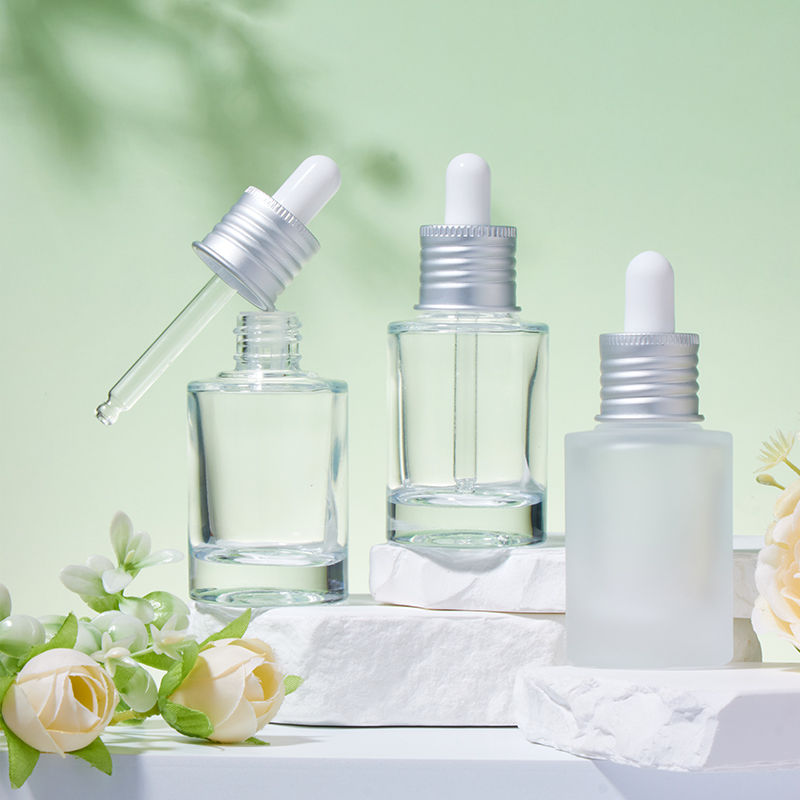
It helps to work with a supplier who already manufactures the closure and the container rather than sourcing one of them elsewhere, since finish compatibility then becomes an internal check rather than a negotiation between two vendors. Reviewing a manufacturer's full component range before requesting samples shows you which finishes, doses and decoration options actually exist, which shortens the brief considerably. Frosted glass formats such as these  30ml Frosted Cosmetic Glass BottlesLong, Slim, Round Shape, Thick BottomView Product → are a good example of a component that can be matched to several pump families, so the bottle decision does not lock the dosing decision.
Frequently Asked Questions About Skincare Packaging
Which neck finish should I choose for a 30 ml serum?
An 18/415 finish is the most flexible starting point for a 30 ml serum because lotion pumps, treatment pumps, mist sprayers and dropper closures are all widely available in that size. If you plan a refill program, favour a screw closure over a crimp so the consumer can reuse the bottle. Confirm the finish with a go/no-go gauge before approving the glass order.
Can I use the same pump for a toner and a body lotion?
Almost never. A toner is thin enough for a fine mist sprayer, while a body lotion needs a lotion pump carrying 1.0 ml to 2.0 ml per press, and the two engines are built around completely different viscosity assumptions. Matching a single pump to both will either clog the mist nozzle or starve the lotion pump.
How accurate is a typical skincare pump dose?
A well-specified pump usually holds within plus or minus 10 percent of the nominal dose across a full bottle when the formula viscosity is stable and the tube length is correct. Airless formats are generally tighter than lotion pumps, but the actual figure depends on the chamber design and the product, so always measure ten consecutive actuations rather than trusting a datasheet alone.
Is an airless bottle worth the extra cost?
It is worth it when the formula is genuinely oxygen or light sensitive, or when the claim depends on delivering a precise dose of an expensive active. For a basic cleanser or a simple moisturiser, a lotion pump in a plastic bottle will do the same job at a lower unit cost, with the bonus of being easier to refill.
What causes leaks during shipping even when the bottle passed a bench test?
Three causes cover most cases: a finish mismatch such as a 410 closure on a 415 neck, inconsistent tightening torque on the filling line, and thermal expansion in a hot container during transit. A 45 degree Celsius inverted storage test plus a defined torque range addresses all three, and both are cheap to add to the specification.
How long should I allow from brief to production?
Allow six to ten weeks for a stock component with a standard decoration, and longer if a new mould or a new glass shape is involved. The stability testing alone typically consumes four to twelve weeks, and that clock only starts once you have a filled sample, so the packaging decision has to be made before the testing begins rather than in parallel with it.
Do mono-material pumps perform as well as mixed-material ones?
An all-PP pump can match a conventional one on dose accuracy and leak resistance for most lotion and treatment formats. The differences usually show up in actuation feel, since the spring geometry has to change, and in the maximum viscosity the pump will handle. Test the mono-material version on your own formula rather than assuming equivalence.
Skincare packaging rewards a specific order of work. Confirm the neck finish with a gauge, agree the dose and the viscosity band with your formulator, choose the container body against the oxygen and light sensitivity of the formula, and only then decide how the pack should look. That sequence costs nothing extra, and it prevents the three failures that delay launches most often: an unmatched closure, a dose that contradicts the label, and a decoration approved before the pump was ever tested with the product.
A sealed, labelled, fully filled approval sample is the single most useful document in the whole project. It settles questions about dose, colour, feel and fit long after the emails have been archived, and it is the fastest way to bring a second production batch back to the standard you signed off.
Start the conversation with those numbers in hand, and most suppliers will respond with a real quote and a real lead time on the first reply.
Our Products //
Related Product

- E-mail: [email protected]
- Phone: +86-15962399191
- Add: No. 60-7, East Side of Jinzhong Road, Jinfeng Town, Zhangjiagang City, Suzhou City, Jiangsu Province
Copyright © Zhangjiagang Haojie Packaging Technology Co., Ltd. All Rights Reserved.
 China Cosmetic Packaging Manufacturers