

 中文简体
 Español
 عربى

Serum Bottle Selection Guide: Neck Sizes, Pumps, Droppers and Airless Options
Industry News-Content
- 1 Neck Finish Comes First: 10 mm to 28 mm in One-Millimetre Steps
- 2 Glass, Airless, or Plastic: Match the Body to the Formula
- 3 Pumps, Droppers and Sprayers: Set the Output by Viscosity and Dose
- 4 Testing a Serum Bottle Before You Approve the Order
- 5 Decoration, Surface Finish and Brand Feel
- 6 Ordering Checklist and Lead-Time Planning
- 7 Frequently Asked Questions About Serum Bottles
- 7.1 What is the most common serum bottle size?
- 7.2 What neck size does a serum bottle use?
- 7.3 Can a mist sprayer be used on a serum bottle?
- 7.4 How much serum does one pump stroke deliver?
- 7.5 Do airless bottles use the same pumps as glass bottles?
- 7.6 How do I stop a serum bottle leaking during shipping?
- 7.7 Can a serum bottle be designed for refilling?
- 8 Getting the Serum Bottle Right the First Time
A serum bottle that leaks in transit, drips two different doses from the same shelf, or refuses to prime after two weeks on display is rarely suffering from a formula problem. It is almost always a mismatch between three numbers: the neck finish, the body material, and the dispenser output. Fix those three first, and everything else in the project becomes routine.
The conclusion, before the detail: choose the neck finish first, because a 30 ml frosted glass bottle with an 18/415 neck will never accept a 13/410 pump, however similar the two threads look in a photograph. Then choose the body that protects the formula, and finally choose a dispenser whose metering range matches the viscosity of the liquid inside. Confirm the combination on a filled sample before tooling, decorating, or booking a production slot.
The ranges quoted throughout this article come from pump and bottle product data covering 10 mm to 28 mm necks and 2 ml to 100 ml containers (Source: Haojie Packaging pump and container catalogue, neck range 10 mm to 28 mm). These are the same figures a factory will ask you for before it can quote, so it pays to have them ready.
Neck Finish Comes First: 10 mm to 28 mm in One-Millimetre Steps
The number before the slash is the neck diameter in millimetres. The digits after the slash describe the thread and bead profile, which is why an 18/410 neck and an 18/415 neck share the same diameter but will not take the same closure. A cap tooled for one will sit loose, cross-thread, or jam on the other.
Serum packaging clusters in a narrow band of necks. Bottles from 5 ml to 15 ml, the sizes used for samples, trial kits and deluxe miniatures, are usually built around 12 mm and 13 mm necks. Retail serum bottles from 15 ml to 50 ml sit at 15 mm, 18 mm and 20 mm. Larger treatment and body serum formats move up to 24 mm and 28 mm.
| Neck finish | Typical bottle size | Matching dispenser | Usual application |
|---|---|---|---|
| 12/410 | 5-15 ml | 12 mm lotion or serum pump | Spot treatments, sample serum |
| 13/410 | 10-20 ml | 13 mm fine mist or lotion pump | Essence mists, watery serum |
| 15 mm crimp | 10-30 ml | 15 mm crimp lotion pump | Ampoule-style serum, travel sets |
| 18/415 | 15-50 ml | 18 mm lotion pump or glass dropper | Standard retail serum, oil blends |
| 20/410 | 20-60 ml | 20 mm lotion pump, airless pump | Vitamin C, retinol, treatment serum |
| 24/410 | 30-100 ml | 24 mm lotion pump, mist sprayer | Body serum, toner, hair serum |
| 28/410 | 50-200 ml | 28 mm high-output lotion pump | Large treatment, cleansing serum |
Ask for the neck drawing with a tolerance figure attached. Glass necks are commonly held to roughly plus or minus 0.15 mm to 0.25 mm depending on the mould, while injection-moulded plastic and aluminium pumps are held tighter. That gap is exactly why the bottle, not the pump, is normally the looser half of the pair. Test the pump on the actual bottle mould, never on a generic sample from a different mould.
Glass, Airless, or Plastic: Match the Body to the Formula
Body material decides how much oxygen and light reach the serum, how heavy the packed bottle feels, and how much you pay per unit. All three formats are available from 5 ml to 100 ml, so the choice is about protection and presentation rather than availability.
Glass dropper bottles
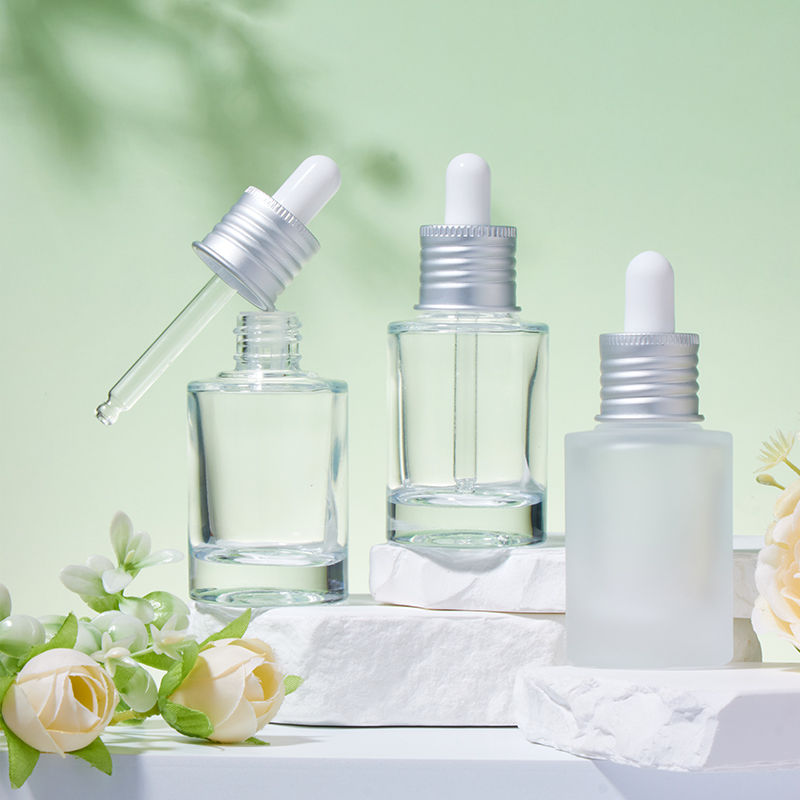
A 30 ml frosted glass dropper bottle is still the default retail serum package, and it earns that position. Glass is inert, so it does not react with essential oils or alcohol-based formulas, and frosted or amber finishing blocks part of the visible light that accelerates colour drift in botanical extracts. A typical build pairs an 18 mm or 20 mm neck with a silver-circle collar and a glass pipette, and standard bodies run through 15 ml, 20 ml, 30 ml, 50 ml and 100 ml in square, round, frosted, amber and gradient versions.
 20mm 30ml Silver Circle Frosted & Transparent Glass Dropper BottlesThis glass dropper bottle is made of high-borosilicate glass, available in transparent and frosted colors. With 20mm neck size and 30ml capacity, it already become the...View Product →
Airless bottles
Airless is the better answer when the formula is the expensive part of the pack. A 10 ml, 15 ml, 20 ml or 30 ml airless bottle uses a piston that rises as product is drawn out, so the contents never touch air and the pump does not draw air back in. For vitamin C, retinol, peptide and fermented-ingredient serums, that protection is worth the higher unit cost. Catalogue sheets for this format commonly quote evacuation above 90 percent of the fill, though thick formulas leave noticeably more behind, so it is worth measuring the residue on your own fill rather than trusting the sheet (Source: manufacturer evacuation claims for 5 ml to 30 ml airless bottles).
 10ml 15ml 20ml 30ml U-Shaped Pressing Purple Cosmetic Airless BottleThis U-shaped pressing purple cosmetic airless bottle(10ml 15ml 20ml 30ml ), is an advanced plastic packaging container designed for high-value skin care products, ess...View Product →
Plastic and PET bodies
PET and PP bottles weigh a fraction of glass, survive e-commerce shipping with far less breakage, and cost less per unit, which matters for refills, subscription programmes and travel sizes.
- Choose glass when the formula is oil-based or alcohol-based, or when the shelf presence depends on weight and a cold feel in the hand.
- Choose airless when the active oxidises, when the fill costs more than the package, or when you want a sealed, non-refillable feel.
- Choose PET or PP when the unit must survive parcel shipping, when the bottle is a refill, or when the target landed cost is tight.
- Whatever body you pick, stay inside the neck range your filling line already handles. A unique neck means a unique filling nozzle, and that cost repeats at every run.
Pumps, Droppers and Sprayers: Set the Output by Viscosity and Dose
Dose is set by the pump engine, not by how hard a customer presses. A lotion pump meters a fixed volume per full stroke, and that volume is decided by the chamber inside the pump, which is why two pumps with the same 18 mm collar can deliver very different amounts.
Viscosity drives the choice more than the bottle does. A serum thin enough to run down the inside of a 30 ml bottle in a few seconds is usually in the low hundreds of centipoise and will mist cleanly. Once a formula approaches roughly 1,000 cP, or carries dispersed powders, a lotion pump is the safer route, because a mist sprayer will sputter or fire a jet instead of a mist. Above roughly 5,000 cP, step up to a 20 mm or 24 mm pump rather than a 12 mm pump, whose narrow chamber struggles to pull thick material (viscosity figures are working ranges used when matching pumps to formulas, not fixed limits, so the filled-bottle test is what decides).
For more on how a small plastic pump behaves with a thin serum, see this testing note on whether a plastic pump head can precisely dispense serum.
 12/410 Plastic Serum Pump Lotion Pump For Small BottleThe pump head is made of high-quality plastic materials, with lightweight, corrosion resistance, non-toxic and tasteless characteristics, the pump head internal design...View Product →
| Dispenser | Output per stroke | Viscosity band | Note |
|---|---|---|---|
| 12 mm serum pump | 0.05-0.10 ml | Thin to medium | Fine control on 5-15 ml bottles |
| 13 mm lotion pump | 0.08-0.15 ml | Thin to medium | Common on essence and sample serum |
| 15 mm crimp pump | 0.10-0.20 ml | Medium | Crimped neck, no refill route |
| 18 mm lotion pump | 0.15-0.25 ml | Medium | Most common retail serum size |
| 20 mm lotion pump | 0.20-0.30 ml | Medium to thick | Treatment serum, foundation serum |
| 24 mm and 28 mm pump | 0.25-0.50 ml | Thick | Body serum, cleansing lotion |
| Fine mist sprayer | 0.05-0.12 ml | Water-thin only | Essence mist, toner-style serum |
| Glass dropper | About 20 drops per ml | Any | Pharmacy convention for aqueous liquid |
Expect three to five strokes to prime a new lotion pump and two to three for a fine mist sprayer. Write that number into the filling line instructions. A bottle that needs nine strokes on first use reads as a defect to a customer, even when the pump itself is perfectly within specification.
Dip tube length deserves the same attention. Cutting the tube to bottle height minus 2 mm or 3 mm is the usual guide, which lets the tube reach the base without curling against the wall and trapping product in the corner.
Testing a Serum Bottle Before You Approve the Order
A serum bottle fails in three ways: it leaks, it doses inconsistently, or it changes the product. Each failure has a cheap test, and all of them are cheaper than a recall or a pallet of unsellable stock.
- Vacuum leak test. Fill around 20 bottles, tighten the closures to the torque your line uses, place them in a vacuum chamber at roughly minus 60 kPa for one minute, then look for wetting around the neck and shoulder. A working check used before shipment by most packaging suppliers.
- Drop test. Drop a filled, boxed 30 ml glass bottle from about 1.2 m onto a hard floor, then inspect for shoulder cracks and neck chips. A common internal check for retail packaging, not a substitute for a transport trial.
- Accelerated aging. Hold filled samples for four weeks at roughly 45 degrees Celsius and 75 percent relative humidity, a widely used accelerated condition, then recheck pump output, colour, odour and closure torque.
- Output consistency. After aging, measure ten consecutive strokes per bottle by weight on a balance. Holding every bottle inside plus or minus 10 percent of the mean is a practical acceptance line for small pumps.
- Compatibility hold. Store filled samples inverted for 72 hours at room temperature and again at about 40 degrees Celsius. Inverting exposes the closure liner and the pump gasket to the formula rather than to air.
These are working conditions rather than universal standards. Confirm the parameters your own brand or distributor requires, and record the results on the same sheet as the bottle and pump part numbers so the approved combination can be reordered exactly.
Decoration, Surface Finish and Brand Feel
Once the mechanical fit is settled, the surface treatment is what a customer actually reacts to. Most serum packs use two or three finishing methods together, and the choices are broader than most brands expect.
- Aluminium collars and covers in gold, rose gold, matt, brushed and anodised finishes. Anodising builds a colour layer into the aluminium surface, which resists rubbing better than a lacquer coat.
- Glass bodies in frosted, gradient, sprayed, amber and fully transparent versions, in square, round and thick-bottom moulds.
- Caps and collars in wood, bamboo, silver circle, square and low-profile shapes, which change the silhouette more than most brands realise.
- Printing by silk screen, hot stamping or UV coating, applied to the body, the collar or the cap.
- Practical note: matt finishes show fingerprints on shelf testers, while gloss aluminium hides them but throws more light into photographs.
Approve colour on a physical sample, never on a screen. Two anodised gold covers from different production batches can differ visibly under shop lighting, and that difference is far easier to settle at the sample stage than after 30,000 units are plated.
Ordering Checklist and Lead-Time Planning
Most production disputes trace back to a spec sheet that was missing one line. The table below lists the fields worth writing down before you request pricing. Standard neck options from 10 mm to 28 mm, along with matching bottles and pumps, are listed in the product catalogue at Haojie Packaging.
| Field | What to write down | Mistake it prevents |
|---|---|---|
| Bottle body | Material, volume, shape, colour, weight | Quoting from a photo alone |
| Neck finish | Diameter and profile, for example 18/415 | Writing 18 mm and losing the thread profile |
| Dispenser | Type, neck, output in ml per stroke | Specifying pump and bottle separately |
| Dip tube | Length in mm, or cut to bottle height minus 2-3 mm | Leftover product at the bottom of the pack |
| Decoration | Method, colour reference, coverage area | Approving colour on a monitor |
| Samples | Two or three rounds, filled and aged | Discovering leaks after mass production |
| Packing | Units per carton, layer pads, pallet height | Breakage discovered at the destination |
Ask for minimum order quantity and lead time in writing at the sampling stage, and ask separately for the lead time on decoration, because plating, spraying and printing usually run on a slower schedule than moulding and assembly. Build a buffer into the launch plan for the second sample round; almost every serum project needs one.
Frequently Asked Questions About Serum Bottles
What is the most common serum bottle size?
30 ml is the retail standard for a dropper serum, with 15 ml used for trial sizes and 20 ml common for airless treatment packs. Sample and travel formats usually sit between 5 ml and 12 ml.
What neck size does a serum bottle use?
Small serum bottles of 5 ml to 15 ml most often use 12 mm or 13 mm necks. Retail bottles of 15 ml to 50 ml use 15 mm, 18 mm or 20 mm, and larger treatment formats move to 24 mm and 28 mm. Always confirm the full profile, for example 18/415 rather than only 18 mm.
Can a mist sprayer be used on a serum bottle?
Yes, if the serum is water-thin and the neck matches a mist sprayer size such as 13/410, 18/415, 20/410 or 24/410. Thicker formulas will sputter or shoot a straight jet, so test the spray pattern on the finished fill before committing to the format.
How much serum does one pump stroke deliver?
Small 12 mm and 13 mm pumps typically meter 0.05 ml to 0.15 ml per stroke, 18 mm pumps 0.15 ml to 0.25 ml, and 24 mm to 28 mm pumps 0.25 ml to 0.5 ml. Verify the figure by weighing ten consecutive strokes on a filled bottle, since the formula viscosity shifts the real number.
Do airless bottles use the same pumps as glass bottles?
No. An airless bottle uses its own piston-driven pump, and the neck is designed as a matched pair with the bottle body. You cannot swap an airless pump onto a standard 18/415 dropper bottle, so treat the airless body and its pump as one part number.
How do I stop a serum bottle leaking during shipping?
Three things do most of the work: correct closure torque, a closure or collar with a proper sealing bead, and a vacuum leak test on filled samples before shipment. Leave headspace in the bottle, keep the pack upright in the carton, and add layer pads between rows of glass.
Can a serum bottle be designed for refilling?
Yes. Screw-neck glass and aluminium bodies from 3 ml to 30 ml are available with refillable sprayers and removable collars, so the outer bottle stays in use while the inner reservoir is replaced. Keep the neck identical between the original and the refill so filling equipment does not need to change.
Getting the Serum Bottle Right the First Time
Serum packaging rewards a short, specific conversation. Bring three things to your supplier: the neck finish with its full profile, the viscosity and fill volume of the formula, and the dose you want per press. Everything else, from the glass colour to the collar finish, is a matter of taste once those three numbers line up.
Then test on a filled bottle, not on a sample pump in a drawer. The three to four weeks spent on leak, aging and dose checks are the cheapest part of the entire project, and the only part that reliably prevents a launch from stalling on a leaking cap.
Pick the neck, protect the formula, set the dose, and the serum bottle stops being a risk item and becomes one of the few parts of the product you never have to think about again.
Our Products //
Related Product

- E-mail: [email protected]
- Phone: +86-15962399191
- Add: No. 60-7, East Side of Jinzhong Road, Jinfeng Town, Zhangjiagang City, Suzhou City, Jiangsu Province
Copyright © Zhangjiagang Haojie Packaging Technology Co., Ltd. All Rights Reserved.
 China Cosmetic Packaging Manufacturers