

 中文简体
 Español
 عربى

Mist Nozzle Selection Guide: Sizes, Types, Compatibility & Spray Performance
Industry News-Content
- 1 What a Mist Nozzle Is and How It Creates a Fine Spray
- 2 Neck Sizes and Finish Codes: Start with the Bottle, Not the Pump
- 3 Crimp, Screw or Bayonet: Choosing the Installation Type
- 4 Spray Performance: Output, Droplet Size and Spray Pattern
- 5 Material Selection: Plastic, Aluminum and Chemical Compatibility
- 6 Matching the Mist Nozzle to Your Product's Viscosity
- 7 Quality Checks to Run Before Placing a Large Order
- 8 Frequently Asked Questions About Mist Nozzles
- 8.1 What exactly is a mist nozzle?
- 8.2 How do I know if my bottle needs a crimp or screw mist pump?
- 8.3 What does "410" mean in a pump specification such as 18-410?
- 8.4 Why does my mist pump leak after a few weeks of storage?
- 8.5 Can the same mist nozzle fit different bottle neck sizes?
- 8.6 How many sprays are in a 5 ml mini atomizer?
- 9 Final Buying Checklist for a New Mist Nozzle Project
The term "mist nozzle" is used in two different industries. In outdoor cooling, a mist nozzle is a tiny metal insert that breaks water into fine droplets for evaporative cooling. In cosmetic and pharmaceutical packaging, a mist nozzle is the complete spray-generating assembly on a sprayer pump — the actuator, swirl chamber, orifice, spring, piston and internal valves that convert bottle contents into a fine, even mist. This article focuses on the packaging meaning, which is the one that matters when you are sourcing sprayers for perfume, toner, facial mist, hair mist, essential oil or sanitizer containers.
If you only remember one piece of advice, keep it simple: choose the smallest mist nozzle that fits your bottle neck, match the delivery rate and droplet size to your product's viscosity, and verify output and leak behavior on real samples before committing to production. Everything else — cap material, actuator shape, crimp versus screw — matters far less than those three decisions.
What a Mist Nozzle Is and How It Creates a Fine Spray
A mist nozzle in packaging is the discharge module of a mist sprayer pump, not just the tiny opening in the plastic tip. A complete mist sprayer pump is built from an actuator (the button you press), a stem, a swirl chamber, an orifice, a piston, a return spring, a ball valve, a gasket and a dip tube that reaches into the bottle. Press the actuator and a chain of events begins: the piston compresses the liquid inside the pump chamber, the liquid is forced at speed into the swirl chamber, and the pressure pushes it outward through the orifice as a cone of fine droplets.
The quality of that cone depends on three numbers: the orifice diameter, the geometry of the swirl chamber, and the force of the return spring. A smaller orifice gives finer droplets but lower output per stroke and a higher risk of blockage. A stronger spring produces higher discharge pressure, which helps a slightly thicker formula atomize, but makes the actuator stiffer for the end user. This is why two pumps with identical-looking tips can spray completely differently.
The table below summarizes the typical performance windows used by pump manufacturers for cosmetic fine mist nozzles. Treat these as reference values; the final droplet size also depends on the liquid's surface tension, viscosity and temperature.
| Nozzle type | Orifice diameter | Approx. droplet size | Typical output per stroke |
|---|---|---|---|
| Ultra-fine mist | 0.30–0.35 mm | 20–40 µm | 50 – 70 µl |
| Standard fine mist | 0.40–0.50 mm | 40–80 µm | 80 – 120 µl |
| Medium mist | 0.55–0.65 mm | 80–120 µm | 120 – 150 µl |
| Coarse spray | 0.70–0.80 mm | above 120 µm | 150 – 200 µl |
Why the fineness of the mist matters
For perfume and facial mist, finer droplets sit on the skin without forming visible wet beads, and alcohol evaporates quickly. For sanitizer or air freshener, a slightly coarser spray reduces inhalation of very small droplets and still covers the surface. For hair mist, coarse droplets penetrate the hair shaft more quickly. So the best nozzle is the one whose droplet range matches the moment of use, not the finest available.
Neck Sizes and Finish Codes: Start with the Bottle, Not the Pump
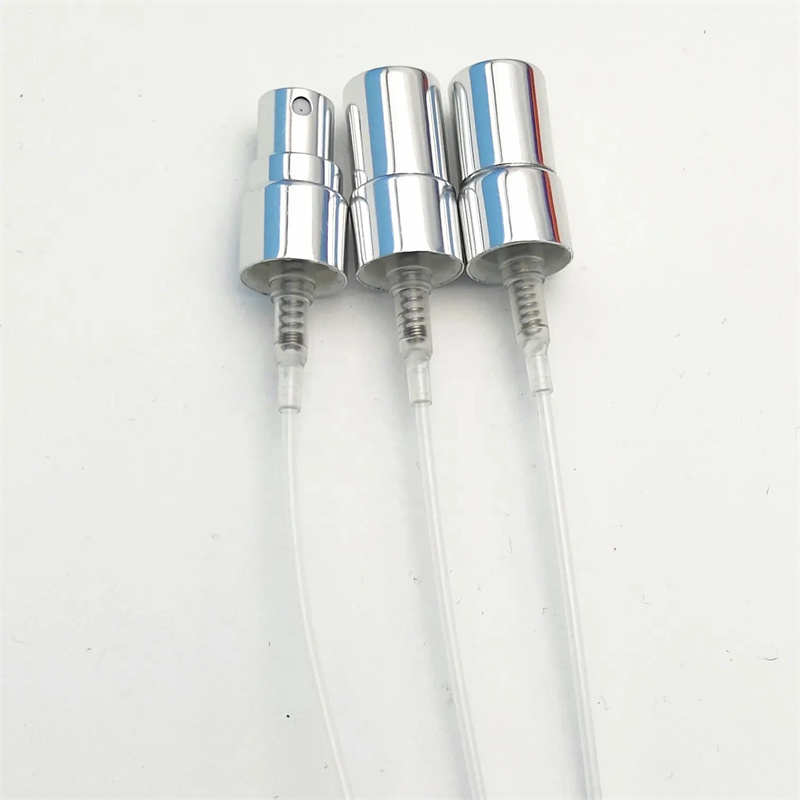 12/410 Aluminum Perfume Glass Bottle Mist Sprayer LidThis aluminum mist sprayer lid uses the 12/410 standard interface to match perfume glass bottles precisely, offering corrosion-resistant protection and a tight seal for reliable perfume packaging.View Product →
The most frequent sourcing mistake is buying a mist pump with the correct spray effect but the wrong neck size. A mist nozzle is designed for one specific bottle finish, and nothing in the pump can be field-adjusted to fit a different neck. Manufacturers in this segment produce mist pumps for neck diameters from 10 mm to 28 mm, in steps of approximately 1 mm: 10, 11, 12, 13, 14, 15, 16, 18, 20, 22, 24 and 28 mm.
For threaded bottles, the finish is described by a code such as 12-410 or 18-415. The first digits give the nominal neck diameter in millimetres; the 400-series indicates a continuous-thread finish; the last two digits define the thread profile (pitch and number of starts). In practice, 410 is the dominant thread profile for fine mist sprayers, while 415 is frequently used on lotion and cream pumps that need a more rigid thread, and 400 appears on selected metal screw mist sprayers.
| Neck size | Finish type | Typical bottle volume | Most common products |
|---|---|---|---|
| 10 mm | Crimp | 2 – 5 ml | Mini perfume samples, testers |
| 11 mm | Screw 11-410 | 3 – 10 ml | Small perfume, cosmetic samples |
| 12 mm | 12-410 | 5 – 30 ml | Eau de parfum, travel atomizers |
| 13 mm | 13-410 | 10 – 50 ml | Perfume, refillable mist |
| 15 mm | 15-410 / crimp | 30 – 100 ml | Perfume, facial toner, body mist |
| 16 mm | 16 mm crimp / screw | 5 – 30 ml | Essential oil, roll-on packages |
| 18 mm | 18-410 / 18-415 | 50 – 100 ml | Toner, hair mist, cream lotion |
| 20 mm | 20-410 | 50 – 150 ml | Hair mist, foundation, lotion |
| 22 mm | 22-400 | 100 – 200 ml | Large fine mist sprays |
| 24 mm | 24-410 | 100 – 250 ml | Full-aluminum mist, large perfume |
| 28 mm | 28-410 | 250 ml and above | Large bottles, heavy-duty mist |
Measuring is easy: use a digital caliper and measure the outer diameter of the bottle neck at the top edge, where the cap seats. If the neck is threaded, read the thread code printed on the sample bottle or ask the bottle supplier. If the neck is smooth with a small lip, the pump will be of the crimp type. Also record the total bottle height; this determines the straw length, which must end a few millimetres above the bottom of the bottle so that the last drop is reachable.
Crimp, Screw or Bayonet: Choosing the Installation Type
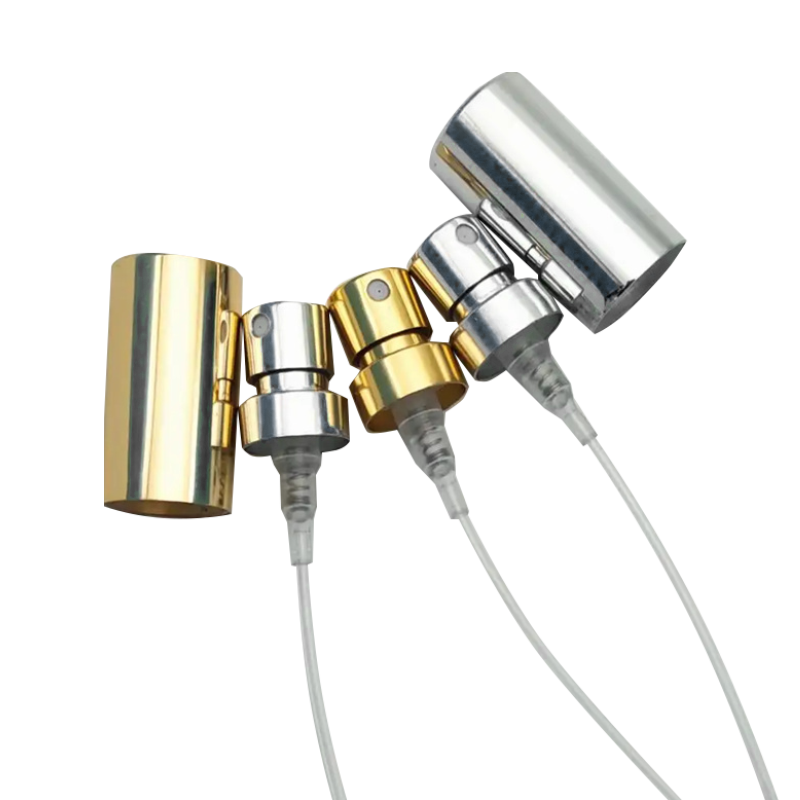 15mm Parfum Crimp Pump Sprayer With Aluminum CapThis crimp-type sprayer with a durable aluminum cap suits smooth-neck bottles, providing a sturdy, wear-resistant design that shields the pump and delivers an even, fine mist for perfume use.View Product →
After the neck size, the next decision is how the pump is fixed to the bottle. There are three installation families, and each one suits a different production setup.
Crimp pumps use a metal collar that is pressed over the bottle lip by a crimping tool. The joint is permanent, very tight, and popular for small glass perfume bottles and sample atomizers in 10 mm and 15 mm sizes. Screw pumps are threaded and can be removed by the end user; they are the standard for refillable perfume and toner bottles with 12-410, 18-410 and 20-410 finishes. Bayonet pumps lock into place with a push-and-twist motion; they are compact, often made entirely of plastic, and common on mini atomizers and lightweight travel containers.
| Criterion | Crimp | Screw | Bayonet |
|---|---|---|---|
| Assembly | Crimping tool | Screw on by hand or capping machine | Push and twist |
| Removable | No | Yes | Yes |
| Typical neck | 10–15 mm | 12–24 mm | 11–14 mm |
| Best for | Small glass perfume | Refillable, standard bottles | Mini all-plastic sprays |
| Leak risk | Very low | Low | Low |
The actuator shape is part of the same choice. The product range includes duckbill, chicken beak, penguin beak, mushroom head and ball cover actuators. These names describe the contour of the discharge tip and the finger pad. An angled duckbill tip is easier to aim at the body, while a straight, flat actuator gives a symmetrical vertical cone for face mists. When you request samples, ask for two actuator styles and compare the direction and feel before finalizing the cap design.
Spray Performance: Output, Droplet Size and Spray Pattern
Once the bottle finish is fixed, focus on behavior. The two numbers that describe a mist nozzle's behavior are output per stroke and droplet size range. Standard fine mist pumps deliver 50–150 µl per stroke. Small sample atomizers usually sit at 50–70 µl; typical 5–30 ml perfume bottles use 80–120 µl; body mist bottles with 50 ml and above tend to use 120–150 µl so the user gets a generous amount per press. The usual production tolerance is about ±10% of the nominal value.
Verify output yourself with a scale. Pump a new, dry pump ten times into a pre-weighed container and note the mass difference after each stroke; the first one or two strokes that only prime the pump do not count. Then divide the total by the number of full strokes. Do the same test after the bottle has been stored horizontally for 24 hours; a good pump will deliver the same output on the first stroke after storage, with no air gap and no after-drip.
Droplet size and pattern take a white-paper test: hold the bottle 15–20 cm from a sheet of paper, press once, and inspect the wetted circle. A stable fine mist leaves a soft, even circle with no streaks and no large drops around the edge. The internal geometry that produces this is worth understanding before you specify, because it is the part that controls the spray quality, as explained in this technical review of how nozzle design changes the spray effect.
Also check the number of strokes needed for a prime from a completely dry pump (usually one to five), and listen for a clean click without spring noise. Excessive after-drip or a slow prime are the first warning signs of a pump that will annoy users in daily use.
Material Selection: Plastic, Aluminum and Chemical Compatibility
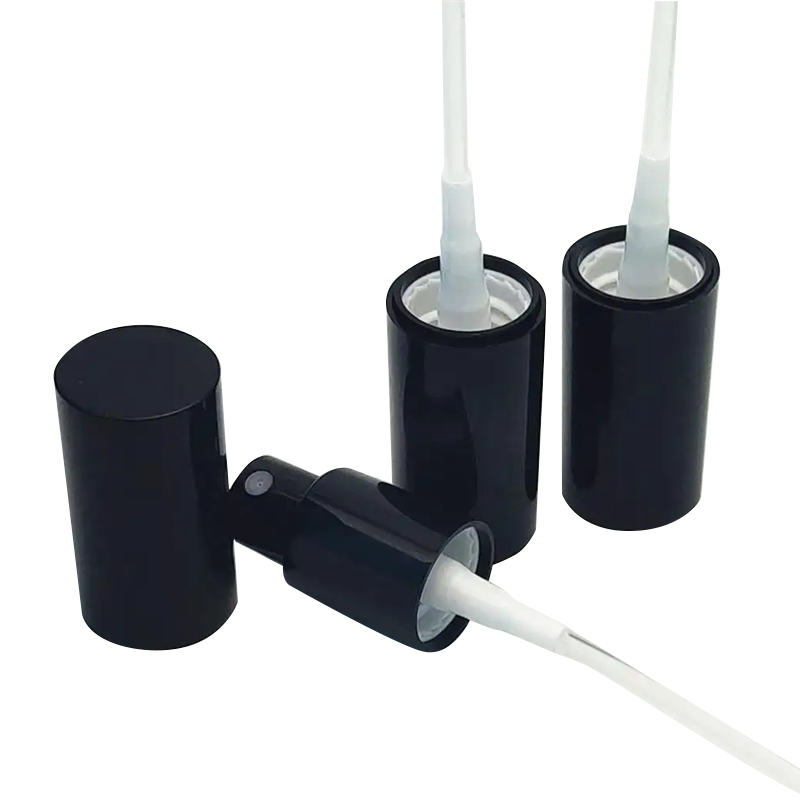 18/415 Full Plastic Mist Pump SprayerMade entirely of lightweight, corrosion-resistant plastics like PP and PE, this easy-to-disassemble pump is convenient to clean, with a precision core and spring for stable liquid dispensing.View Product →
A mist nozzle is an assembly of materials, and the buyer should know which part touches the liquid. The actuator and the pump body are normally molded from PP or POM (acetal); the spring is stainless steel; the ball valve is stainless steel or glass; the gasket is a rubber or PE-based seal; the outer collar is either aluminum alloy or PP.
Full-plastic pumps are an important trend because they simplify the whole packaging structure for recycling and keep the cost low. They work well with alcohol, water, toner, mild detergents and most perfume concentrates, and they eliminate the metal spring and ball valve from the product-contact side. For example, the full-plastic 18-415 mist pump on this site uses plastic internals while retaining 410-series thread compatibility.
Aluminum caps are the other standard. Anodized aluminum adds a hard, corrosion-resistant surface layer and can be produced in gold, silver, rose gold, black and matte finishes. Because the aluminum part is mainly the outer cap and collar, premium perfumes use this structure to achieve a metallic, seamless look without exposing the liquid to the metal.
There is one condition to verify: compatibility between the formula and the wetted plastic parts. Alcohol is fine; most essential oils are fine with PP and POM; but solvents, strong oxidizing agents, high salt loads and certain dyes can swell the plastic or cause sealing rings to harden. Before ordering, send the actual formula to the manufacturer and ask for a storage test of at least 30 days in the intended bottle, both upright and inverted.
Matching the Mist Nozzle to Your Product's Viscosity
The viscosity of the liquid determines whether a fine mist is even possible. Water-like formulas with a viscosity around 1–30 cP atomize well in standard mist pumps. Between approximately 30 and 100 cP the spray becomes streaky unless the orifice and internal passages are adjusted. Above roughly 100 cP, a mist nozzle is the wrong choice entirely; a lotion pump with a larger chamber is more appropriate.
| Product example | Approx. viscosity | Recommended pump |
|---|---|---|
| Perfume / Eau de parfum | 1–5 cP | 12–13 mm fine mist |
| Facial mist / toner | 2–20 cP | 15–18 mm fine mist |
| Light serum | 50–300 cP | 18-415 lotion / serum |
| Body lotion | 1,000–5,000 cP | 20–24 mm lotion pump |
| Cream | above 10,000 cP | 24–28 mm cream pump |
If your formula sits near the boundary, tell the supplier the exact viscosity and the alcohol percentage. Ethanol reduces surface tension and produces finer droplets at the same orifice size, so a pump tuned for water will often behave differently with a perfume concentrate containing 80% alcohol.
Do not forget the dip tube. The straw must suit the bottle height: replace it with a straw that ends 2–3 mm from the bottom, otherwise several percent of the product remains unusable. A 5 ml sample atomizer and a 100 ml body mist can use the same pump model with completely different straws.
Quality Checks to Run Before Placing a Large Order
Sample approval is the moment when most problems can be avoided. A beautiful cap that leaks after transport is worse than an ugly cap that works. Run the following checks before you sign off:
- Dimensional check: measure the outer cap diameter, total pump height, actuator travel and straw length with a caliper; compare to the drawing.
- Output check: ten full strokes on a scale, compute the average and the spread; the spread should stay close to ±10%.
- Prime check: count the strokes needed to achieve the first full mist from a dry unit (1–5 strokes is typical).
- After-drip check: press once, hold a tissue under the nozzle for 5 seconds; no liquid should appear.
- Horizontal leak check: fill the bottle, close with the pump, store on its side for 24–48 hours, and check whether any liquid has migrated past the gasket.
- Visual check: look for flash lines, uneven color, scratches on the anodized surface, and a loose actuator.
Defects that appear repeatedly are red flags: crimp collars that are not airtight, missing ball valves that cause back-leak, weak springs that create a weak spray, straws that curl before reaching the bottom, and anodized caps with uneven color between batch lots.
It also helps to see the supplier's full range before making a final decision. If you are comparing structures and materials from different suppliers, the complete mist sprayer pump catalog on this site shows how the same neck size can be produced with aluminum, plastic, full cover, small cover, screw or crimp constructions.
Frequently Asked Questions About Mist Nozzles
What exactly is a mist nozzle?
In packaging, the mist nozzle is the spray-generating head of a mist sprayer pump — the actuator plus the internal swirl chamber and orifice that convert liquid into fine droplets. It is the part that determines whether a spray feels like mist or like a jet of water.
How do I know if my bottle needs a crimp or screw mist pump?
Inspect the bottle neck. If the neck is smooth with a small flange or lip, choose a crimp pump. If the neck has a thread, choose a screw pump whose finish code matches the bottle, for example 12-410 or 18-410.
What does "410" mean in a pump specification such as 18-410?
It describes the bottle finish: the first two digits give the nominal neck diameter in millimetres; the three-digit code means a continuous-thread finish, and 410 is the most common thread profile for spray pumps. The 415 profile is a variant typically used for viscous lotion and cream finishes.
Why does my mist pump leak after a few weeks of storage?
Three causes are most common: the sealing gasket is incompatible with the formula and has swollen or hardened; the crimp collar was not pressed tightly enough; or the pump was stored horizontally with the actuator in a partially pressed position. Ask the supplier for a 30-day storage test with your reference formula and check the leak behavior in both orientations.
Can the same mist nozzle fit different bottle neck sizes?
No. Each pump is built for one neck finish. A 12-410 pump will not seal on an 18-410 bottle. The only way to use the same pump on a different bottle is to change the bottle to the same finish or select a different pump model.
How many sprays are in a 5 ml mini atomizer?
A 5 ml bottle contains 5,000 µl of liquid. At a typical fine mist output of 80–100 µl per stroke, that means roughly 50–60 sprays. A lower-output pump at 50 µl can extend it to about 100 sprays.
Final Buying Checklist for a New Mist Nozzle Project
- Measure the bottle neck diameter and determine the finish type (threaded, crimp or bayonet).
- Choose a pump with the exact finish code that matches the bottle.
- Decide the spray direction: vertical, angled, or duckbill actuator based on how the product will be used.
- Specify output per stroke and the approximate droplet feel, with the formula's viscosity in hand.
- Confirm the dip tube length matches the bottle height.
- Request a dimensional drawing and compare it with the physical unit.
- Run the leak, output, after-drip and prime tests from the checklist above.
- Keep a sealed reference sample from the pre-production batch for comparison with bulk delivery.
Sourcing a mist nozzle is rarely the hardest part of a project; sourcing one that fits, sprays correctly and does not leak is. Start with the bottle neck, match the viscosity, check the output, and test samples the same way your customers will use the product.
Our Products //
Related Product



- E-mail: [email protected]
- Phone: +86-15962399191
- Add: No. 60-7, East Side of Jinzhong Road, Jinfeng Town, Zhangjiagang City, Suzhou City, Jiangsu Province
Copyright © Zhangjiagang Haojie Packaging Technology Co., Ltd. All Rights Reserved.
 China Cosmetic Packaging Manufacturers