

 中文简体
 Español
 عربى

Amber Glass Dropper Bottles: The Complete Packaging Guide for Oils & Serums
Industry News-Content
- 1 Why Amber Glass? The Science of UV Protection
- 2 Soda-Lime or Borosilicate: Matching Glass Chemistry to Your Formula
- 3 Neck Finish Sizes: The First Compatibility Decision
- 4 Dropper Assembly Options: Bulb, Pipette, and Cap
- 5 Capacity Planning and Fill Volume Calculations
- 6 Best Applications for Amber Dropper Bottles
- 7 Six Quality Checks to Run Before You Commit to a Supplier
- 8 What to Expect When Ordering Custom Amber Dropper Bottles
- 9 Amber Glass Dropper Bottle FAQ
- 9.1 Why do serums and essential oil blends almost always come in amber glass dropper bottles?
- 9.2 Do amber glass bottles block 100 percent of light?
- 9.3 What is the difference between a 20 mm and a 24 mm dropper bottle?
- 9.4 How many drops per milliliter will my dropper bottle deliver?
- 9.5 Can amber dropper bottles be reused?
- 9.6 Do I need special filling equipment for dropper bottles?
Amber glass dropper bottles do two jobs at once: they keep light-sensitive formulations from degrading, and they deliver precise, repeatable doses through a glass pipette and bulb assembly. In practice, that makes them the default format for essential oil blends, facial serums, herbal tinctures, and concentrated vitamin products. When you are selecting one, keep the decision order simple: neck finish first, glass type second, dropper assembly third, and capacity last. Getting the neck finish wrong creates leaks that no cap can fix. Choosing the wrong glass type risks long-term interaction with your formula. A mismatched dropper quietly destroys the user experience.
The good news for a brand team or packaging engineer is that amber dropper bottles are a mature category with consistent dimensional conventions. Once you know your product's viscosity, fill volume, and light-sensitivity profile, you can compare supplier offers using facts rather than surface appearance. This guide walks through the specific numbers, tolerances, and factory-level test methods used to qualify a dropper bottle that will run smoothly on your filling line and hold up in your customer's bathroom cabinet.
Why Amber Glass? The Science of UV Protection
Amber glass is made by adding iron oxide, sulfur, and carbon compounds to a standard glass batch. These additives do not merely tint the container; they reshape its spectral transmission curve so that a typical 2 mm cosmetic bottle wall absorbs the overwhelming majority of ultraviolet radiation. The protection is broad, which is why amber has historically been the color of medicine and premium botanical packaging:
- UV-C (100–280 nm): effectively zero transmission through any glass wall thick enough to hold liquid.
- UV-B (280–320 nm): transmission is near zero in amber glass. This is the wavelength band that most aggressively degrades retinol, citrus oils, and many plant actives.
- UV-A (320–400 nm): the majority of this band is absorbed. In production batches of cosmetic-grade amber glass at standard wall thicknesses, transmission at 350–400 nm often measures below 10 percent.
- Visible light (400–700 nm): partially transmitted, which is why the bottle looks translucent brown rather than opaque.
That filtering matters because ultraviolet exposure is the primary trigger for two failure modes in natural formulas: photo-oxidation and photodegradation. Limonene and other citrus terpenes oxidize into irritating by-products, retinol loses potency, and pigment-rich botanical extracts shift color. In clear glass these reactions advance noticeably under retail lighting; in amber glass they slow to a small fraction of that rate. The practical rule is simple: use amber glass and keep the bottle away from direct sunlight. Amber is a protective packaging layer, not a license to put finished goods in a shop window.
One common misconception is that blue or green glass offers similar protection. It does not. Cobalt blue mainly absorbs in the longer visible band and transmits notable UV-A. Green glass performs better than flint but far worse than amber. For products where photostability is a genuine shelf-life concern, amber remains the most reliable mainstream choice.
Soda-Lime or Borosilicate: Matching Glass Chemistry to Your Formula
Glass chemistry determines how the container interacts with your product over months of contact. Packaging engineers describe glass by its hydrolysis resistance class, which predicts how much mineral material can be released into the liquid. For skincare, essential oils, and tinctures, three categories dominate the dropper bottle market:
| Glass category | Chemical resistance | Thermal shock resistance | Relative cost | Typical use |
|---|---|---|---|---|
| Untreated soda-lime glass | Moderate | Moderate | Baseline | Serums, essential oils, tinctures, most cosmetics |
| Dealkalized soda-lime glass | Good | Moderate | Higher | Hydro-alcoholic products, long-shelf-life liquids |
| Borosilicate glass | Excellent | High | Highest | pH-aggressive actives, high-purity formulations |
For most essential oil blends and anhydrous serums, untreated soda-lime amber glass is completely adequate and is what you will receive from the majority of Chinese packaging manufacturers. The main exception is a formula with high water content plus a low or high pH, such as an L-ascorbic acid serum. Over long storage, the glass surface can release alkali or develop microscopic etching. If your stability protocol shows pH drift during accelerated aging, a dealkalized or borosilicate amber bottle is the more robust choice.
A second point worth checking is wall thickness consistency. For dropper bottles, the neck threads and shoulder take concentrated mechanical stress during capping. If one side of the bottle is visibly thicker than the other, the thin zone is where thermal shock and transit impact will crack the glass. Ask your supplier for the wall-thickness readings from their in-process inspection. A variation band of roughly 1.2–1.8 mm across the sidewall is common for a 20 mm dropper bottle; the issue is not the absolute number but how tightly the factory controls it.
Neck Finish Sizes: The First Compatibility Decision
The neck finish is the threaded portion of the bottle that accepts the dropper cap. Dropper bottles follow glass packaging conventions, with the first number indicating the outer thread diameter in millimetres and the second number indicating the thread profile. For cosmetic and skincare droppers, 18 mm, 20 mm, 24 mm, and 28 mm are the standard sizes you will encounter.
| Neck finish | Typical capacity range | Pipette length | Best fit |
|---|---|---|---|
| 18 mm | 3–15 ml | Short, 40–55 mm | Pure oils, sample sizes |
| 20 mm | 10–30 ml | Standard, 60–80 mm | Serums, face oils |
| 24 mm | 30–50 ml | Long, 80–100 mm | Tinctures, larger serums |
| 28 mm | 50–100 ml | Extra long, heavy wall | Body oils, multi-month refills |
The 20 mm finish is the most common dropper bottle size in the skincare market because it balances pipette volume, bulb size, and hand comfort. A standard 20 mm dropper cap mates with a glass pipette of roughly 60–80 mm in length depending on bottle height, giving a drop volume between 0.04 and 0.06 ml for aqueous products. One example of a well-specified 20 mm amber dropper, in the 15–30 ml range, is the amber dropper bottle collection with bamboo circle from the Haojie cosmetic glass series:
 20mm Amber Glass Dropper Bottles with Bamboo Collar in Multiple SizesThis high-borosilicate amber glass dropper bottle collection features a 20mm neck and bamboo collar, available in 15ml to 100ml and 30g/50g sizes, making it a well-specified example for skincare or essential oil packaging with precise drop dispensing.View Product →
When a supplier cannot give you exact finish dimensions, thread profiles, and cap torque recommendations in writing, treat that as a warning sign. Finish selection is also the main compatibility constraint when a brand wants to switch between dropper caps, spray pumps, or cream pumps on the same container family. The same compatibility logic that applies to 20 mm dropper closures also governs miniature spray closures, as our technical note on container and closure compatibility explains in practical detail.
Dropper Assembly Options: Bulb, Pipette, and Cap
The dropper assembly is a miniature precision pump. Even a simple rubber-bulb dropper has four components that each influence dispensing accuracy, leak resistance, and long-term compatibility:
- Bulb. Natural rubber remains the classic material, but EPDM and silicone offer more consistent composition and lower absorption of essential oil actives. Silicone bulbs are the practical choice for highly aromatic formulas because they do not swell or discolor as readily.
- Glass pipette. Pipettes are available with straight, tapered, or bent tips. The bore diameter controls drop size. A 1 mm bore will deliver a fine thread of liquid, while a 2 mm or 3 mm bore produces heavier drops suited to viscous oils.
- Outer cap. Polypropylene caps are light and inexpensive; aluminum caps add stiffness; bamboo or wood caps give a premium natural brand image. The cap must generate enough torque to compress the gasket without cracking the glass finish.
- Gasket or liner. An inner liner or flexible plug creates the air-tight seal between cap and finish. This part is the most frequent source of slow leakage, especially with low-viscosity liquids such as alcohol-based tinctures.
The drop factor is the specification that connects the dropper to your dosage claim. At 20 °C, distilled water delivered through a standard glass pipette with a 1.5 mm bore produces approximately 20 drops per milliliter, or 0.05 ml per drop. As viscosity increases, drops get larger and the number per milliliter falls. Alcohol reduces surface tension, so an ethanol-based tincture may produce more, smaller drops. The only reliable way to know your drop factor is to test it with the actual formulation, temperature, and pipette geometry you intend to use.
Brands often overlook the pipette length. The pipette must reach close to the bottom of the bottle so the user can draw liquid even when the fill level is low, but it must not press on the bottom so hard that it bends the bulb or creates a stress point on the neck. A good rule is to specify pipette length as bottle internal height minus 5–7 mm.
Capacity Planning and Fill Volume Calculations
Capacity is the rated brim volume of the bottle, not the amount you should pour in. Because the dropper assembly displaces space inside the bottle, a fill line set too high will overflow when the dropper cap is inserted. A conservative target is 80–85 percent of rated capacity, and a practical maximum is 90 percent when the pipette is narrow and the bottle shoulder is generous.
| Rated capacity | Recommended fill | Headspace after dropper | Common product |
|---|---|---|---|
| 5 ml | 3.5–4 ml | 1–1.5 ml | Pure essential oil tester |
| 10 ml | 7.5–8.5 ml | 1.5–2.5 ml | Single-note essential oil |
| 15 ml | 11.5–13 ml | 2–3.5 ml | Facial serum |
| 30 ml | 24–26 ml | 4–6 ml | Face oil, tincture |
| 50 ml | 40–44 ml | 6–10 ml | Body oil, large tincture |
Fill volume also interacts with filling line speed. If your line uses piston fillers, the tolerance on each head may be ±0.5 ml, which is fine on a 50 ml bottle but risky on a 5 ml sample. For small formats, specify a narrower fill tolerance and validate every filling head against the pipette displacement of the final cap assembly.
Temperature matters too. Essential oils and carrier oils expand noticeably when the warehouse is warm. A bottle filled at 25 °C and later stored at 35 °C will show a higher fill level and reduced headspace. If your supply chain crosses climate zones, design your fill volume using the warmest storage condition, not the filling room temperature.
Best Applications for Amber Dropper Bottles
Amber dropper bottles earn their place wherever three conditions appear together: a light-sensitive formula, a dose-sensitive user, and a liquid viscosity low enough to flow through a glass pipette. The most proven applications are:
- Essential oil blends and aromatherapy concentrates (5–15 ml). Phototoxic citrus oils and delicate florals need UV screening; the dropper gives metered blending and direct application.
- Facial serums and treatment oils (15–30 ml). A 20 mm dropper bottle is the recognized premium format for vitamin C, retinol, squalane, and rosehip oil products.
- Herbal tinctures and liquid supplements (30–50 ml). Higher alcohol content is well tolerated by soda-lime glass, and the larger bottle length supports a longer pipette for one-handed dosing.
- Nail, cuticle, and lip oils (5–10 ml). Small amber droppers suit high-potency blends applied drop by drop to a brush area or directly to skin.
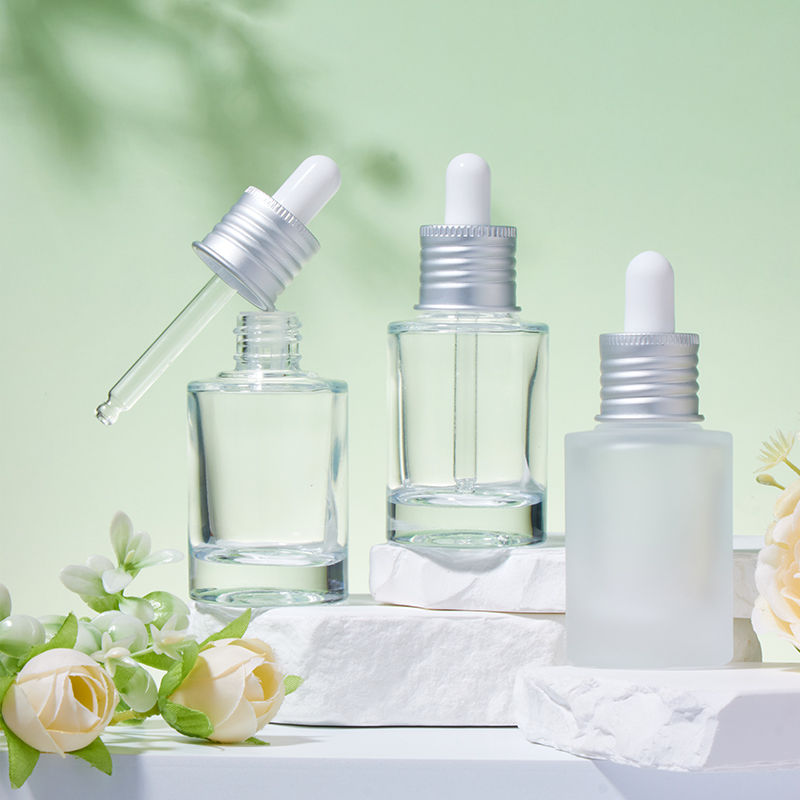
Not every formula needs amber protection. If the product is not light-sensitive and you want the natural color of the liquid to show through, frosted or clear glass dropper bottles offer the same dispensing precision with a brighter presentation. The 30 ml frosted transparent dropper bottle is a popular choice for gel-based and water-based formulas:
 30ml Frosted and Transparent Glass Dropper Bottles with Silver CollarOffered in frosted or clear glass with a 20mm neck and matte aluminum collar, this 30ml dropper bottle suits gel-based and water-based formulas that don't require light protection, while the silicone dropper head enables accurate liquid dispensing.View Product →
For oil formulas that need broad surface contact rather than drop-by-drop precision, such as cuticle oil, lip oil, or roll-on perfume, an amber roll-on bottle is the complementary format to a dropper line. Roll-on closures apply the product by skin contact and eliminate the risk of a glass pipette slipping out of the consumer's hand:
 5ml 10ml 15ml Amber Roll-On Glass Bottles with Steel or Glass BallThese amber roll-on bottles in 5ml, 10ml, and 15ml capacities feature a matte black PP cap and a choice of food-grade 304 stainless steel or high-transmittance glass rolling ball, ideal for oil-based products like cuticle oil, lip oil, or roll-on perfume.View Product →
The key is to resist the urge to force one format onto every product. If the brand's core range includes both a precise-dosing serum and a fast-application cuticle oil, the amber dropper and the amber roll-on can sit side by side with identical design cues and deliver a better user experience than either format alone.
Six Quality Checks to Run Before You Commit to a Supplier
A beautiful amber bottle can still fail on the production line. Run these six checks on samples before placing a bulk order:
- Neck finish fit and cap torque. Thread the supplier's dropper cap onto the bottle and measure the application torque. A common target for a 20 mm dropper cap is 8–12 in·lb. If the cap reaches full engagement without compressing the gasket, or if the threads strip below that torque, the finish is out of tolerance.
- Wall thickness uniformity. Use a glass thickness gauge at six points around the bottle wall and three points on the shoulder. Large deviations, especially thin spots near the neck or heel, predict crack failures during capping and transit.
- Brim volume verification. Fill the bottle to the brim with water and measure the volume. Compare it with the rated capacity on the datasheet. A 30 ml bottle with a true brim volume of only 28 ml will force your filling line to recalibrate or under-deliver.
- Drop factor test. Fit the final dropper assembly, fill with distilled water at 25 °C, and count the drops per milliliter. Repeat on at least ten bottles. If the mean differs from the dropper specification by more than about 10 percent, the pipette bore or bulb geometry is inconsistent.
- Closed-bottle evaporation test. Weigh sealed bottles, store them upside down at 40 °C and 75 percent relative humidity for seven days, and weigh again. A weight loss below 0.5 percent is a commonly used internal pass threshold. Higher loss points to a leaking gasket or loose cap torque.
- Light transmission check. Ask for the spectral transmission curve of the actual glass batch. For true amber cosmetic bottles, transmission in the 350–400 nm band should sit well below 10 percent at standard wall thickness.
These checks do not require a full laboratory. A digital torque meter, a 5 ml graduated pipette, an analytical balance, and a small oven will cover the first five. The transmission curve is usually available from the glass supplier and should be included in the bottle's technical datasheet.
What to Expect When Ordering Custom Amber Dropper Bottles
When you are ready to move from sampling to production, start by requesting a dimensional drawing of the bottle and the dropper cap together. Many packaging factories treat the bottle and the dropper as separate catalog items, but the performance of the final assembly is what matters. Ask specifically for the drawn neck finish dimensions, the pipette length, and the cap torque range.
The order quantity puzzle is real. Most glass factories run one production cycle per size, so a 30 ml amber dropper bottle and a 10 ml amber dropper bottle are two separate jobs. If your brand needs both sizes, negotiate a family MOQ across the two bottle sizes and the shared dropper components. This approach reduces inventory risk while improving line efficiency.
Decoration changes the game. Amber glass is often silk-screened in white, gold, or silver, and the contrast is dramatic. But decoration introduces additional variables: ink adhesion on the cool end of the annealing lehr, alignment on cylindrical bottles, and scratch resistance during transport. Order decorated samples and test them with the same cartons and dividers you intend to use in distribution.
Finally, ask the supplier how they verify long-term seal quality during production. A reliable manufacturer will have a documented in-house leak and torque test procedure. Our own factory testing approach for closures and sealing performance, including the variables that cause slow evaporation in 24/410 closures, is described in detail in our long-term storage and leakage testing explainer. The same discipline applies to dropper assemblies, and you should expect your supplier to speak the same technical language.
Amber Glass Dropper Bottle FAQ
Why do serums and essential oil blends almost always come in amber glass dropper bottles?
Because ultraviolet exposure is the fastest route to oxidation. Amber glass filters nearly all UV-B and UV-C and most UV-A, keeping aromatic compounds and active ingredients stable far longer than clear glass would. The dropper format adds precise dosing and keeps the formula away from fingertips, reducing contamination.
Do amber glass bottles block 100 percent of light?
No. Amber glass blocks the vast majority of ultraviolet light but still transmits some visible light, which is why the bottle looks brown rather than black. Near-infrared and heat still pass through. For maximum protection, store amber bottles in a closed cabinet or secondary carton and avoid direct sunlight.
What is the difference between a 20 mm and a 24 mm dropper bottle?
The neck finish diameter. A 20 mm finish is the industry standard for 10–30 ml dropper bottles and gives a comfortable balance between pipette size and cap ergonomics. A 24 mm finish is used for 30–50 ml bottles, allowing a longer pipette and a larger bulb for faster draw-up. The choice is driven by capacity and dosing frequency, not aesthetics.
How many drops per milliliter will my dropper bottle deliver?
With water-like liquids at room temperature, a standard glass pipette with a 1.5 mm bore delivers approximately 20 drops per milliliter, which equals 0.05 ml per drop. Viscous oils form larger drops and deliver fewer drops per milliliter; alcohol-rich tinctures form smaller drops and deliver more. Always calibrate the dropper with your actual product.
Can amber dropper bottles be reused?
Yes, with careful cleaning. Rinse the bottle immediately after use, wash with warm water and a mild detergent, rinse thoroughly, and air-dry completely before refilling. Avoid harsh solvents and abrasive brushes inside the pipette. Replace the rubber bulb if it becomes sticky or discolored, and check that the pipette tip has not chipped.
Do I need special filling equipment for dropper bottles?
Standard piston or peristaltic fillers work well because the narrow neck restricts splash. The critical setting is the nozzle depth: it must reach below the neck so the liquid does not foam or wet the inner threads. For 5–10 ml bottles, use a nozzle with a smaller diameter and a slower release cycle to avoid overfill.
Selecting an amber glass dropper bottle is straightforward once you separate the surface questions from the structural ones. Start with the neck finish, verify the glass type against your formula's chemistry, then match the dropper assembly to your required drop volume. Use the fill-volume table as a planning baseline, validate with the six quality checks, and choose a supplier willing to share dimensional drawings, test data, and torque specifications.
A well-specified amber dropper bottle is more than packaging; it is a dosage device, a stability tool, and a brand touchpoint. When the finish, glass, and dropper all perform together, your product looks better on the shelf, survives longer in the warehouse, and delivers the same exact dose every time the customer presses the bulb.
Our Products //
Related Product

- E-mail: [email protected]
- Phone: +86-15962399191
- Add: No. 60-7, East Side of Jinzhong Road, Jinfeng Town, Zhangjiagang City, Suzhou City, Jiangsu Province
Copyright © Zhangjiagang Haojie Packaging Technology Co., Ltd. All Rights Reserved.
 China Cosmetic Packaging Manufacturers