

 中文简体
中文简体 Español
 عربى
عربى
How Long Can You Keep Lip Gloss? Full Shelf Life Guide
Industry News-Content
- 1 How Long Can You Keep Lip Gloss? The Direct Answer
- 2 What the PAO Symbol Actually Means for Lip Gloss
- 3 Signs Your Lip Gloss Has Gone Bad
- 4 How Packaging Affects Lip Gloss Shelf Life
- 5 Lip Gloss Shelf Life Comparison by Packaging Type
- 6 How Storage Conditions Change Everything
- 7 Hygiene Habits That Extend Lip Gloss Life
- 8 Ingredient Formulas That Last Longer
- 9 Why Cosmetic Glass Bottles Are the Premium Choice for Lip Gloss Packaging
- 10 What Happens If You Use Expired Lip Gloss
- 11 Practical Tips for Managing Your Lip Gloss Collection
How Long Can You Keep Lip Gloss? The Direct Answer
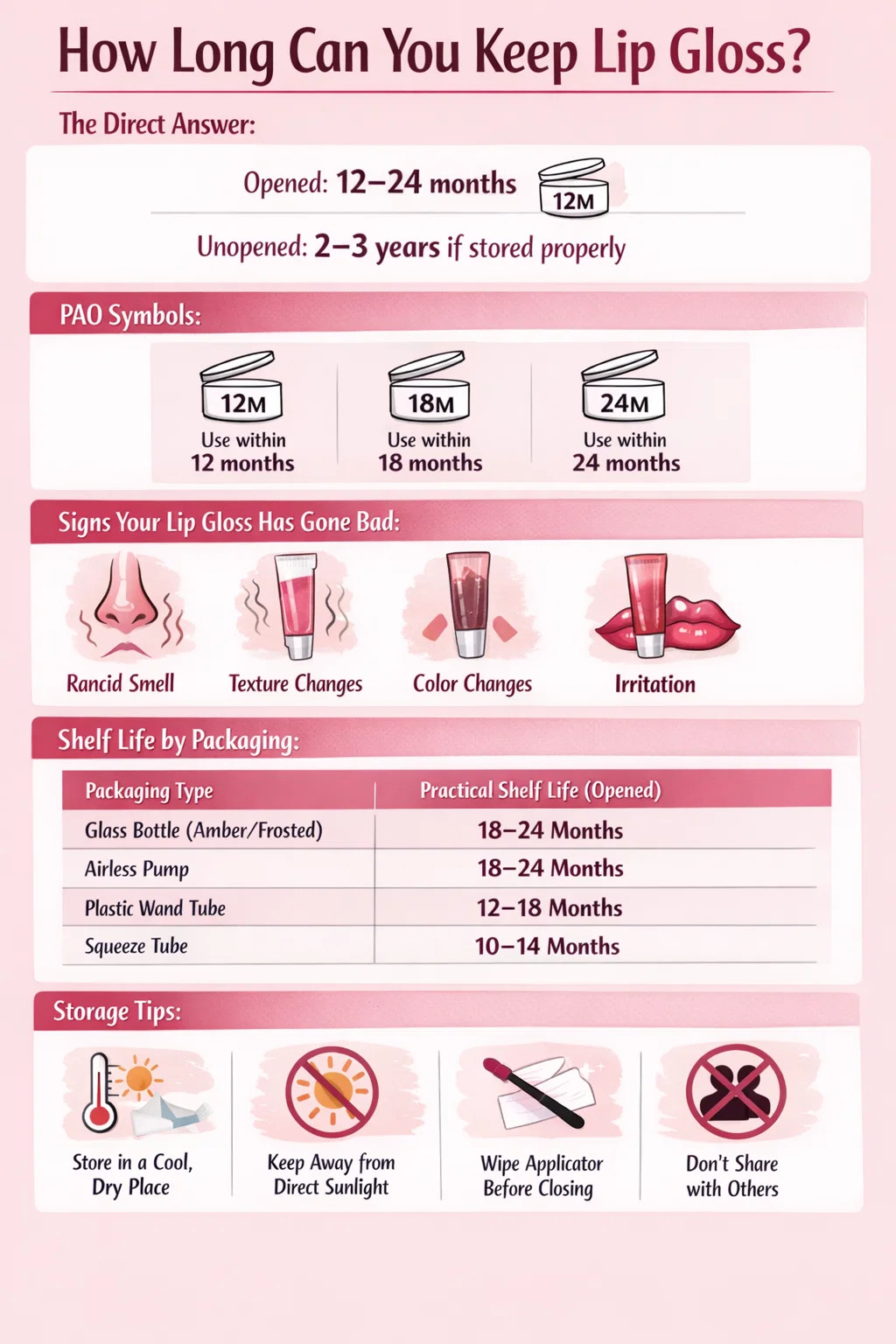
Most lip glosses last between 12 and 24 months after opening, and up to 2 to 3 years if left unopened and stored properly. The moment you uncap the tube or wand and expose the formula to air, light, and bacteria, the clock starts ticking. Some glosses carry a PAO (Period After Opening) symbol — a small open jar icon with a number like "12M" or "18M" — printed on the packaging. That number tells you exactly how many months the product remains safe and effective after first use.
However, that timeline is not fixed. Whether your lip gloss lasts closer to 12 months or stretches toward 24 depends heavily on the packaging it comes in, the preservative system used in the formula, how you store it, and whether you practice hygienic application. A gloss in a cosmetic airless bottle with an airtight seal will almost always outlast one stored in a soft, squeezable plastic tube — and understanding why can save you money and protect your lip health.
What the PAO Symbol Actually Means for Lip Gloss
The Period After Opening symbol is a regulatory standard used across the EU and widely adopted internationally. It is not the same as an expiry date. An expiry date tells you when an unopened product expires. The PAO tells you how long the product stays safe after you first open it.
For lip gloss specifically, the most common PAO ratings are:
- 12M — Use within 12 months of opening. Common in glosses with minimal preservatives, natural formulas, or oil-heavy bases.
- 18M — Use within 18 months. The most common rating across mainstream lip gloss products.
- 24M — Use within 24 months. Typically found in products with strong synthetic preservative systems and well-sealed packaging such as cosmetic glass bottles or airless pumps.
If your lip gloss has no PAO symbol and no expiry date, a conservative general guideline is to replace it after 12 months of use. This is especially important for glosses with applicator wands, which dip directly into the formula and introduce bacteria with every use.
Signs Your Lip Gloss Has Gone Bad
Do not rely solely on dates. Your senses are reliable tools for identifying a spoiled lip gloss. Here is what to watch for:
Smell Changes
A rancid or sour smell is the clearest sign that the oils in your gloss have oxidized. Most lip glosses contain polybutene, castor oil, or vitamin E oil as base ingredients. When these oxidize, the gloss smells noticeably off — sometimes similar to old cooking oil or crayons. If the scent has changed from its original fragrance, discard immediately.
Texture and Consistency Changes
Separation, clumping, or a gummy texture that was not there when the product was new are all signs of formula breakdown. A gloss that once applied smoothly but now drags or pulls at the lips has likely degraded past safe use.
Color Changes
If the gloss has changed color — especially if it has turned darker or developed spots — this can indicate oxidation or microbial contamination. Pigmented glosses are more prone to visible color shifts over time.
Physical Irritation
If applying your lip gloss causes tingling, stinging, swelling, or dryness that was not present before, stop using it. These reactions can result from degraded preservatives failing to prevent bacterial growth, or from oxidized ingredients irritating the lip skin barrier.
How Packaging Affects Lip Gloss Shelf Life
Packaging is one of the most underestimated factors in cosmetic preservation. The container your lip gloss comes in — or the one you choose when buying refillable or artisan products — directly affects how long the formula stays effective. This is why many premium and professional cosmetic brands have shifted toward cosmetic glass bottles for their lip gloss lines.
Cosmetic Glass Bottles vs. Plastic Tubes
Glass is chemically inert. It does not react with the formula inside, does not absorb fragrance compounds, and does not allow oxygen to migrate through the walls over time the way some plastics do. Plastic, particularly low-density polyethylene (LDPE) — the material used in most soft squeeze tubes — is slightly permeable to oxygen and volatile compounds. Over months, this permeability allows micro-oxidation to occur even in a sealed tube.
In practice, this means:
- A lip gloss stored in a cosmetic glass bottle with an airtight wand closure can realistically maintain formula integrity for the full 24-month PAO window.
- The same formula in a soft plastic squeeze tube may begin showing oxidation signs at 12 to 15 months, even if the PAO states 18M.
- Airless pump bottles — whether glass or high-quality plastic — protect formulas from air exposure during dispensing and can further extend effective shelf life.
UV Light Protection in Glass Packaging
Many cosmetic glass bottles designed for lip gloss are made with amber or frosted glass, which blocks ultraviolet light. UV exposure is a significant driver of formula degradation — it breaks down both pigments and oil-based ingredients. A clear plastic tube sitting on a sunny bathroom counter can accelerate gloss degradation by several months compared to the same product stored in UV-blocking glass packaging.
If you purchase a lip gloss in a clear container — glass or plastic — storing it in a drawer or cosmetic bag away from direct light is essential to hitting its stated shelf life.
Wand Applicators and Contamination Risk
The applicator wand is the primary contamination vector in any lip gloss. Each time you dip the wand into the bottle after touching it to your lips, you introduce saliva, bacteria, and cellular debris into the formula. Over time, this cumulative contamination overwhelms even well-formulated preservative systems.
Cosmetic glass bottles with narrow-neck openings and well-fitted wand gaskets minimize the amount of air and contaminants that re-enter the bottle with each dip. Wide-neck jars — regardless of material — are the worst option for applicator-style glosses because they allow the most air exposure and the most surface area contact.
Lip Gloss Shelf Life Comparison by Packaging Type
The table below summarizes how different packaging types affect the practical shelf life of lip gloss formulas under normal storage conditions:
| Packaging Type | Oxygen Barrier | UV Protection | Contamination Risk | Practical Shelf Life (Opened) |
|---|---|---|---|---|
| Cosmetic Glass Bottle (amber/frosted, narrow neck) | Excellent | High | Low | 18–24 months |
| Cosmetic Glass Bottle (clear, wide neck) | Good | Low | Medium | 12–18 months |
| Airless Pump (glass or high-quality plastic) | Excellent | Medium | Very Low | 18–24 months |
| Hard Plastic Wand Tube | Medium | Low–Medium | Medium | 12–18 months |
| Soft LDPE Squeeze Tube | Low | Low | Medium | 10–14 months |
| Open Pot / Wide Jar | Poor | Low | High | 6–12 months |
How Storage Conditions Change Everything
Even the best packaging cannot compensate for poor storage conditions. Temperature, humidity, and light exposure are the three main environmental factors that accelerate lip gloss degradation.
Temperature
Lip gloss should ideally be stored between 15°C and 25°C (59°F to 77°F). Heat accelerates the oxidation of oil-based ingredients and can cause the formula to separate or become runny. Leaving a gloss in a hot car — where interior temperatures can exceed 60°C (140°F) in summer — can degrade the formula within hours and make it unsafe to use. Conversely, extremely cold temperatures can cause thickening or crystallization, though this is typically reversible and does not signal spoilage on its own.
Humidity
Bathrooms are convenient but genuinely bad storage locations for lip gloss. Steam and humidity from showers create an environment that promotes microbial growth and can compromise the seal on wand-style bottles. If you notice condensation inside your gloss tube or bottle, that moisture has entered the formula and significantly shortened its remaining shelf life. A bedroom vanity drawer is consistently cooler, drier, and better lit than a bathroom shelf — making it a superior storage spot.
Light Exposure
UV radiation breaks down both synthetic and natural pigments and degrades the polymers that give lip gloss its characteristic shine. Glosses stored in windowsill displays or clear acrylic organizers in sunny rooms are exposed to direct UV for hours daily. Over weeks, this causes visible color fading and accelerates internal formula degradation. This is one of the reasons that cosmetic glass bottles in amber or violet glass — which filter UV wavelengths — are used by professional and pharmaceutical-grade brands to extend product viability.
Hygiene Habits That Extend Lip Gloss Life
Packaging and storage matter enormously, but how you use your lip gloss day to day is equally important. Small habit changes can meaningfully extend how long a product remains safe and pleasant to use.
- Never apply directly after eating. Food particles and digestive enzymes on the lips transfer to the wand and into the formula on the next dip. Wipe your lips clean before application.
- Do not share lip gloss. Even a single shared application introduces a different person's bacteria, viral particles, and skin cells into the formula. Herpes simplex virus (HSV-1), which causes cold sores, can survive on applicator wands for hours.
- Apply with a clean brush when possible. Using a disposable or cleaned lip brush rather than the wand applicator directly reduces contamination with every use. This is particularly practical for glosses stored in wide-neck cosmetic glass bottles.
- Wipe the wand before re-inserting. After each use, wiping the wand with a clean tissue before reinserting it into the bottle removes some of the surface bacteria and lip residue before they enter the formula.
- Keep the cap tightly closed. Even a few minutes of open-air exposure after each use introduces enough oxygen and environmental bacteria to accumulate meaningfully over months. Make closing the cap tightly an automatic habit.
- Never use a gloss when you have an active lip infection. If you have a cold sore, fever blister, or any lip wound, using your regular gloss will contaminate the entire bottle and require disposal after the infection resolves.
Ingredient Formulas That Last Longer
Not all lip glosses are formulated equally from a preservation standpoint. The base ingredients have a significant impact on how long the product stays stable.
Synthetic Polymer Bases
Glosses built on polybutene or dimethicone bases tend to be more oxidation-resistant than natural oil bases. Polybutene — the most common lip gloss base ingredient in mainstream products — is highly stable and does not go rancid in the way that plant oils do. A standard polybutene-based gloss can realistically maintain safety and texture for the full 18 to 24 months of its PAO, especially when stored in a cosmetic glass bottle or similarly well-sealed container.
Natural and Oil-Heavy Formulas
Lip glosses marketed as "natural," "clean," or "organic" typically use plant-based oil bases such as jojoba oil, rosehip oil, argan oil, or sweet almond oil. These oils are prone to oxidative rancidity — a chemical process driven by oxygen, heat, and light exposure that produces off-smells and potentially irritating byproducts. A natural oil-based lip gloss with no synthetic preservatives should generally be replaced after 6 to 12 months of use, regardless of the stated PAO, particularly if it is stored in anything other than a well-sealed, UV-protective cosmetic glass bottle.
Vitamin E as a Preservative Aid
Many lip gloss formulas include tocopherol (vitamin E) as an antioxidant preservative specifically to slow oxidative rancidity in their oil components. This is an effective strategy, but it is not indefinite — the tocopherol itself gets consumed over time as it neutralizes free radicals. A gloss with vitamin E listed as one of the last ingredients (meaning it appears in a very small concentration) has minimal antioxidant protection and should be treated with the same caution as a formula without it.
Water-Containing Formulas
Any lip gloss that contains water — identifiable as "aqua" or "water" in the ingredient list — requires a robust antimicrobial preservative system to remain safe. Water is the medium in which most bacteria thrive. Water-containing lip gloss formulas without adequate preservation can become unsafe within 3 to 6 months, even under ideal storage conditions. These products are best housed in airless pump packaging or narrow-neck cosmetic glass bottles that minimize each formula's contact with ambient air and contaminants.
Why Cosmetic Glass Bottles Are the Premium Choice for Lip Gloss Packaging
From a purely functional standpoint, glass packaging outperforms plastic in almost every category relevant to cosmetic preservation. But the advantages extend beyond shelf life into sustainability, brand perception, and consumer safety.
No Chemical Leaching
Plastic containers — particularly those made from PVC or polycarbonate — can leach plasticizers and other chemicals into oil-based products over time. Phthalates and bisphenol A (BPA), both commonly found in cosmetic plastic packaging, are endocrine-disrupting compounds that you would then be applying directly to your lips. Cosmetic glass bottles are completely inert and will not transfer any chemicals into your formula under any normal storage condition.
Infinitely Recyclable
Glass can be recycled indefinitely without degradation in quality — unlike plastic, which downgrades in polymer quality with each recycling cycle and ultimately ends up in landfill. For brands and consumers increasingly concerned with packaging sustainability, cosmetic glass bottles represent a genuinely circular packaging solution rather than a "less bad" alternative.
Premium Tactile Experience
The weight and feel of a glass bottle communicates quality in a way that plastic simply cannot replicate. For lip gloss brands positioned in the prestige or luxury segment, cosmetic glass bottles contribute to the perceived value of the product. This is not purely a marketing consideration — it reflects a genuine material investment in packaging that protects the formula more effectively and lasts longer in the hands of the consumer.
Refillable Format Compatibility
The cosmetic industry is moving toward refillable packaging formats, and glass is better suited to this model than plastic. A cosmetic glass bottle designed for lip gloss can be cleaned, sterilized, and refilled far more effectively than a soft plastic tube — which cannot be fully cleaned, tends to absorb fragrance compounds into its walls, and degrades with repeated handling. Several prestige beauty brands have already launched refillable glass lip gloss bottle systems that allow consumers to purchase formula refills while keeping the original packaging.
What Happens If You Use Expired Lip Gloss
Using a lip gloss past its safe-use window is rarely catastrophic, but it carries real risks that are worth understanding clearly.
- Bacterial infection: The most serious risk. The lips and the adjacent mucous membranes of the mouth are highly susceptible to bacterial infection if you introduce a contaminated product. Staphylococcus aureus and Pseudomonas aeruginosa — two bacteria commonly found in expired cosmetics — can cause significant infections requiring medical treatment.
- Allergic reactions: Degraded preservatives and oxidized ingredients become chemically different from their original states. Your immune system may react to these new compounds even if you have never had a reaction to the product before.
- Chapped and dry lips: Rancid oils are irritating to skin. Regular application of a gloss with oxidized oil components can compromise the lip skin barrier and cause chronic dryness and peeling.
- Poor performance: Even setting aside safety, an expired gloss simply will not perform well. Texture degradation, color shifts, and loss of glossy finish mean you are not getting the product you paid for.
The financial argument for replacing lip gloss on schedule is stronger than most people realize. A high-quality lip gloss in a cosmetic glass bottle retails between $20 and $60. The cost of treating a lip infection — including a doctor visit and antibiotic prescription — easily exceeds that figure, quite apart from the discomfort and disruption involved.
Practical Tips for Managing Your Lip Gloss Collection
If you own more than a few lip glosses, keeping track of when each was opened becomes genuinely difficult. A few simple systems make it much more manageable.
- Label with a date sticker. When you open a new lip gloss, write the opening date on a small sticker and place it on the bottom of the bottle. A 12-month or 18-month gloss with a visible start date requires no guesswork.
- Do a quarterly audit. Every three months, go through your lip products and smell, inspect, and feel each one. Discard anything that shows spoilage signs regardless of the date.
- Buy fewer, better glosses. A single high-quality lip gloss in a protective cosmetic glass bottle that you use daily will outlast — in safety and quality — six cheap glosses that sit in a drawer mostly unused for two years.
- Store your daily gloss at room temperature. Do not refrigerate your lip gloss unless the packaging or brand specifically recommends it. Repeated temperature shifts from refrigerator to room temperature cause condensation that introduces moisture into the formula.
- Keep backups sealed. If you buy a backup product before finishing the current one, keep it completely sealed until you start it. An unopened cosmetic glass bottle of lip gloss stored at room temperature away from light can remain safe and effective for 2 to 3 years.
Our Products //
Related Product

- E-mail: [email protected]
- Phone: +86-15962399191
- Add: No. 60-7, East Side of Jinzhong Road, Jinfeng Town, Zhangjiagang City, Suzhou City, Jiangsu Province
Copyright © Zhangjiagang Haojie Packaging Technology Co., Ltd. All Rights Reserved.
 China Cosmetic Packaging Manufacturers
China Cosmetic Packaging Manufacturers