

 中文简体
中文简体 Español
 عربى
عربى
Cosmetic Packaging Trade Shows: What to Know Before You Go
Industry News-Content
- 1 The Bottom Line on Cosmetic Packaging Trade Shows
- 2 Major Cosmetic Packaging Trade Shows Around the World
- 3 What to Look for When Sourcing Cosmetic Glass Bottles at Trade Shows
- 4 How to Prepare for a Cosmetic Packaging Trade Show
- 5 Trends in Cosmetic Glass Bottle Packaging Visible at Trade Shows
- 6 Evaluating Cosmetic Glass Bottle Suppliers Beyond the Trade Show Floor
- 7 Related Packaging Categories Worth Exploring Alongside Cosmetic Glass Bottles
- 8 Making the Most of Your Trade Show Investment
The Bottom Line on Cosmetic Packaging Trade Shows
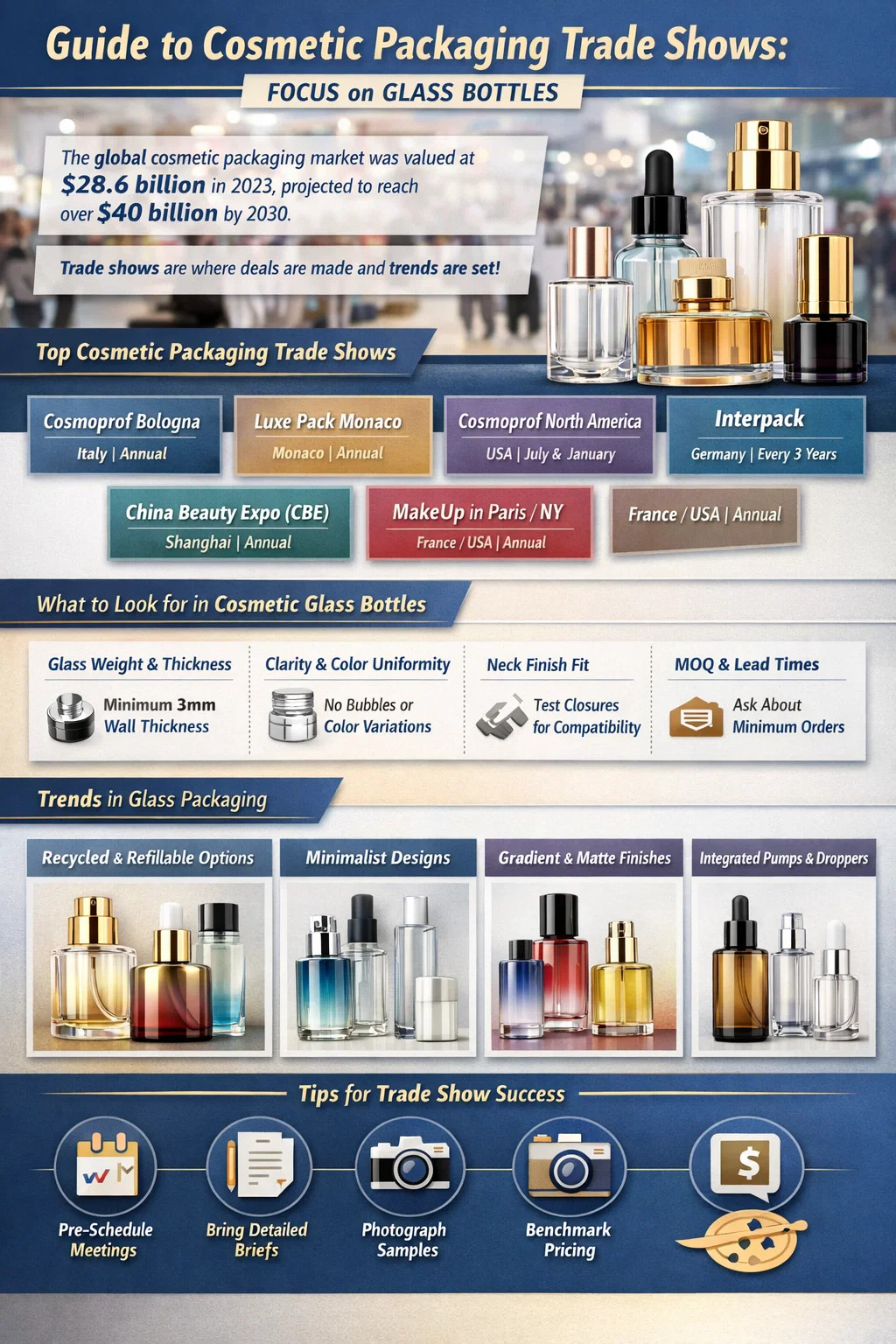
If you are sourcing packaging for cosmetic products — especially premium materials like cosmetic glass bottles — attending the right trade shows is one of the most efficient decisions you can make. In a single venue, you can compare hundreds of suppliers, handle physical samples, negotiate pricing directly, and build relationships that take months to replicate through email outreach. The global cosmetic packaging market was valued at approximately $28.6 billion in 2023 and is projected to reach over $40 billion by 2030, according to Grand View Research. Trade shows are where a significant portion of this market is shaped — deals are made, trends are set, and supplier networks are built.
This article covers the major cosmetic packaging trade shows worth your time, how to approach them strategically, what to look for when sourcing cosmetic glass bottles and related materials, and how to turn a few days on a trade floor into lasting business value.
Major Cosmetic Packaging Trade Shows Around the World
Not every trade show carries equal weight. The events listed below are consistently attended by serious buyers, packaging manufacturers, and material specialists — including major producers of cosmetic glass bottles, dropper bottles, airless pumps, and sustainable alternatives.
Cosmoprof Worldwide Bologna
Held annually in Bologna, Italy, Cosmoprof Worldwide is widely regarded as the single most important event in the global cosmetics and beauty supply chain. The 2023 edition attracted over 250,000 visitors from more than 150 countries, with thousands of exhibitors spanning finished products, raw materials, and packaging. The Cosmopack section is dedicated entirely to packaging, machinery, and components — this is where you will find glass packaging specialists, including manufacturers of high-end cosmetic glass bottles used in serums, perfumes, and luxury skincare lines. Walking Cosmopack alone can take a full day given its scope.
Luxe Pack Monaco
Luxe Pack Monaco is the go-to event for premium and luxury packaging buyers. Held each October in Monaco, it specifically targets the high-end segment of the cosmetic, wine, spirits, and perfume industries. If your brand works with frosted cosmetic glass bottles, custom-molded flacons, or specialty closures, this is the show where those conversations happen at the highest level. The 2023 event featured more than 500 exhibitors and drew around 9,000 visitors. Unlike broader trade fairs, Luxe Pack is focused on craftsmanship, innovation, and sustainability in premium materials — so the dialogue with suppliers tends to be more technically detailed.
Cosmoprof North America (Las Vegas & Miami)
Cosmoprof North America runs two editions — one in Las Vegas each July, and a newer edition in Miami each January. The Las Vegas show is one of the largest beauty industry events in the Western Hemisphere, typically hosting over 36,000 attendees and 1,200+ exhibitors. The packaging hall includes suppliers of cosmetic glass bottles, plastic components, tubes, and folding cartons. For North American brands sourcing domestically or from Asian manufacturers with US distribution, this show reduces a lot of logistical friction — many exhibitors can ship samples directly from US warehouses.
Interpack (Düsseldorf)
Interpack is a broader packaging trade show — not exclusive to cosmetics — but it is one of the largest packaging events on the planet. Held every three years in Düsseldorf, Germany, it attracts over 170,000 visitors and 2,700 exhibitors across food, pharmaceutical, and cosmetic sectors. For cosmetic glass bottle manufacturers, Interpack is significant because it overlaps heavily with pharmaceutical glass packaging — many glass producers serve both industries simultaneously. If you are evaluating glass suppliers from Europe and want to assess production capability and quality standards at scale, Interpack is highly relevant.
China Beauty Expo (CBE Shanghai)
China Beauty Expo, held annually in Shanghai, is one of the most important sourcing events for brands working with Chinese manufacturers — which accounts for a substantial share of the global cosmetic glass bottle supply. With more than 3,000 exhibitors and 400,000 visitors in recent editions, CBE is massive in scale. It covers OEM/ODM manufacturing, raw materials, finished goods, and packaging. For buyers focused on cost-effective glass packaging with relatively short lead times, connecting with Chinese glass factories directly at CBE can dramatically shorten the sourcing cycle.
MakeUp in Paris and MakeUp in New York
These two boutique events by Beauteam focus specifically on makeup formulation and packaging, with a curated selection of suppliers. While smaller than Cosmoprof, MakeUp in Paris and MakeUp in New York are valuable for brands in the color cosmetics space who want highly targeted conversations. Glass packaging — including glass lipstick cases, glass compact mirrors, and decorative glass bottles for serums and foundation — makes regular appearances from European and Asian suppliers.
| Trade Show | Location | Frequency | Best For | Glass Packaging Focus |
|---|---|---|---|---|
| Cosmoprof Bologna | Italy | Annual | Global sourcing, full supply chain | High |
| Luxe Pack Monaco | Monaco | Annual | Luxury & premium packaging | Very High |
| Cosmoprof North America | USA (Las Vegas / Miami) | Annual (2 editions) | North American brands | Moderate–High |
| Interpack Düsseldorf | Germany | Every 3 years | European glass & pharma-grade packaging | High |
| China Beauty Expo | Shanghai, China | Annual | Cost-effective Asian sourcing | High |
| MakeUp in Paris / NY | France / USA | Annual | Color cosmetics packaging | Moderate |
What to Look for When Sourcing Cosmetic Glass Bottles at Trade Shows
Trade shows give you a rare opportunity to evaluate cosmetic glass bottles in person before committing to production runs. Most brands make the mistake of focusing only on aesthetics — how the bottle looks on the table. In practice, the decisions made at a trade show booth should go much deeper.
Glass Weight and Wall Thickness
Pick up any cosmetic glass bottle sample on a trade show floor and pay attention to its weight distribution. Thick-walled glass bottles typically weigh between 80g and 200g for 30ml–50ml sizes. Bottles with uneven wall thickness — detectable by sight or by rolling the bottle gently — are more prone to cracking under thermal stress or pressure during filling. Ask the supplier for their stated wall thickness tolerance. For luxury skincare brands, a minimum wall thickness of 3mm is generally considered the baseline for premium perception.
Glass Clarity and Color Consistency
Hold the sample bottle up to the trade show lighting — fluorescent or LED. In clear glass cosmetic bottles, you should see no streaks, bubbles, or cloudiness. In colored glass (amber, cobalt blue, frosted), check that the color is uniform across the entire bottle and not blotchy near the base or shoulder. Color inconsistencies between batches are a common complaint from buyers who skip this step at trade shows. Ask suppliers to show you multiple samples from different production batches — not just their best display piece.
Neck Finish and Closure Compatibility
One of the most common sourcing problems in cosmetic glass packaging is neck finish incompatibility. The neck finish — the threaded or non-threaded opening at the top of the bottle — must match the cap, pump, or dropper assembly precisely. Standard neck finishes include GPI 18/415, 20/410, 24/410, and 28/410, among others. Always test-fit the closures you plan to use at the trade show booth. If a supplier cannot provide samples with the exact neck finish you need, that is a lead time and custom tooling conversation you need to have before leaving their booth.
MOQ and Lead Times
Minimum order quantities for cosmetic glass bottles vary enormously. Stock (off-the-shelf) glass bottles from Chinese manufacturers often start at 500–1,000 units per SKU, while custom-molded glass bottles from European suppliers typically require 5,000–50,000 units depending on the complexity of the mold. Lead times for custom glass can run from 90 days to 180 days from mold approval to delivery. At trade shows, always ask specifically about stock availability for the items you are considering — many booth displays feature custom showpieces that are not actually available as stock items.
Decoration and Finishing Capabilities
Trade shows are excellent for evaluating the decoration quality on cosmetic glass bottles — screen printing, hot stamping, acid etching, UV coating, and metallic spraying. Ask the supplier to show you finished decorated samples, not just plain glass. Check screen-printed samples for edge bleed, ink adhesion, and color accuracy under different light sources. Hot-stamped foiling on glass should be crisp and free of peeling at the edges. These details are hard to assess from a photograph or factory video — which is exactly why trade shows matter.
How to Prepare for a Cosmetic Packaging Trade Show
Walking into a large cosmetic packaging trade show without preparation is a reliable way to waste both time and budget. The difference between a productive show visit and an overwhelming one usually comes down to the work done in the two weeks before you arrive.
Build a Priority Supplier List in Advance
Most major trade shows publish their full exhibitor list at least four to six weeks before the event opens. Download the list, filter by category (glass packaging, closures, pumps, labels), and build a shortlist of 15–20 suppliers you want to visit. For cosmetic glass bottle sourcing specifically, search for exhibitors tagged under "glass packaging," "primary packaging," or "glass containers." Pre-schedule meetings where possible — many exhibitors at Cosmoprof and Luxe Pack are booked solid by the first afternoon of the show.
Bring a Clear Brief for Each Packaging Category
A packaging brief does not need to be lengthy. For cosmetic glass bottles, it should specify: bottle volume (e.g., 15ml, 30ml, 50ml, 100ml), neck finish type, preferred glass color (clear, amber, frosted), surface decoration requirements, intended filling method (manual, automated), target unit cost, and annual volume. Handing a supplier this brief immediately elevates the conversation from generic to productive. It also signals that you are a serious buyer — which affects the quality of pricing and attention you receive.
Allocate Time Deliberately
At Cosmoprof Bologna, the Cosmopack hall alone can take six to eight hours to cover thoroughly. Budget at least 20–30 minutes per priority supplier — enough time to review samples, discuss specifications, and exchange contacts. Leave buffer time each afternoon to revisit any booth where the initial conversation was promising. Do not try to cover the entire show in a single day; two to three dedicated days at the packaging halls is more productive than a rushed one-day sprint.
Document Everything at the Booth
Photograph every sample you handle, noting the booth number and supplier name. Collect physical spec sheets where available. Write brief notes on each business card — the person's name, what was discussed, any pricing mentioned, and any follow-up items. After two days on a trade floor, the details of 40 supplier conversations will blur together. A simple note-taking system — whether on paper or a phone app — is the difference between actionable follow-ups and vague impressions.
Trends in Cosmetic Glass Bottle Packaging Visible at Trade Shows
Trade shows do not just facilitate sourcing — they function as a real-time snapshot of where the industry is heading. Over the past three to four years, certain trends in cosmetic glass bottle design and material innovation have become consistently prominent across Cosmoprof, Luxe Pack, and related events.
Sustainable and Recycled Glass
Recycled glass content in cosmetic glass bottles has moved from a niche claim to a mainstream expectation among premium brands. At Luxe Pack Monaco 2023, a noticeable share of exhibiting glass manufacturers highlighted bottles made with 30%–70% post-consumer recycled (PCR) glass content. The trade-off is a slight reduction in optical clarity in clear glass (recycled glass tends toward a faint green or gray tint), which some brands are now actively embracing as a visual cue for sustainability. Ask suppliers for documentation of their recycled content — percentage, source, and certification — rather than taking marketing language at face value.
Refillable Glass Packaging Systems
Refillable cosmetic packaging — a system where the outer glass component is retained and the inner cartridge or formula pod is replaced — has gained significant traction at trade shows. Several European packaging manufacturers now offer modular refillable glass bottle systems for skincare and fragrance. The primary cosmetic glass bottle typically features a weighted, decorative outer shell, while the inner component is a lightweight plastic or thin glass cartridge. These systems add complexity to the supply chain but command meaningfully higher retail price points and strengthen brand loyalty.
Minimalist and Architectural Bottle Forms
The design language visible across glass packaging at recent trade shows has shifted decisively toward geometric simplicity — rectangular profiles, flat-sided bottles, squared shoulders, and minimal surface decoration. This reflects both consumer aesthetic preferences and the practical advantage of flat surfaces for printing and labeling. At Cosmoprof Bologna, the contrast with the ornate bottle forms that dominated a decade ago is striking. Clean geometric cosmetic glass bottles also photograph better for e-commerce — an increasingly relevant consideration for direct-to-consumer brands.
Color and Texture Innovation
Beyond the classic clear, amber, and cobalt blue, trade shows have showcased expanding ranges of specialty glass finishes. Opalescent glass, smoke-effect glass, sandblasted matte finishes, and gradient-colored glass bottles have all appeared prominently in recent exhibition halls. These specialty finishes typically carry a premium of 20%–60% over standard clear glass equivalents, but they substantially differentiate product appearance on shelf and in unboxing content. Several Chinese manufacturers have introduced competitive pricing on matte frosted cosmetic glass bottles — a finish previously dominated by European producers.
Integrated Applicator and Pump Innovations
Cosmetic glass bottles are increasingly shown at trade shows as complete systems — bottle, pump, dropper, or applicator — rather than just the glass component in isolation. Airless pump systems fitted to glass bottles (previously uncommon due to technical challenges) have become more widely available. At Cosmoprof North America 2023, several exhibitors showed all-glass dropper bottles with integrated silicone bulbs — eliminating the rubber component traditionally used in dropper assemblies, which appeals to brands pursuing clean or non-reactive packaging claims.
Evaluating Cosmetic Glass Bottle Suppliers Beyond the Trade Show Floor
Meeting a supplier at a trade show is a beginning, not a conclusion. The follow-up process after a trade show determines whether the contact becomes a reliable supply partner or just another business card in a drawer. Here is a structured approach to evaluating cosmetic glass bottle suppliers after initial trade show contact.
Request a Formal Sample Program
Within two weeks of the trade show, follow up with your priority suppliers and request a formal sample program. For cosmetic glass bottles, this means receiving at least three to five samples of each relevant bottle style, ideally from different production batches. Test the samples against your specifications: measure wall thickness with a digital caliper, test the neck finish with your intended closure, evaluate glass clarity under natural and artificial light, and assess the weight in hand. Only suppliers who can deliver consistent, specification-compliant samples deserve further investment of time.
Conduct a Factory Audit or Request a Third-Party Report
For any supplier you are considering for ongoing volume orders, a factory audit is non-negotiable. This can be conducted in person (particularly practical for suppliers in China if you are already traveling for CBE), through a third-party audit firm such as SGS, Bureau Veritas, or Intertek, or via video audit as a preliminary step. Key things to verify include: glass melting and forming equipment capacity, quality control processes, minimum order capabilities, and relevant certifications (ISO 9001, ISO 14001, food-grade or cosmetic-grade glass standards). A supplier who presents well at a trade show but cannot produce documentation or facilitate an audit warrants caution.
Benchmark Pricing Against Multiple Suppliers
Trade shows allow you to collect pricing data from multiple competing suppliers for similar cosmetic glass bottle specifications — which is extremely difficult to replicate through normal outreach. After attending a major show, you should have indicative unit pricing from at least five to ten suppliers for your key bottle SKUs. Use this data to establish a realistic price range before entering formal negotiation with your preferred suppliers. Pricing for a standard 30ml clear glass serum bottle, for example, can range from $0.35 to $1.20 per unit depending on wall thickness, quality grade, order volume, and country of origin — a range that only becomes clear through direct multi-supplier comparison.
Assess Communication and Responsiveness
How quickly a supplier responds to your follow-up after a trade show tells you a great deal about how the relationship will function under production pressure. A supplier who takes more than five business days to respond to a sample request — when you met them in person less than two weeks ago — is giving you information about their operational culture. For time-sensitive product launches, supplier responsiveness is as important as product quality.
Related Packaging Categories Worth Exploring Alongside Cosmetic Glass Bottles
Cosmetic glass bottles rarely exist in isolation within a product line. At most trade shows, the surrounding categories are equally important for building a coherent packaging system.
- Glass dropper bottles: Standard in serums, facial oils, and CBD-infused formulas. Available in amber (UV-protective) or clear glass, in sizes ranging from 5ml to 100ml. Evaluate dropper tip material and dropper draw volume alongside the bottle itself.
- Glass cream jars: Used for thick formulas — balms, eye creams, body butters. Wide-mouth glass jars with metal or acrylic lids are a recurring category at every major packaging show. Pay attention to lid seal quality and whether the inner plug fits the jar diameter correctly.
- Glass perfume bottles: A specialized sub-category with its own design language. Many exhibitors at Luxe Pack Monaco focus exclusively on fragrance glass packaging — flacons, spray bottles, and decorative bottles for niche and luxury perfumery.
- Closures and pumps: The closure system is integral to the cosmetic glass bottle — a poor-fitting pump or leaking cap undermines the entire product. Evaluate closure suppliers alongside glass suppliers to ensure system compatibility.
- Secondary packaging: Boxes, cartons, and cases that house the glass bottle. Several packaging trade shows, including Cosmoprof and Interpack, include strong secondary packaging sections. Matching the quality level of outer carton and glass bottle is important for brand coherence.
- Labels and decoration applicators: Whether you are using pressure-sensitive labels, direct screen printing, or sleeve labels on cosmetic glass bottles, trade shows include label converters and decoration specialists who can advise on the best application method for your glass surface.
Making the Most of Your Trade Show Investment
Attending a major cosmetic packaging trade show is a significant investment — registration fees, travel, accommodation, and two to four days of time. The return on that investment depends almost entirely on the quality of preparation and follow-through, not on the number of booths visited.
The brands and procurement teams that consistently extract the most value from events like Cosmoprof and Luxe Pack share a few common habits: they arrive with specific sourcing objectives (not just general curiosity), they engage suppliers with technical questions rather than vague inquiries, and they complete all follow-up actions within ten business days of returning. Deals initiated at trade shows but not followed up within two weeks close at a fraction of the rate of those where follow-up is prompt — a pattern that anyone who has worked a supplier booth will confirm.
For cosmetic glass bottle sourcing in particular, trade shows compress a three-month supplier evaluation process into three days. No other channel — not Alibaba, not LinkedIn outreach, not virtual trade shows — replicates the combination of physical sample evaluation, direct negotiation, competitive benchmarking, and trend intelligence that a well-attended cosmetic packaging trade show delivers. The cost of attendance, when measured against the value of a single good supplier relationship secured, is almost always justified.
Our Products //
Related Product

- E-mail: [email protected]
- Phone: +86-15962399191
- Add: No. 60-7, East Side of Jinzhong Road, Jinfeng Town, Zhangjiagang City, Suzhou City, Jiangsu Province
Copyright © Zhangjiagang Haojie Packaging Technology Co., Ltd. All Rights Reserved.
 China Cosmetic Packaging Manufacturers
China Cosmetic Packaging Manufacturers