

 中文简体
 Español
 عربى

Fragrance Packaging Guide: Choosing Mist Sprayers, Pumps and Bottles for Leak-Free Filling
Industry News-Content
- 1 What Fragrance Packaging Actually Consists Of
- 2 Neck Finish Sizes Decide Which Pump Fits
- 3 How a Fine Mist Sprayer Actually Works
- 4 Glass Bottle Choices That Protect the Scent
- 5 Caps, Collars and the Finish That Sells
- 6 Pumps and Airless Bottles for the Rest of the Range
- 7 Testing That Prevents Leaks and Complaints
- 8 Sourcing and Lead Time Realities
- 9 Frequently Asked Questions
- 9.1 Which neck finish should a new 50ml perfume bottle use?
- 9.2 How much liquid should one press of a perfume sprayer deliver?
- 9.3 Why does my mist turn coarse in the last few millilitres?
- 9.4 Are plastic pumps good enough for a premium fragrance?
- 9.5 Can one pump work for both alcohol-based and oil-based formulas?
- 9.6 What does refillable packaging change in the specification?
- 9.7 How many samples should be tested before a full production run?
- 9.8 How early should a packaging supplier be involved in product development?
A 50ml eau de parfum ran through a filling line without a single reject. Six weeks later, 460 of the 12,000 bottles on that pallet came back from a European distributor with damp labels, stained cartons and a complaint that had nothing to do with the juice. The investigation found two numbers: the glass neck finished at 15.32mm after annealing, while the crimp collar in the bill of materials had been validated at 15.15mm. The pump still snapped into place and the line still ran at full speed. It simply never sealed.
That single failure explains why fragrance packaging is not a design exercise first and a purchasing exercise second. It is a dimensional exercise. The neck finish decides which pump can be fitted, the pump decides the spray character, and the bottle decides how the formula ages over twelve months. Colour, cap weight and metallic finish decide whether a shopper picks up the box, but they only matter after those first three are correct.
What follows is the order in which the decisions should actually be made, the tolerances that cause the most returns, the tests that catch problems before a container leaves port, and the sourcing questions that come up most often from brands, filling plants and OEM teams.
What Fragrance Packaging Actually Consists Of
A finished perfume pack is not one product. It is a stack of eight parts that must agree with each other within fractions of a millimetre. When a brand changes only one of them, the other seven usually need checking.
- The container, whether glass, plastic or aluminium, ranging from a 2ml sample vial to a 100ml flacon.
- The neck finish, the threaded or crimp-ready opening, always written as a diameter plus a style code.
- The collar or ferrule, the metal or plastic ring that locks the pump onto the bottle.
- The pump engine, made up of spring, piston, gasket and metering chamber.
- The actuator or spray head, which forms the orifice and shapes the mist.
- The dip tube, the thin straw that pulls liquid from the base of the bottle.
- The insert, a small cup or restrictor sitting between pump and bottle mouth.
- The overcap, which is often where most of the perceived brand value is concentrated.
The code system is simpler than it looks. A 13/415 neck measures 13mm across and takes a 415 style collar, which in practice is a crimp-ready metal ferrule used on small purse sprays. A 24/410 neck measures 24mm and carries a standard 410 screw thread, so the pump screws on rather than being crimped. The first number is compatibility, the second is assembly method. Reading a bottle spec sheet without understanding both is how mismatched components end up on a purchase order.
Refillable formats deserve attention at this stage rather than later, because reuse changes the whole specification. A refillable glass perfume spray bottle has to survive repeated opening and closing without the collar losing grip, and the pump has to keep its output after the bottle has been washed and refilled several times.
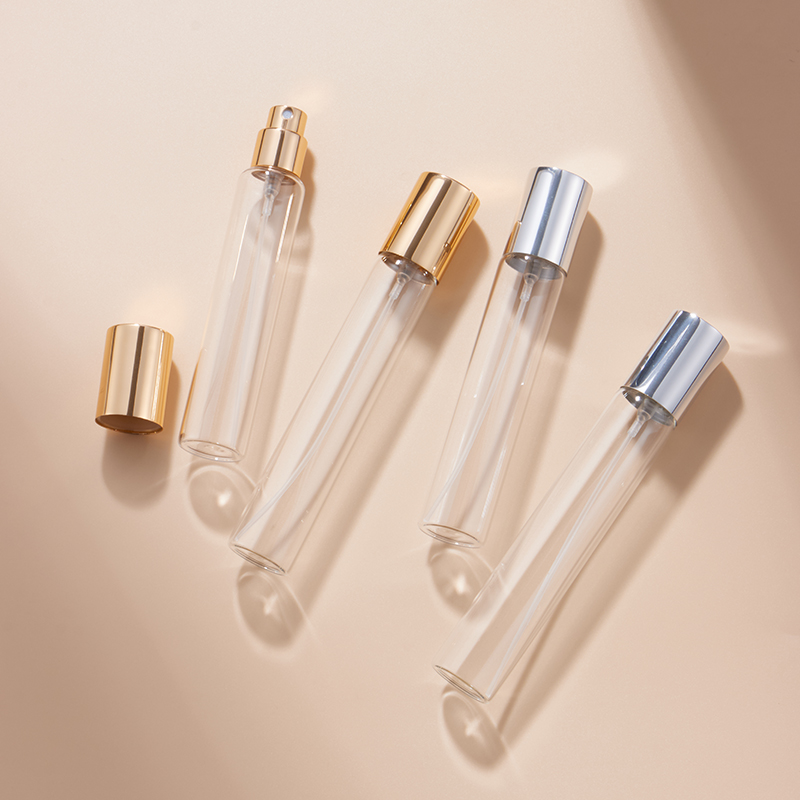
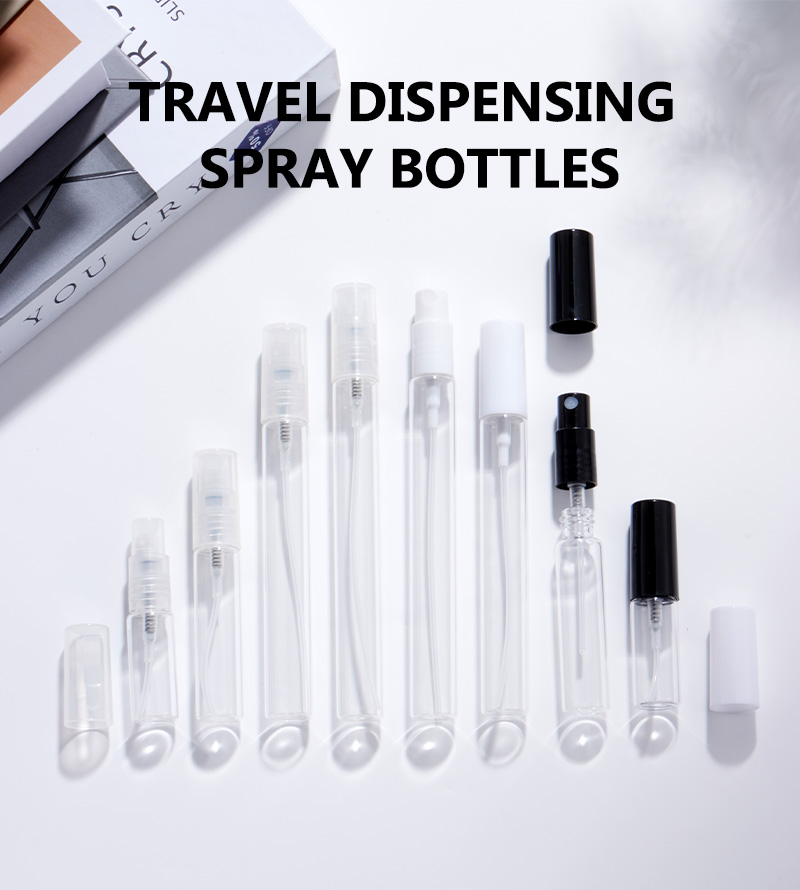 3ml 5ml 10ml 12ml Refillable Glass Perfume Spray BottleThis 3ml, 5ml, 10ml, 12ml refillable glass perfume spray bottle, with multiple sizes and a plastic cap, accepts customization, which is an ideal packaging solution, su...View Product →
Neck Finish Sizes Decide Which Pump Fits
Start here, not with the bottle shape. A pump supplier can offer twelve diameter options for the same spray character, and the only one that matters is the one your glass can accept. Crimp finishes generally give a tighter, more tamper-resistant joint. Screw finishes are faster to fill, easier to refill and simpler to swap during sampling.
| Neck finish | Typical assembly | Common formats | Output per actuation | Most frequent failure |
|---|---|---|---|---|
| 10mm crimp | Mini metal mist sprayer | 2ml to 5ml vials | 0.045 to 0.07ml | Crimp pressure crushing the gasket |
| 11/410 | Mini plastic mist pump, screw | 3ml to 10ml travel sprays | 0.06 to 0.09ml | Thread slip when over-torqued |
| 13/415 | Crimp sprayer, metal or plastic | 5ml to 15ml purse sprays | 0.07 to 0.10ml | Neck height variance across glass lots |
| 15/415 | Crimp pump, aluminium or plastic | 15ml to 30ml flacons | 0.08 to 0.11ml | Short dip tube, sputtering near empty |
| 18/415 | Crimp or screw mist pump | 30ml to 50ml mainstream | 0.09 to 0.12ml | Orifice too wide for high-alcohol juice |
| 20/410 | Screw mist sprayer or lotion pump | 50ml to 75ml | 0.10 to 0.13ml | Cross-threading during high-speed capping |
| 24/410 | Screw mist sprayer or lotion pump | 75ml to 100ml | 0.10 to 0.14ml | Gasket compression loss in long storage |
| 28/410 | Large mist sprayer, lotion pump | 100ml and above, hair mists | 0.12 to 0.16ml | Panel denting on thin-wall glass |
Two tolerances cause more returns than any other pair in this table. Neck diameter on moulded glass typically runs within plus or minus 0.15mm, and neck height within plus or minus 0.20mm. When a brand sources pumps and bottles from different suppliers without exchanging measurement data, those two windows can sit on opposite sides of the target. The interface specification should always be agreed in writing before tooling starts, and it should always name the gauge, not just the nominal size.
Buyers who want the deeper compatibility case, including how a standard 13/410 interface behaves when it meets other neck types, can read this breakdown of 13/410 interface compatibility across neck types.
How a Fine Mist Sprayer Actually Works
A mist pump is a metering device, not a trigger. Pressing the actuator compresses a spring inside the chamber, pressurises the liquid behind a one-way ball or disc valve, and forces it through a tiny orifice where it breaks into droplets. The character of that mist comes down to four variables that a buyer can specify individually.
- Output per stroke. Most fragrance pumps deliver between 0.045ml and 0.14ml per full press. Output is fixed by chamber volume, so changing it means changing the pump, not the setting on a machine.
- Orifice diameter. Typical values sit between 0.06mm and 0.12mm. Smaller orifices give a finer, dryer mist but demand a cleaner formula and better filtration.
- Dip tube bore. A 1.0mm to 2.0mm internal bore feeds the chamber fast enough to avoid cavitation on a quick second press. A tube that is too narrow produces a weak second and third stroke.
- Spring and gasket material. Standard stainless springs handle alcohol-based juices, while the gasket compound determines how much the formula swells or shrinks the seal over months of storage.
Ethanol content changes the picture more than most spec sheets admit. A typical eau de parfum runs 60 to 80 percent alcohol by weight, which evaporates quickly and lowers viscosity. A pump validated on a water-based body mist will often produce a coarser, faster-collapsing cone on that same perfume. That is why every fragrance pump trial should be run with the actual filled formula, at the actual fill volume, at the actual storage temperature.
Nozzle geometry matters just as much as the pump chamber, and the effect of nozzle design on spray effect is worth reviewing before you lock an actuator shape for a launch.
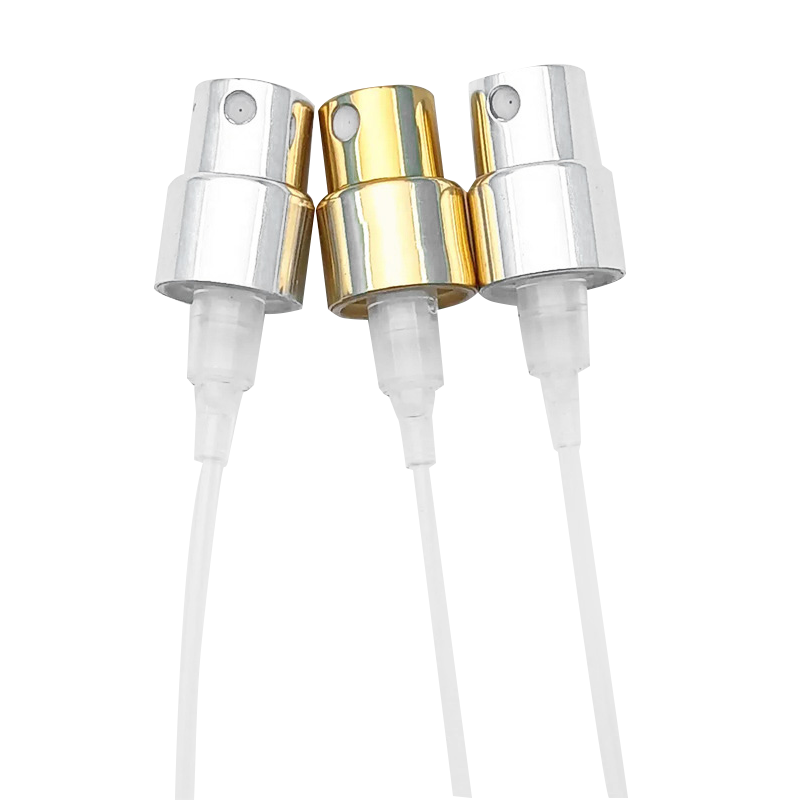 10mm Small Bottle Mini Metal Mist Sprayer CrimpThe metal material is made of, making the sprayer more robust and durable, but it also has a certain aesthetic, metal material helps to maintain the shape and structur...View Product →
Glass Bottle Choices That Protect the Scent
Glass is chemically inert and does not absorb fragrance oils, which is why it still dominates the category despite costing more than plastic. Where brands go wrong is treating glass as a visual decision only. Three physical properties carry most of the weight.
Wall thickness and base weight
A thick-bottomed 50ml flacon signals value on the shelf, but extra base weight adds freight cost and can slow the annealing curve after moulding. Wall thickness usually sits between 1.5mm and 2.5mm on standard cosmetic glass. Anything under 1.2mm should be checked for panel deformation before it is approved for a large run.
Surface treatment and light exposure
Frosting, sandblasting and gradient coating all change how much light reaches the formula. Clear glass shows oxidation and colour drift sooner, which is a visible quality issue even when the scent is unchanged. Amber and darker coatings slow that process. For citrus-heavy compositions, which oxidise faster than heavy orientals, a coloured or frosted body is often a technical choice rather than a decorative one.
Capacity from 2ml to 100ml
Sample and travel formats start at 2ml and 2.5ml, then move through 3ml, 5ml, 8ml, 10ml and 12ml purse sizes. Mainstream retail formats cluster at 30ml, 50ml and 100ml. Neck geometry usually changes with volume: mini vials favour crimp necks, while larger flacons commonly use 15/415, 18/415 or 20/410 openings that accept screw pumps for easier refilling.
Caps, Collars and the Finish That Sells
Once the neck and pump are settled, the visible metal becomes a cost and quality conversation. Anodised aluminium collars and actuators are the default premium option because the oxide layer is part of the metal rather than a coating that can flake. A typical anodised layer measures 8 to 15 microns. Below 6 microns, colour looks patchy and wear marks appear quickly at the collar edge.
- Matte and satin finishes hide fingerprints better and photograph more consistently than high gloss.
- Gold and rose gold tones are achieved through dyeing during anodising, so the colour sits inside the oxide layer.
- Full-plastic actuators are lighter, lower cost and easier to recycle as a single material stream.
- Wood and bamboo overcaps add tactile value but are less dimensionally stable, so clearance to the collar should be re-checked after humidity changes in transit.
- Full-cap designs cover the entire pump, which improves tamper evidence and reduces accidental actuation in a carton.
A practical check: with the cap removed, press the actuator twenty times in a row and then look at the collar for play. If the collar moves relative to the glass, either the crimp dimension is loose or the neck height is out of window. This two-minute test catches most interface problems before a laboratory is involved.
Pumps and Airless Bottles for the Rest of the Range
Most fragrance houses now sell more than a spray. Hair mists, body oils, hand creams, beard oils and travel sets all need the same visual language with different dispensing mechanics, and the mechanical part is where consistency is won or lost.
Lotion and cream pumps are available from 12mm up to 28mm and control output through a metering chamber the same way a mist pump does, but with a nozzle designed for a ribbon or dollop rather than a cloud. Output for a 15mm cream pump commonly lands near 0.20ml per stroke, while a 24mm or 28mm version may deliver 0.5ml or more. Viscosity is the deciding variable: a pump validated on a thin lotion may stall on a thick balm, and a pump sized for a cream will deliver an inconsistent, fast squirt on a watery serum.
Airless bottles take a different approach. Instead of a dip tube, a piston rises from below as product is dispensed, so the formula stays in contact with almost no air. This matters for vitamin C serums, retinoid blends and any oil rich in unsaturated fatty acids, where oxygen contact drives discolouration and rancidity. Airtight designs also allow very high evacuation, which is why airless packaging literature routinely cites usable-product rates well above those of a conventional dip tube pack. Common format sizes run from 5ml and 10ml travel units up to 30ml, with 18mm and 25mm neck families covering most of the range.
One neat option for hybrid lines is a single 18mm component that accepts both a toner spray and a lotion pump, so a brand can run a 10ml mist and a 15ml serum on the same neck and the same bottle mould.
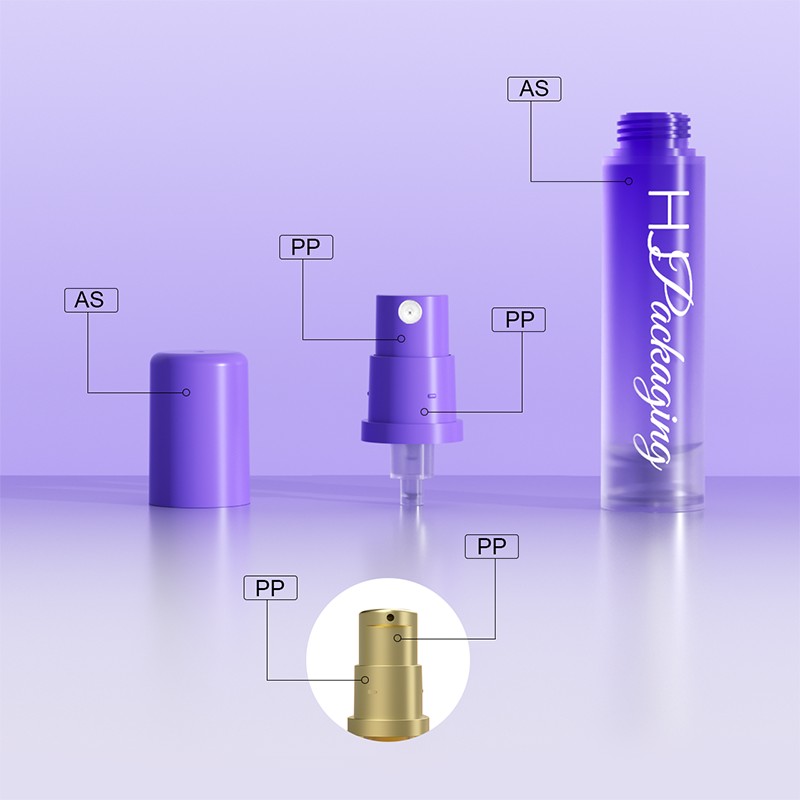 18mm 5ml 10ml 12ml 15ml Airless Bottle with Toner Spray Lotion PumpThe 5ml, 10ml, 12ml and 15ml airless bottle with a diameter of 18mm, are made of AS and PP material. The screw on design makes it easy to refill new skin care products...View Product →
Testing That Prevents Leaks and Complaints
Fragrance packaging failures are rarely dramatic. They appear as a damp carton in a warehouse, a sticky collar in a retail tester, or a mist that weakens over the last five millilitres. All three are predictable with a qualification protocol run before mass production, not after.
| Test | Method | Acceptance target |
|---|---|---|
| Inverted leak | 24 hours upside down at 50 degrees Celsius | No visible trace on blotting paper |
| Vacuum seal | Minus 0.05MPa held for 60 seconds | No continuous bubble stream at the collar |
| Actuation force | Compression test at 20 degrees Celsius | 25 to 40 newtons on a 15mm crimp pump |
| Output consistency | 30 consecutive strokes, each weighed | Within plus or minus 8 percent of the mean |
| Stroke recovery | Timed return after full press | Under 1.5 seconds at 20 degrees Celsius |
| Drop test | 1.2m onto steel, six orientations | No leakage, no collar separation |
| Formula compatibility | 4 weeks at 40 degrees Celsius, 75 percent humidity | No swelling, discolouration or output drift |
| Thermal cycling | Minus 10 to 50 degrees Celsius, three cycles | No cracking, no change in mist pattern |
Run the sequence in this order and problems surface early, when they are still cheap to fix:
- Measure neck dimensions on at least 30 glass samples from three different mould cavities.
- Fit pumps to those samples and record crimp or torque values.
- Fill with the real formula at the real fill volume, not with water.
- Run leak, output and recovery tests on day one and again after the storage period.
- Pack a full shipper and drop it, because a carton changes how energy reaches the collar.
Sourcing and Lead Time Realities
Once the specification is agreed, the commercial questions decide whether a launch date holds. A few figures come up repeatedly in fragrance packaging projects.
- New mould tooling for a custom pump or cap typically runs 15 to 25 working days after drawing approval.
- Standard moulds in a supplier catalogue are usually available as samples within 5 to 7 working days.
- Bulk production after sample approval generally runs 20 to 30 working days, longer for custom colour matching.
- Colour difference between production lots should be controlled to a delta E of 1.5 or less for a repeat order to look identical.
- Minimum order quantities are usually set per component, so a mixed order of crimp and screw pumps may be quoted on the highest single-run requirement.
Sea freight adds its own risks. A container crossing the equator can see internal temperatures high enough to soften low-grade gaskets and to push alcohol vapour past an already tight seal. Cartons should be lined, desiccant used where humidity is high, and the qualification sample should ideally travel the same route at least once before a full season is committed. Brands that test only in an air-conditioned lab often discover this on the first commercial shipment.
It also helps to keep the number of neck finishes in a portfolio small. Every distinct neck size means a separate pump, a separate overcap and a separate set of qualification tests. A range built on three neck families rather than eight can cut tooling cost, reduce spare stock and shorten every future development cycle.
Frequently Asked Questions
Which neck finish should a new 50ml perfume bottle use?
For a mainstream 50ml flacon, 15/415 and 18/415 are the two most practical choices. The 15/415 crimp gives a tighter joint and a smaller collar profile, which suits a clean, minimal design. The 18/415 accepts both crimp and screw pumps, so it is friendlier if you plan refillable versions or expect to change pump suppliers later. Decide based on assembly method first, then on collar diameter, and confirm the glass neck height with the pump maker before tooling is cut.
How much liquid should one press of a perfume sprayer deliver?
Typical fine mist pumps deliver between 0.07ml and 0.12ml per full stroke. A 50ml bottle therefore yields roughly 400 to 700 presses, which is a useful way to sanity-check whether the output feels generous or mean during a consumer panel. Consistency matters more than the absolute number: variation of more than 8 percent across a 30-stroke test usually points to a chamber or gasket problem rather than a formula problem.
Why does my mist turn coarse in the last few millilitres?
Almost always a dip tube length or bore issue. If the tube stops short of the bottle base, the pump draws air along with liquid and the mist becomes a sputter. A tube that touches the base can also seal against the glass and starve the pump. The usual rule is a 0.5mm to 1.0mm clearance from the internal base, with the tube cut at an angle so it cannot fully occlude. Tube bore should match the chamber, since a narrow tube cannot refill fast enough for a quick second press.
They can be, and the performance gap has narrowed considerably. Full-plastic actuators reduce component weight, simplify recycling and remove the risk of metal surface wear. What consumers notice is the feel of the press, the weight of the cap and the fineness of the mist, none of which depend on metal. Aluminium still wins on perceived luxury and on colour depth, particularly for matte and anodised gold finishes, so many brands use an aluminium collar with a plastic actuator to balance both.
Can one pump work for both alcohol-based and oil-based formulas?
Rarely without changes. Alcohol is thin and evaporates quickly, so it needs a tighter seal and often a slightly smaller orifice. Oil is viscous and needs a larger bore and a chamber that refills more slowly. Gasket compounds also behave differently: the elastomer that resists ethanol swelling may soften in a heavy oil blend. A pump qualified on an alcohol juice should be re-tested for at least four weeks at 40 degrees Celsius before it is used with an oil blend.
What does refillable packaging change in the specification?
Three things. The collar must tolerate repeated removal and re-fitting without losing grip, so crimped designs are usually replaced by screw or bayonet closures. The pump must keep its output after the bottle has been cleaned, which means gaskets need to survive contact with water and mild detergent. And the glass must be thick enough to handle washing and reuse, typically above 1.5mm wall thickness, with a neck that stays inside tolerance across many cycles.
How many samples should be tested before a full production run?
A workable minimum is 30 filled units taken from at least three different component lots. That is enough to catch dimensional drift on glass necks, output variation between pump batches and any early signs of formula incompatibility. For a launch with a strict leak requirement, 60 to 100 units gives more confidence and costs relatively little compared with the freight and reputation cost of a recall. Every unit tested should be traceable to its bottle lot and pump lot number.
How early should a packaging supplier be involved in product development?
Before the bottle drawing is approved, ideally. Neck finish, pump output, dip tube length and cap clearance are all fixed at the drawing stage, and each one constrains the others. Bringing a supplier in at the concept stage usually costs nothing extra and often saves a tooling revision, which is where both time and money disappear fastest in a fragrance project.
Fragrance packaging rewards discipline more than creativity. Get the neck finish right, match the pump to the formula rather than the marketing brief, qualify the pack with real juice at real temperatures, and the decorative decisions become simple. Skip those steps and the most beautiful flacon on the shelf becomes the one that leaks in a warehouse in Hamburg.
If you want to compare the numbers in this article against real components, browse our mist sprayer and glass bottle range and check the neck families, output ranges and available finishes against your own specification sheet. The right time to do that is before the mould is cut.
Our Products //
Related Product

- E-mail: [email protected]
- Phone: +86-15962399191
- Add: No. 60-7, East Side of Jinzhong Road, Jinfeng Town, Zhangjiagang City, Suzhou City, Jiangsu Province
Copyright © Zhangjiagang Haojie Packaging Technology Co., Ltd. All Rights Reserved.
 China Cosmetic Packaging Manufacturers