

 中文简体
 Español
 عربى

Dropper-Dispensed Skin Care Packaging: A Practical Guide to Glass Pipette Bottles
Industry News-Content
- 1 The Three Variables That Decide Whether a Dropper Package Works
- 2 Start With the Neck Finish, Not the Bottle Shape
- 3 Drop Volume, Viscosity and the Numbers Buyers Should Ask For
- 4 Glass Body Choices: Amber, Clear, Frosted and Gradient
- 5 Frosted Finishes and How They Age on a Vanity Shelf
- 6 Gradient Colour, Light Protection and the Clear Window Trick
- 7 What a Filling Line Needs From a Dropper Assembly
- 8 Leak, Evaporation and Shelf-Life Checks Worth Running
- 9 Refill, Travel and Small-Format Dropper Trends
- 10 Bringing a Dropper Pack to Production: A Realistic Brief
- 11 Frequently Asked Questions
- 11.1 Does a 30 mL serum bottle always use a 20/410 neck?
- 11.2 Why does my dropper deliver smaller drops when the bottle is nearly empty?
- 11.3 Can the same dropper work for both a serum and a facial oil?
- 11.4 How many drops should a 30 mL bottle deliver?
- 11.5 What is the most common cause of dropper bottle leakage in transit?
A customer lifts a 30 mL serum bottle out of its carton, tilts it, and waits. Three drops fall in roughly a second and a half. That small moment is the entire promise of dropper-dispensed skin care: a dose the user controls, delivered by a piece of glass and a rubber bulb that cost a few cents. When it fails, it fails in very specific ways. The fourth drop lands on the bathroom counter. The pipette tip keeps dripping between uses. The collar sweats a thin ring of oil onto the label after two months in a warehouse.
Here is the conclusion before the explanation: in dropper-dispensed skin care, the dropper is a dosing system and the bottle is only its housing. Lock down the neck finish and the pipette first, then choose the glass. Teams that work in the opposite order, falling in love with a bottle shape before checking the collar, are the ones who pay for new molds in the second year of production.
What follows is the working checklist behind that conclusion: the neck finishes that actually exist on the market, how drop volume drifts with viscosity, how amber and frosted glass behave differently in storage, what a filling line needs from a dropper assembly, and the tests worth running before anyone commits to a 50,000-unit order.
The Three Variables That Decide Whether a Dropper Package Works
Strip away decoration and a dropper bottle is three mechanical interfaces stacked on top of each other. Each one can be changed independently, and each one quietly changes the user's experience.
- The neck finish. A 18/415, 20/410 or 24/410 finish sets the collar diameter, the thread pitch and how much glass the collar has to grip. Two millimeters of difference is the gap between a leak-free seal and a shoulder crack at the capping station.
- The pipette geometry. Tip orifice diameter, taper angle and stem length decide drop size and determine whether the tip still reaches the last 3 mL of product.
- The bulb and collar interface. This pair controls how much air returns to the bottle after each squeeze, and therefore how fast an antioxidant serum oxidizes between uses.
The arithmetic explains why small differences matter. A serum used twice daily means roughly 730 drops a year. If a pipette change moves the drop from 0.045 mL to 0.055 mL, the user consumes about 7 mL more per year, or nearly a quarter of a 30 mL bottle. That is the difference between a product that lasts three months and one that lasts just under four, and it shows up in repeat-purchase data long before it shows up in a complaint.
Start With the Neck Finish, Not the Bottle Shape
Neck finishes in skin care glassware are standardised enough that tooling already exists, but the range is narrower than most buyers expect. In practice, four finishes cover the overwhelming majority of dropper-dispensed products on shelves today.
| Neck finish | Common bottle sizes | Dropper collar | Typical drop volume, aqueous serum | Best fit |
|---|---|---|---|---|
| 13/415 | 5 to 10 mL | Mini collar, short stem | 0.035 to 0.045 mL | Sampling size, eye-area concentrate |
| 18/415 | 10 to 20 mL | Slim collar, 65 to 70 mm stem | 0.045 to 0.050 mL | Spot treatments, retinol, blemish serum |
| 20/410 | 30 mL | Standard collar | 0.048 to 0.055 mL | Vitamin C, niacinamide, hyaluronic serum |
| 24/410 | 50 to 100 mL | Wide collar, long stem | 0.055 to 0.065 mL | Face and body oil, scalp serum, beard oil |
A practical warning that comes up in nearly every project review: an 18/415 collar will not seat on a 20/410 neck, and forcing it produces one of two outcomes. Either the collar threads bind and the filling line stalls, or the collar torques down far enough to stress the shoulder, which later fails under vacuum during shipping. If a brand wants one collar to serve two bottle sizes, that has to be a design decision made at the drawing stage, not a purchasing shortcut.
Drop Volume, Viscosity and the Numbers Buyers Should Ask For
Drop volume is not a fixed property of a pipette. It is the result of tip orifice diameter, the liquid's surface tension and viscosity, and the pressure curve the user applies to the bulb. The long-standing convention in pharmacopoeia tables is 20 drops per milliliter for water-like liquids, which works out at 0.05 mL per drop. That figure is a reference point, not a specification for your serum.
Viscosity moves the number in a predictable direction. A watery niacinamide serum in the 1,000 to 3,000 cP band will sit close to 0.05 mL per drop. A thicker retinol emulsion around 8,000 cP typically pushes past 0.06 mL because the liquid resists breaking away from the tip. A dry facial oil at 50 to 100 cP usually falls faster and slightly smaller, around 0.04 mL, which surprises teams who assume oil equals heavy. Pipette tip orifices in skin care glassware generally land between 1.2 mm and 1.8 mm internal diameter; each 0.1 mm of extra orifice is worth roughly 0.003 to 0.005 mL of drop volume in a water-based formula.
Droppers are not the only way to dose a serum, and it is worth understanding the alternative before committing. A pump-driven package delivers a mechanically fixed dose, usually 0.2 mL per full stroke, which is about four drops. You can read more on whether a pump can dose serum just as precisely as a dropper when your formula needs repeatability rather than user control.
A drop-volume test you can run in an afternoon
- Fill the assembled unit with the actual production formula, not water, to 80 percent of nominal capacity.
- Condition the samples at 20 to 25 degrees Celsius for at least two hours before testing.
- Weigh 20 drops on a balance readable to 0.001 g, then divide by 20.
- Repeat five times across five units and calculate the coefficient of variation. Under 5 percent is a healthy target for a glass pipette.
- Repeat the whole sequence with the bottle half empty, because tip immersion depth changes the pressure balance and, in some designs, the drop size as well.
Glass Body Choices: Amber, Clear, Frosted and Gradient
Once the neck finish is fixed, glass selection becomes a question of light management and shelf presence. The three options behave differently enough that the choice should follow the formula rather than the mood board.
Amber glass
Amber is the default for photosensitive actives because the iron oxide in the batch absorbs short-wavelength light, including most ultraviolet, while still letting the user judge the fill level. For vitamin C, retinoid or essential-oil blends, amber is usually the low-risk answer. The trade-off is honest and simple: you lose the colour of the formula as a visual asset, and pale yellow serums turn muddy behind amber walls.
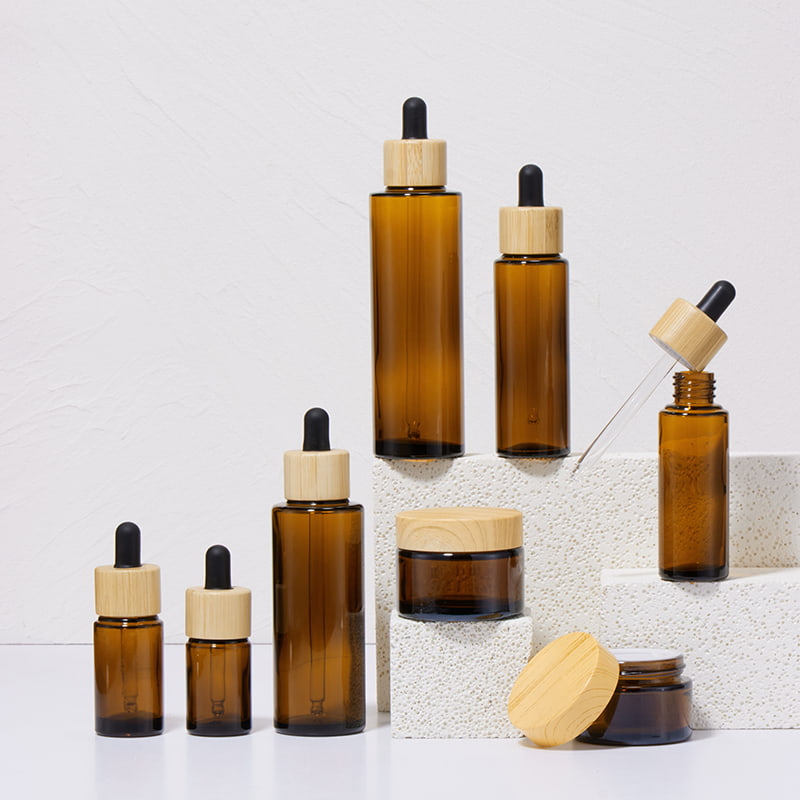
 20mm Amber Glass Dropper Bottle Collection With Bamboo CircleThis amber glass collection is made of high-borosilicate glass, available in various volumes 15ml 20ml 30ml 50ml 80ml 100ml 30g 50g. With 20mm neck size and bamboo mat...View Product →
Clear glass
Clear glass shows the product exactly as the formulator designed it, which matters for gels, micellar concentrates and tinted oils. It offers almost no barrier to visible light, so it suits formulas with robust preservative systems and short in-use windows, or those packed in an outer carton that stays closed between uses.
Frosted and etched glass
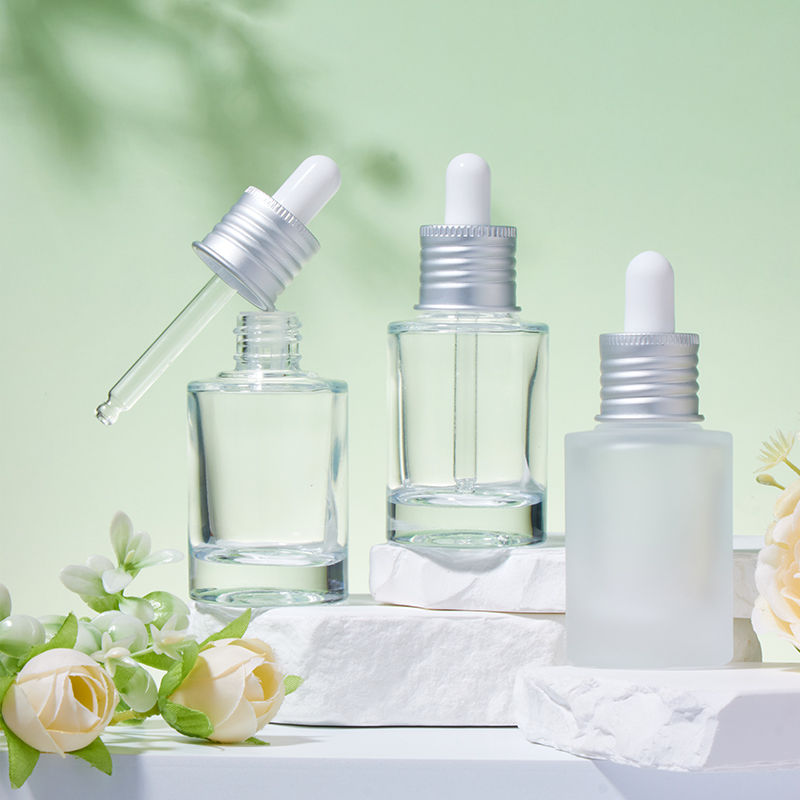
A frosted exterior scatters light and gives a soft, matte touch that photographs well and hides fingerprints. Frosting is a surface treatment, not a light barrier, so it does not replace amber for sensitive actives. Frosting the inside is rarer and generally a mistake: it hides the fill level and traps residue that makes the bottle look used even when it is new.
Frosted Finishes and How They Age on a Vanity Shelf
Frosted dropper bottles are the workhorse of mid-market serums, and they hold up well when the etching is done properly. The failure mode to watch for is uneven frost density between production lots, which is visible the moment two units sit side by side on a shelf. Ask for a frost density range and inspect a sample under warm and cool light before approving bulk.
Frosting also changes how labels adhere. A matte etched surface gives better grip for paper labels with a soft-touch laminate, while a smooth coated surface takes clear film labels with fewer air bubbles. If your artwork covers most of the bottle, the frost is doing very little visual work, and clear glass will usually be cheaper and easier to source in consistent quality.
 20mm 30ml Silver Circle Frosted & Transparent Glass Dropper BottlesThis glass dropper bottle is made of high-borosilicate glass, available in transparent and frosted colors. With 20mm neck size and 30ml capacity, it already become the...View Product →
Gradient Colour, Light Protection and the Clear Window Trick
Gradient spray coating is one of the few decorations that solves two problems at once. A dense coat at the shoulder protects the upper volume of product from direct light while the clear section at the base keeps the fill level readable. Users judge remaining product by looking up through the bottom of the bottle, so a gradient that stops too high creates the worst outcome: a package that hides light and hides the product at the same time.
When specifying a gradient, ask for three things in writing: the exact depth in millimetres where the solid colour ends, the coating thickness tolerance, and how the collar will be matched to the spray. A gold anodised collar on a warm gradient reads as deliberate. The same collar on a cool grey gradient reads as a parts-bin compromise, and buyers notice that on a retail shelf without being able to explain why.
 30ml 40ml Gradient Red Cosmetic Glass Dropper Bottles30ml 40ml gradient red cosmetic glass dropper bottles are a kind of packaging container that is both beautiful and practical. Its dropper design facilitates accurately...View Product →
What a Filling Line Needs From a Dropper Assembly
Dropper bottles are harder to fill at speed than pump bottles, for one structural reason: the pipette has to end up inside the glass, which means the closure cannot simply be pressed on. Most lines handle this by filling the bottle on one station and assembling the collar and pipette on another.
- Fill the glass body to the target weight, leaving headspace for the pipette displacement. A 30 mL bottle usually takes 28 to 29 mL of liquid once the stem is inserted.
- Press the pipette into the collar on a separate assembly station, verifying that the bulb skirt seats fully.
- Torque the assembly onto the neck. Glass droppers on standard finishes typically sit in a narrow band, and over-torquing is the single most common cause of late-stage breakage complaints.
- Check that the pipette tip clears the bottle base by 3 to 6 mm. Touching the bottom prevents the last millilitre from being drawn up; sitting too high wastes product the user sees but cannot reach.
Puck and adapter design also matters more than teams expect. A bottle that wobbles by a fraction of a millimetre on the conveyor will present at slight angles to the capping head, and a run of 20,000 units will produce a handful of cross-threaded collars that only surface as leaks during shipping.
Leak, Evaporation and Shelf-Life Checks Worth Running
A dropper bottle's seals are tested differently from a pump's, because there is no spring or valve to absorb pressure. Three checks cover most of the real risks.
- Inverted leak test. Fill units, torque to the production setting, invert and hold for 24 hours at room temperature, then repeat at elevated temperature. Inspect both the collar thread and the glass shoulder.
- Mass-loss test. Weigh filled, closed units to 0.001 g, store upright for four weeks at elevated temperature, then reweigh. A sensible internal target for a well-sealed dropper pack is under 1 percent mass loss over that window.
- Cycled use test. Open and close the unit 60 times, drawing product each time, then recheck drop volume and collar torque. This is where bulb fatigue and thread wear show up.
Run these on the finished formula rather than on water. Alcohol content, essential oils and low-pH systems each interact with silicone bulbs, gaskets and coatings in ways that a water test never reveals.
Refill, Travel and Small-Format Dropper Trends
Two format shifts are reshaping dropper packaging. The first is refillability: a heavier, reusable glass body paired with a replaceable inner vial or a simple aluminium cap that lets customers keep the dropper and buy the liquid separately. The second is small-format travel sizes, where 5 mL and 10 mL dropper bottles with 13/415 or 18/415 finishes dominate sample and discovery kits.
Both trends push in the same direction: fewer parts, tighter tolerances, and a finish that stays consistent across every size in the range. A brand selling 10 mL, 30 mL and 50 mL versions of the same serum benefits from using one collar and one bulb specification across all three, because the customer's hand learns the feel of the drop and expects it to be identical in every bottle.
Bringing a Dropper Pack to Production: A Realistic Brief
The most reliable projects start with a one-page brief rather than a rendered image. Include the neck finish, the target fill volume, the formula viscosity band, the required drop volume with a tolerance, the glass colour and wall thickness, the collar material and finish, and the decoration method. Suppliers who already run tooling across the common neck sizes can usually confirm feasibility in days instead of weeks, without new mold investment.
It also helps to work with a packaging manufacturer that runs tooling from 10 mm through 28 mm and pairs pump or dropper closures with matching glass and airless containers, because the neck finish, the closure and the filling line are one conversation. Splitting them across three vendors is the fastest way to discover a compatibility problem after the bottles have already been printed.
Frequently Asked Questions
Does a 30 mL serum bottle always use a 20/410 neck?
No, but 20/410 is the most common choice because it accepts a standard dropper collar that is widely available and inexpensive. Some 30 mL bottles use 18/415 to achieve a slimmer profile, and a few use 24/410 when the formula is thick and the brand wants a wider pipette. The neck finish should be confirmed on the bottle drawing before artwork is finalised, since a 2 mm difference changes both the collar and the visual proportion of the whole pack.
Why does my dropper deliver smaller drops when the bottle is nearly empty?
Two effects combine. As the liquid level drops, the pipette tip is immersed less deeply, so less liquid is drawn in per squeeze and the hydrostatic head pushing liquid out is lower. In some designs the tip also comes closer to the residue on the bottle wall. Testing drop volume at full, half and nearly empty states is the only way to know how large the drift is for your specific pack.
Can the same dropper work for both a serum and a facial oil?
Mechanically, yes, provided the neck finish matches. Practically, the drop volume will differ because oil and water-based serum behave differently at the tip, and the stem length needed to reach the last millilitre changes with bottle height. If both products share a bottle size and neck finish, one dropper specification can serve both, but the drop volume should be validated separately for each formula.
How many drops should a 30 mL bottle deliver?
At the common convention of 20 drops per millilitre, a 30 mL bottle contains roughly 600 drops. Real-world numbers land between 550 and 620 depending on drop size and how much product remains coating the pipette and the glass walls. If your marketing copy references a specific number of uses, base it on a measured drop volume rather than the theoretical figure.
What is the most common cause of dropper bottle leakage in transit?
Over-torqued collars on glass necks, followed by under-torqued collars that loosen under vibration. Both are capping-line problems rather than component problems, which is why the torque value should be documented alongside the collar specification and rechecked at the start of every production run.
If there is a single takeaway from all of this, it is that dropper-dispensed skin care rewards teams who treat the closure, the pipette and the glass as one system. Fix the neck finish first. Measure drop volume in the real formula, at full and nearly empty. Test the seal by weight loss rather than by eye. Choose glass according to what the formula needs from light, not only what the label looks like.
Do those four things and the small moment at the start, the customer tilting a bottle and counting three clean drops, stops being a lucky outcome and becomes something your package reliably delivers, bottle after bottle.
Our Products //
Related Product

- E-mail: [email protected]
- Phone: +86-15962399191
- Add: No. 60-7, East Side of Jinzhong Road, Jinfeng Town, Zhangjiagang City, Suzhou City, Jiangsu Province
Copyright © Zhangjiagang Haojie Packaging Technology Co., Ltd. All Rights Reserved.
 China Cosmetic Packaging Manufacturers