

 中文简体
中文简体 Español
 عربى
عربى
Fine Mist Spray Bottle Guide: Specifications, Materials, and Buying Tips
Industry News-Content
- 1 What Exactly Counts as a Fine Mist Spray Bottle?
- 2 How a Fine Mist Sprayer Turns Liquid into Droplets
- 3 Neck Finish Compatibility: The First Decision You Actually Make
- 4 Spray Output and Nozzle Size: What "Fine" Actually Means
- 5 Plastic or Aluminum: Material Trade-Offs for the Pump Body
- 6 Which Liquids Work Best in a Fine Mist Spray Bottle?
- 7 Applications: Where Fine Mist Spray Bottles Earn Their Keep
- 8 Custom Finishes: Matching Pump Aesthetics to Your Brand
- 9 Quality Checks to Run Before Committing to a Supplier
- 10 Frequently Asked Questions About Fine Mist Spray Bottles
- 10.1 Can a fine mist bottle handle a thick lotion or cream?
- 10.2 How do I know if my bottle is 20/410 or 18/415?
- 10.3 Why is my pump spitting instead of spraying a fine mist?
- 10.4 Which pump material is safer for an alcohol-based perfume?
- 10.5 Can a fine mist spray pump be reused with a different liquid?
- 10.6 What output per press should I expect from a fine mist pump?
- 11 Data Sources and Technical Notes
A fine mist spray bottle is defined by its pump, not by the glass or plastic container underneath it. A true fine mist sprayer atomizes liquid into droplets of roughly 20 to 60 microns and releases about 0.06 to 0.12 ml per full press. That combination is what makes the spray feel dry, float briefly in the air, and settle evenly across skin, fabric, or any other surface.
If you are sourcing packaging for perfume, facial toner, hair mist, or surface care, three decisions matter more than anything else: the neck finish of the bottle, the pump output rate, and the material of the pump body. Get those right and most other packaging problems disappear. This guide walks through each one with the specifications, tolerances, and purchasing risks that actually show up when you request factory samples.
The sections below cover how atomization works, which neck sizes fit which products, how much liquid a fine mist pump releases per stroke, when to choose plastic versus aluminum, and how to run basic quality checks before placing a large order.
What Exactly Counts as a Fine Mist Spray Bottle?
A fine mist spray bottle is a complete dosing system made up of four components: a container, a pump head with an internal swirl chamber, a dip tube, and a nozzle. The pump compresses the liquid, forces it through a small orifice, and relies on the geometry of the internal chamber to break the stream into fine droplets. The bottle itself is almost irrelevant to spray quality; everything that matters is in the pump assembly.
Do not confuse a fine mist pump with a trigger sprayer. Trigger sprayers are built for larger volumes, typically 0.5 to 1.5 ml per squeeze, and their droplets usually land in the 150 to 400 micron range. That is a coarse, wet spray, not a mist. A lotion pump, by contrast, delivers a stream or a cream dollop rather than droplets. The fine mist pump sits in between: small output per stroke, very small droplets, and a soft spray pattern that does not immediately wet the target surface.
The four internal parts that determine spray performance are:
- Pump housing and piston: create pressure inside the chamber and control the liquid volume delivered per stroke.
- Swirl chamber: spins the liquid at high speed so it can be torn apart at the nozzle opening.
- Nozzle or actuator: the orifice size is the main factor in final droplet diameter; typical fine mist orifices measure 0.25 to 0.45 mm.
- Dip tube: must reach the bottle bottom; its length and inner diameter also affect draw-up speed and residual volume.
How a Fine Mist Sprayer Turns Liquid into Droplets
Atomization happens in four quick steps. Understanding them helps you read technical datasheets and troubleshoot spray quality problems on the production line.
- Suction: when the actuator is released, the piston rises and pulls liquid up through the dip tube into the pump chamber.
- Compression: pressing the actuator pushes the piston down; the spring compresses and the pressure inside the chamber rises quickly.
- Swirl: the liquid is forced through tangential slots in the piston, creating a rotating film that spins at high speed.
- Atomization: the spinning film exits through the nozzle orifice and is torn into fine droplets as it meets the surrounding air.
The nozzle geometry is the decisive factor. An orifice around 0.3 mm paired with a swirl piston can produce droplets under 50 microns; the same orifice with a straight non-swirl channel often produces droplets above 80 microns. Packaging technicians have published a detailed comparison of how nozzle shape changes output, available here: the effect of nozzle design on mist spray quality (technical note from the manufacturer's industry library).
Neck Finish Compatibility: The First Decision You Actually Make
If the pump does not fit the bottle neck, nothing else matters. This is the most common sourcing mistake in fine mist packaging: buyers select a beautiful bottle and a good pump separately, then discover the thread pitch or crimp diameter does not match. The pump neck and the bottle neck must be specified together.
Screw-type pumps use the GPI neck finish naming system. A size such as 20/410 means the bottle neck outer diameter is 20 mm and the thread belongs to the 410 family. The 410 series is the most common fine-thread standard for cosmetic closures; the 415 series has a coarser pitch and appears on larger or higher-torque closures. Crimp pumps, common on glass perfume bottles, have no threads at all: the pump is pressed onto the neck and secured with a metal cap. Common crimp sizes are 13 mm, 15 mm, 18 mm, and 20 mm, measured at the outer rim of the glass neck.
To confirm which size you need, measure the outer diameter of the bottle mouth with a digital caliper and compare it against the pump datasheet. A tolerance of roughly 0.2 mm is normal, which is why the reliable verification method is always a physical test fit: screw the pump onto the bottle and check for wobble, over-rotation, or a gap around the neck.
For 30 ml and 50 ml bottles, 20/410 is the specification you will encounter most often in supplier catalogs. One direct example from the manufacturer:
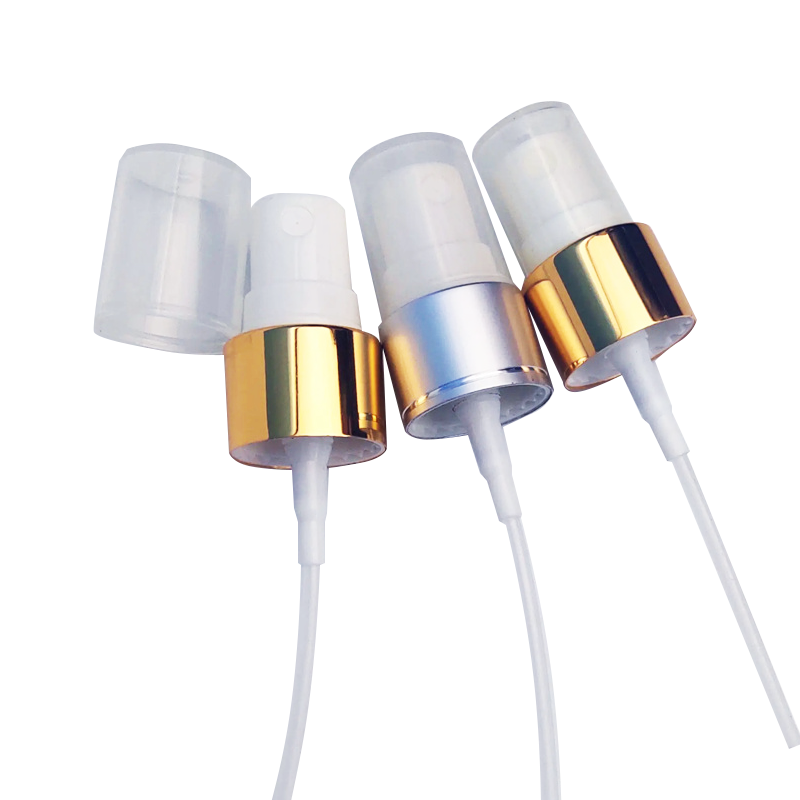 20/410 Aluminum Fine Mist Sprayer for 30ml and 50ml BottlesThis 20/410 aluminum sprayer fits the common neck finish for 30 ml and 50 ml bottles. Lightweight and corrosion-resistant, it delivers a fine, uniform mist ideal for perfume packaging.View Product →
The manufacturer's mist sprayer pump range runs from 10 mm to 28 mm, so you can compare pumps across the full neck-size spectrum here: complete fine mist sprayer pump collection.
Spray Output and Nozzle Size: What "Fine" Actually Means
When a datasheet says "fine mist," it is making a claim about droplet size and output volume per stroke. A genuine fine mist pump delivers 0.06 to 0.14 ml per full press and produces droplets between 20 and 80 microns. Anything above that range is a coarse spray; anything below 20 microns drifts in the air and may not deposit well on the target surface.
Output volume is controlled mainly by the diameter of the pump chamber and the stroke length. The nozzle orifice controls droplet size: a smaller orifice produces a finer mist but requires more force and may clog more easily. The table below summarizes how typical pump types compare. These figures represent common values taken from supplier catalogs and packaging engineering references; specific models vary.
| Format | Output per stroke | Droplet range | Best suited for |
|---|---|---|---|
| Standard fine mist | 0.10 to 0.14 ml | 40 to 80 microns | Toner, body splash, fragrance |
| Micro fine mist | 0.06 to 0.10 ml | 20 to 50 microns | Face mist, serum water, travel samples |
| Coarse spray | 0.14 to 0.20 ml | 80 to 150 microns | Multi-purpose cleaning sprays |
| Lotion pump | 0.20 to 1.00 ml | Stream or cream, no mist | Serum, cream, gel |
Output consistency is measured by priming the pump, then pressing it ten times into a tared container and dividing the total weight by ten. A well-built fine mist pump holds stroke-to-stroke variation within about 10 percent. If you see more than 15 percent variation, the pump chamber, ball valve, or dip tube seal is likely inconsistent, and the defect will become obvious to consumers.
Plastic or Aluminum: Material Trade-Offs for the Pump Body
If your formula contains more than 60 percent alcohol, an anodized aluminum pump looks premium and tolerates short-term alcohol contact well. If your formula is a water-based toner with salts, essential oils, or low pH ingredients, a full-plastic pump avoids metal corrosion risk and usually costs less. The frame of the pump, the cap, and the external spring are the parts most likely to be aluminum; internal springs and ball bearings may be stainless steel regardless of the outer material.
| Property | Anodized aluminum | All plastic (PP/POM) |
|---|---|---|
| Appearance | Metallic, premium, color-anodized | Molded color, matte or glossy |
| Weight | Heavier, perceived quality | Light, lower shipping cost |
| Alcohol resistance | Good short-term; test above 70% ethanol | Good with PP and POM |
| Chemical resistance | Weaker against strong acids and alkalis | Broad pH tolerance |
| Cost | Higher material and finishing cost | Lower per-unit cost in volume |
If your formula is sensitive to metal contact, or if you want a lightweight pump with fewer corrosion risks in long-term storage, an all-plastic construction removes most compatibility concerns. A representative product in this category:
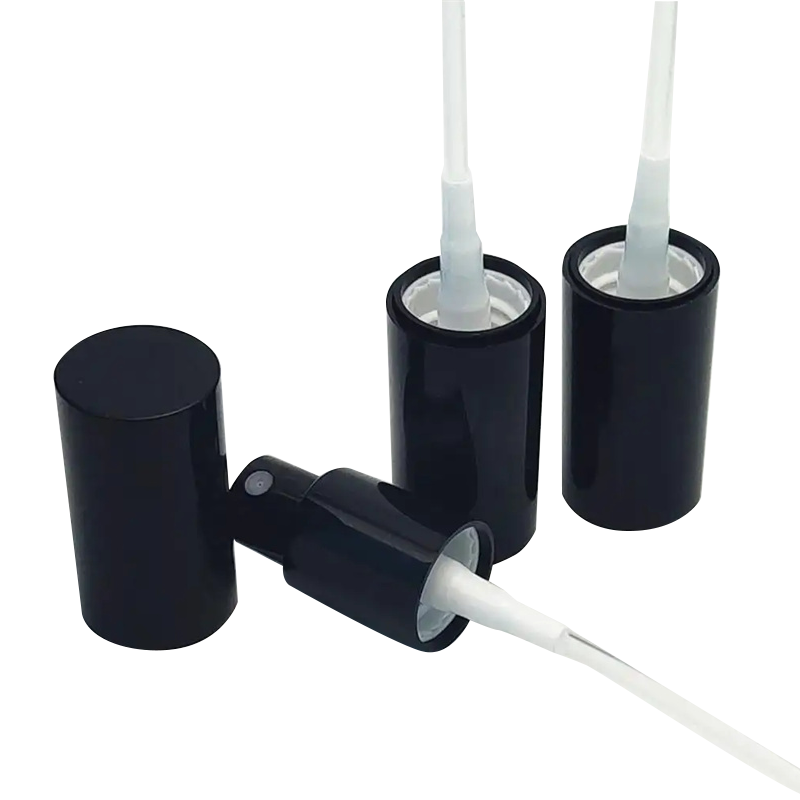 18/415 Full Plastic Mist Pump Sprayer for Metal-Sensitive FormulasThis all-plastic pump suits formulas sensitive to metal contact. Its easy-to-disassemble design simplifies cleaning, while the precision core maintains steady output for low-viscosity liquids.View Product →
Which Liquids Work Best in a Fine Mist Spray Bottle?
The practical limit for a fine mist pump is viscosity. Water has a viscosity of about 1 cP at 20 degrees C. A fine mist pump sprays cleanly when the formula is below roughly 5 to 8 cP. Perfume with 70 to 90 percent ethanol is about 1.5 to 2.5 cP. A standard facial toner is usually 1 to 3 cP. Once the viscosity rises above that threshold, the swirl chamber cannot shred the liquid cleanly, and the pump starts spitting uneven droplets instead of a mist.
Air temperature also shifts viscosity. A formula that sprays acceptably at 25 degrees C may become too thick at 5 degrees C, so always run cold-storage spray tests if your product will ship through winter logistics. High alcohol content is generally fine for both plastic and anodized aluminum pumps, but long-term immersion tests matter more than short spray tests when the product will sit on a shelf for months.
Formulas that spray well in a fine mist pump include:
- Alcohol-based perfumes and body splashes
- Hydrosols, rose water, and facial toners
- Facial mists with humectants such as glycerin below 5 percent
- Hair waters and leave-in styling mists
- Fabric, linen, and air freshener sprays
Formulas that will not work without a different pump:
- Thick serums, gels, and cream lotions above 10 cP; use a lotion pump instead
- High-oil sunscreen without a dedicated emulsion pump
- Foaming cleansers, which require a foam pump with a mesh
- Strong acid or bleach solutions that may corrode pump metals
Applications: Where Fine Mist Spray Bottles Earn Their Keep
The fine mist format crosses several industries because it solves the same problem everywhere: apply a small, even amount of liquid without waste. The biggest commercial uses are fragrance, skincare, hair care, and home surface care.
Perfume and fragrance samples
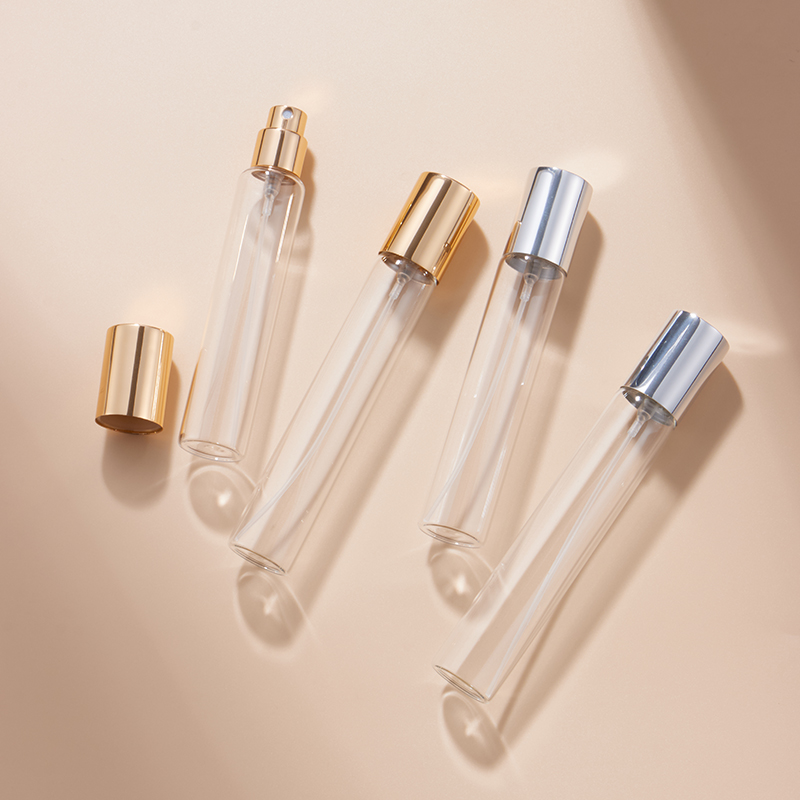
Glass perfume bottles from 2 ml to 15 ml dominate the sample and travel atomizer market. Small crimp pumps in 13 mm and 15 mm sizes are the standard for this segment because they dock directly onto glass with a metal collar. For a consumer, the spray from a 5 ml vial needs to feel as fine as the spray from a 50 ml retail bottle; otherwise the brand experience breaks down at the first touchpoint.
Facial toner and essence mist
Toner, essence water, and setting mist are usually packaged in 50 to 250 ml PET or glass bottles with 20/410 or 24/410 screw pumps. Consumers expect a very fine, dry mist that does not leave droplets running down the face. This is the most demanding application for atomization quality because the spray pattern lands on the most sensitive surface.
Hair care and home care
Hair water, scalp freshener, and styling mists go into 100 to 300 ml bottles with 24/410 or 28/410 pumps. Home care sprays, including fabric freshener and all-purpose cleaners, favor full-plastic pumps because plain water and surfactant solutions are aggressive to metal parts over time.
For 3 to 10 ml vial formats, the miniature pump is the most common sourcing request in the sample market. A matching example from the product catalog:
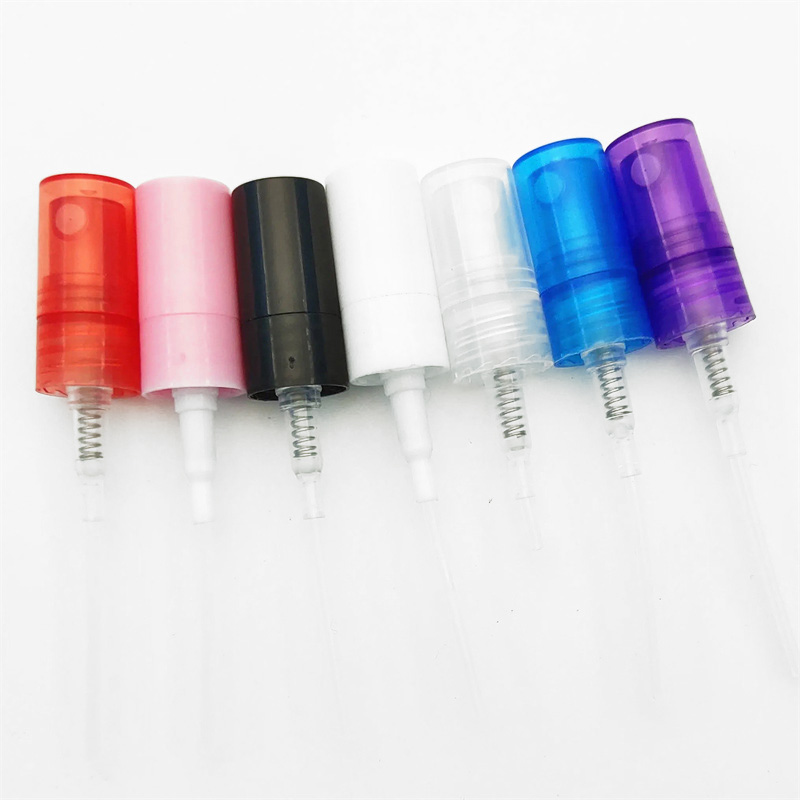 12/410 Mini Micro Fine Mist Plastic Spray Bottle for VialsDesigned for 3 to 10 ml vial formats, this compact plastic bottle with a 12/410 pump prevents leaks and resists impact. A practical choice for sample sizes and travel-friendly packaging.View Product →
Custom Finishes: Matching Pump Aesthetics to Your Brand
In branded packaging, the pump is part of the first impression. Anodized aluminum pumps support a wide palette of cosmetic finishes: gold, rose gold, champagne, matte black, silver, and gradient effects. The anodizing process produces a hard, colored oxide layer on the aluminum surface, which also improves scratch resistance compared with painted parts.
Plastic pump bodies can be molded in any standard color, with options such as frosted, striped, glossy, or pearlescent finishes. The actuator shape is another branding lever. Duckbill, penguin tip, ball cover, mushroom head, and flat cap actuators are all common in the current market, and the same pump internals can often accept multiple actuator shapes so a brand can change the look without requalifying the whole pump.
Custom metal colors and special actuator shapes usually carry longer lead times and higher minimum quantities than stock black or white pumps. Before sampling, confirm the MOQ for the custom color, the lead time for anodizing or plating, and whether the cap can be decorated with silk-screen printing or hot stamping. These details determine whether the finished package looks custom or generic on a retail shelf.
Quality Checks to Run Before Committing to a Supplier
Pump quality varies significantly between factories, and the only reliable way to evaluate a pump is to test it with your actual formula in your actual bottle. Five checks catch most defects before they reach consumers.
- Stroke consistency test: fill the bottle with your formula, prime twice, then press ten times into a tared container and weigh the total. Divide by ten to get the average output per stroke. A variation above 15 percent between repeated tests indicates an unstable pump chamber or ball valve.
- Leak test: store filled bottles upright, inverted, and on their side for 72 hours at room temperature and at 40 degrees C. Check for seepage at the neck, actuator, and cap. This is also a good moment to verify torque retention on the cap.
- Priming count: count the strokes needed from the first press to achieve a full, stable spray. Most fine mist pumps prime in two to five strokes. If priming takes more than eight strokes, the dip tube may be leaking air or the check ball is not seated properly.
- Drop test: drop fully assembled bottles from one meter onto a hard floor, with the cap locked if the pump has a locking feature. Inspect the actuator for cracking and the cap for pop-off.
- Compatibility soak: submerge the pump head components that contact liquid in your formula for at least 72 hours, then compare weight, color, and spray behavior against a fresh pump. Swelling, discoloration, or a change in output means the material is incompatible.
Frequently Asked Questions About Fine Mist Spray Bottles
Can a fine mist bottle handle a thick lotion or cream?
No. Once the viscosity exceeds roughly 5 to 8 cP, the swirl chamber cannot create a fine mist and the pump will spit or deliver a weak stream. For creams and thick serums, switch to a lotion pump with a larger chamber output of 0.2 to 1.0 ml per stroke.
How do I know if my bottle is 20/410 or 18/415?
Measure the outer diameter of the bottle neck with a caliper. A 20/410 neck measures about 20 mm across the outer wall; an 18/415 neck measures about 18 mm. The 410 thread pitch is visibly finer than 415, and the two are not interchangeable. When in doubt, request a matching pump sample from the supplier and test fit it.
Why is my pump spitting instead of spraying a fine mist?
The most common causes are trapped air in the dip tube, formula viscosity above the pump rating, or a partially clogged nozzle. Prime the pump two or three times to expel air, check the viscosity, and clean the nozzle orifice with warm water. If the problem persists, examine the dip tube seal.
Which pump material is safer for an alcohol-based perfume?
Both anodized aluminum and PP/POM plastic pumps are commonly used with 70 to 90 percent ethanol perfumes. Anodized aluminum resists short-term alcohol contact and gives a heavier, more expensive feel; all-plastic pumps avoid any risk of metal surface reaction and are usually lighter and cheaper. Always test the pump in your exact formulation for several weeks before production.
Can a fine mist spray pump be reused with a different liquid?
Yes, but with caution. Rinse the pump by pressing clean water through it five to ten times, then let it dry thoroughly. Metal springs and balls can corrode if the previous formula was acidic or saline, so reuse the pump only with a similar formula and inspect the internal metal parts first.
What output per press should I expect from a fine mist pump?
A standard fine mist pump delivers 0.10 to 0.14 ml per full press; a micro fine mist pump delivers less, around 0.06 to 0.10 ml. Check the datasheet rather than assuming: the output figure comes from the pump chamber diameter and stroke length, which vary by model even within the same neck size.
Data Sources and Technical Notes
The droplet-size ranges, output volumes, and viscosity thresholds in this article reflect typical values published in pump manufacturer datasheets and general packaging engineering references. Actual performance depends on your formula, bottle geometry, pump model, and factory production tolerance, so always verify with physical samples before committing to production.
Zhangjiagang Haojie Packaging Technology Co., Ltd. manufactures fine mist sprayer pumps from 10 mm to 28 mm, including crimp and screw styles in plastic and anodized aluminum, plus matching glass bottles and airless containers. Explore the collection above or contact the sales team for fitting samples and custom color requests.
Our Products //
Related Product


- E-mail: [email protected]
- Phone: +86-15962399191
- Add: No. 60-7, East Side of Jinzhong Road, Jinfeng Town, Zhangjiagang City, Suzhou City, Jiangsu Province
Copyright © Zhangjiagang Haojie Packaging Technology Co., Ltd. All Rights Reserved.
 China Cosmetic Packaging Manufacturers
China Cosmetic Packaging Manufacturers