

 中文简体
中文简体 Español
 عربى
عربى
What is the difference between a soap pump and a lotion pump?
Industry News-Content
Although lotion pumps and soap pumps look very similar and are often used interchangeably, they have significant differences in their internal design and functionality.
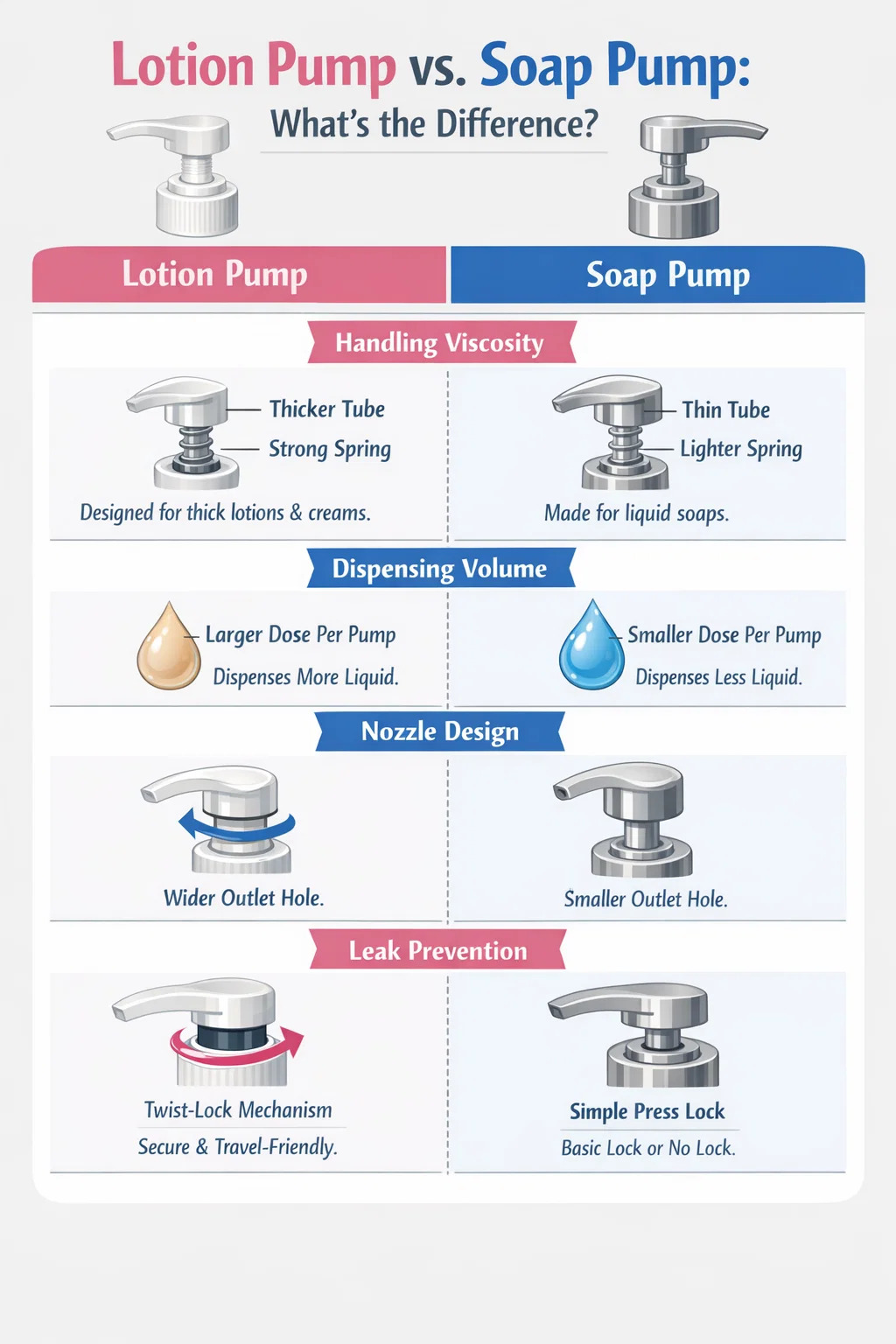
◾ Lotion Pump vs. Soap Pump: What's the Difference?
▸ Different Capabilities for Handling Viscosity
Lotion Pump: It's designed to handle thick, viscous lotions, creams, or conditioners. Its suction tube is usually thicker, and the internal spring has stronger pushing power, allowing it to draw up even very thick liquids.
Soap Pump: Its target is usually highly fluid hand soap or dish soap. If you put a thick body lotion into a regular soap pump, you might find it difficult to press down, or it might not spring back up properly.
▸ Different Dispensing Volumes
Lotion Pump: Considering that a certain amount is needed for applying to the body or hair, it usually dispenses a larger amount of liquid per press, allowing you to cover an arm with just one or two presses.
Soap Pump: Its design is focused on saving. To prevent waste, it usually dispenses a smaller amount per press, typically just enough for one hand wash.
▸ Differences in Nozzle Design
Lotion Pump: To prevent thick liquids from drying and clogging the outlet, its outlet hole is generally slightly larger.
Soap Pump: The hole is relatively smaller. If you put a cream that easily clumps inside, the small hole can easily become completely blocked after a few days of disuse.
▸ Leak Prevention and Sealing
Lotion Pump: Many lotion pumps have a more complex "twist-lock" function, making them convenient for travel.
Soap Pump: Many soap pumps used in kitchens or bathrooms do not have a locking function, or only have a simple press-down lock.
Our Products //
Related Product


- E-mail: [email protected]
- Phone: +86-15962399191
- Add: No. 60-7, East Side of Jinzhong Road, Jinfeng Town, Zhangjiagang City, Suzhou City, Jiangsu Province
Copyright © Zhangjiagang Haojie Packaging Technology Co., Ltd. All Rights Reserved.
 China Cosmetic Packaging Manufacturers
China Cosmetic Packaging Manufacturers